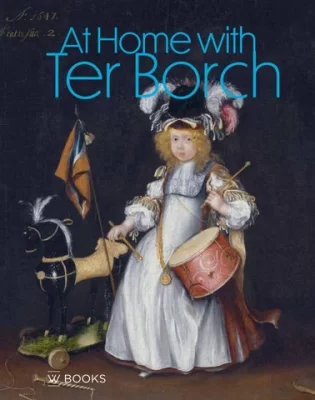
Published in conjunction with the exhibition in Zwolle, this book is devoted to the art of the Ter Borch family, much of which consists of works on paper now housed in the Rijksmuseum since 1887. The exhibition and catalogue build on a series of earlier exhibitions and publications on more or less the same theme. In 1988, the publication of Alison Kettering’s two-volume study of what became known as the Ter Borch studio estate, produced in collaboration with the Dutch literary historian Hans Luijten, led to an exhibition in the Rijksmuseum Print Room, accompanied by a brochure-style publication for a wider audience by Annemarie Vels Heijn. In 1997, the Stedelijk Museum Zwolle organized the exhibition Zwolle in de Gouden Eeuw, and in 2004–5 Gerard ter Borch the Younger was the focus of an exhibition at the National Gallery of Art in Washington and the Detroit Institute of Arts. Thuis bij Ter Borch had already been the title of a presentation of works from the studio estate at the Rembrandthuis in Amsterdam in 2005, which was introduced to a broad public in the Rijksmuseum kunstkrant by drawings curator Marijn Schapelhouman. In 2010, the Stedelijk Museum Zwolle presented De Gouden Eeuw van Gesina ter Borch, accompanied by a modest book aimed at a non-specialist audience. Until now, however, there had been no exhibition devoted to the artistic production of the entire Ter Borch family, as Museum de Fundatie has organized here.
The exhibition, which had been postponed a few times, was indeed ambitious in scope, especially for a smaller museum with financial limitations such as De Fundatie. Its newly appointed director Beatrice von Bormann deserves credits for making it happen, which is nothing less than an achievement. Iconic paintings by Gerard ter Borch the Younger from Washington, Los Angeles, Paris, Dresden and Detroit made for a splendid presentation, and these were supplemented with paintings from private sources that are never or hardly ever on view. The Rijksmuseum generously supplied drawings, watercolors and paintings by Gesina (not to mention her poetry album and her magnum opus, the so-called family scrap book), Gerard the Elder and Younger, Moses and Harmen ter Borch, and together with more loans of mostly work on paper by these family members a truly impressive survey of the rich artistic output of the Ter Borchs was on display; a unique occasion that is unlikely to ever be repeated.
The exhibition and catalogue present the Ter Borch home as a family studio in which Gerard the Elder, as pater familias, instructed and encouraged his children – mostly gifted amateurs – to develop through mutual inspiration. The catalogue is a handsome hardcover volume, with concise essays, short explanatory texts, and numerous color illustrations. Marjorie Wieseman, former head of Northern European paintings at the National Gallery of Art in Washington, served as the museum’s ideal guest curator and wrote the main essay, “At Home with the Ter Borchs: A Look inside an Artistic Family.” It is concise, thoughtful, and a pleasure to read. In the following essay, “Homes and Graves,” Michael Klomp, Zwolle’s municipal archaeologist, and Geertje Havers, also of the city’s cultural heritage team, present new archival findings on the family’s early history, the houses in which they lived, and their graves in the Grote Kerk.
Inevitably, one wants to know more about the setting of the Ter Borch home itself. The authors go little further than noting that Gerard ter Borch’s painted interiors cannot be treated as reliable evidence. For specialists in art history and historic interiors this is hardly new, yet the connection between these images and the family’s domestic surroundings deserves fuller consideration. Sassenstraat 21, the home of Gerard ter Borch the Elder, who served as convoy and licence master, can safely be assumed to have been a well-appointed residence, regularly visited by merchants and town officials. Although some interiors in Gerard the Younger’s elegant genre scenes represent the height of luxury, many of the objects they show – velvet-upholstered furniture and musical instruments such as lutes, a harpsichord, and recorders – were probably drawn from life and may well have formed part of the household inventory. The final scholarly essay, by Ilona van Tuinen, offers a clear and useful account of the family’s drawing practices and techniques. The text by the French-Moroccan contemporary artist Chourouk Hriech provides a personal and perceptive reflection on, curiously, just the paintings of Gerard ter Borch the Younger. It is not scholarly but does invite the reader to connect with Gerard’s art.
There are some critical remarks to be made on the catalogue as a whole. It lacks unity. The short texts (that were adopted from the exhibition texts) are so general that they don’t bridge the scholarly essays. The matter-of-fact writing style makes the text by Klomp and Havers read like a report. These are editorial issues. Other problems relate to the core message and scope, in particular there is a gap between promises made in the preface and living up to the expectations raised. For instance, it is lamented in the preface that previous exhibitions did not consider the family’s social and professional networks in Zwolle. That is not correct. Lydie van Dijk gave a brief account of this in the catalogue Zwolle in de Gouden Eeuw.[1] It is rather the De Fundatie exhibition and book that do not do that. The Ter Borch family’s position in Zwolle’s patriciate and regent milieu is not fleshed out. The same applies to religion, which permeated daily life and is relevant because social conditions and religion were intertwined in the early modern era. According to the prevalent Christian worldview it was considered a moral and cosmic imperative to live according to your rank. An old prominent family in Zwolle, the Ter Borchs were obliged to secure and maintain the family’s socially elevated position. Key to this social strategy was reputation. As role models in a hierarchical environment, the Ter Borchs reckoned their prime duty to serve God and the community, as reflected in texts Gesina ter Borch included in her albums. God’s mercy, they believed, was a prerequisite for realizing the family’s gentrification, and this shaped the lives of the Ter Borch family members and informed their art.
Wieseman rightly interprets the Ter Borchs’ artistic training and practice as the pursuit of a characteristic humanist ideal associated with the elite. Yet this aspect deserved more sustained attention throughout the publication. It is difficult, after all, to imagine such artistic activity was an entirely private pursuit. In the Dutch Republic, houses were far less secluded than they are today: doors often stood half open, neighbors and acquaintances came and went with ease, and social oversight was constant. Domestic life was therefore closely connected to the outside world, and the Ter Borchs’ artistic production would almost certainly have reached an audience beyond family members and close friends. The family lived on the street where the city council met and the magistrates governed the town, a location that they may well have used to maintain and expand their social network. People of influence passed by daily. Although Zwolle had neither monarch nor court, the historian Jean Streng has argued that it possessed a distinct “stadhuiscultuur” (town hall culture).[2] Did the Ter Borchs see themselves as courtiers in the orbit of the town government? Who visited their home, watched them work, and admired their art? And did such visitors help shape their artistic choices? These are fundamental questions. In early modern society, status mattered greatly, especially to those with much to lose. Awareness of rank recurs throughout the Ter Borchs’ art, and social ambition was a driving force. This broader historical context is essential to understanding both the family’s artistic identity and its artistic production.
Another issue worth considering is the local professional context. Several artists lived in the Sassenstraat, among them Pieter van Noort, a painter of genre scenes and fish still lifes, and, from at least 1680, Hendrick ten Oever, who painted portraits, landscapes, and still lifes. Jan Grasdorp, who painted townscapes and portraits grew up at the Old Fish market very close to the Sassenstraat, and later lived in the Kamperstraat, a five-minute walk from the Ter Borchs. Like his younger half-brother Gerrit, a draughtsman, he clearly had access to the Ter Borch studio. None of these artists are mentioned. So far from offering the full story, or even a comprehensive account of what is already known, this catalogue is best understood as an introduction for a broad audience – perhaps, one might say, for a new generation.
Eddy Schavemaker
Rijksmuseum, Amsterdam
[1] Lydie van Dijk, “Zwolse schilders in de 17de eeuw: kracht in variatie,” in: Jean Streng and Lydie van Dijk, Zwolle in de Gouden Eeuw: cultuur en schilderkunst, exh. cat. Zwolle (Stedelijk Museum Zwolle) 1997, pp. 45-48.
[2] Jean C. Streng, ‘Stemme in staat’. De bestuurlijke elite in de stadsrepubliek Zwolle, 1579-1795 (Hilversum: Verloren, 1997), pp. 235-317.