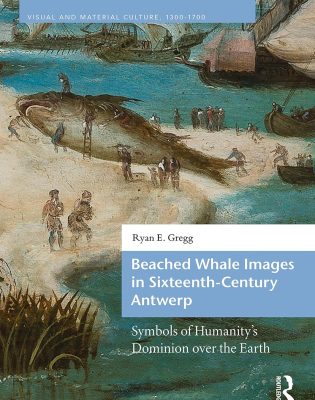
Today, when a whale of any kind (what Ryan Gregg often calls “cetaceous units”) gets stranded on a beach, support is mobilized to keep the animal hydrated and to prepare the creature for return to the sea. Of course, as Melville reminds us, whaling ships were a major industry across the nineteenth century, as the animals provided whale oil for lamps as well as other by-products. A well-known diary entry of Albrecht Dürer (1521) reports his rush to Zierikzee to observe a beached whale from life, though he arrived too late.
This richly researched new study by Ryan Gregg, professor at Webster University, turns to early modern Netherlandish representations of whales, but also delves into medieval and even Roman prehistory of earlier attitudes toward these animals. His larger claim is bold, possibly overly allegorical. Gregg claims that this imagery is a visual synecdoche for humanity’s domination over nature writ large (in all senses), arguing that “the cetaceous unit visualizes an act of defining humanity’s difference from the animal world through domination and use” (p. 13) Inevitably, he ties the close observation recorded in these images to the emerging inductive study and description of nature promoted by Francis Bacon. And he sees a sea change from the earlier fear in medieval bestiaries of the ocean’s giants as versions of Leviathan, an avatar of Satan who offers temptation in battles with saintly virtue.
At the heart of the sixteenth-century imagery lies flensing, the processing of whales’ bodies into blubber and oil, so vividly recounted in Moby Dick. Chapter One begins with graphic representation of whales, often including flensing on maps (Olaus Magnus, 1539 and 1555) and in naturalist compendia by Conrad Gessner (1558), Pierre Belon (1551), and others. While some of this material will be familiar from Susan Dackerman’s groundbreaking exhibition, Prints and the Pursuit of Knowledge in Early Modern Europe (2011), Gregg’s meticulous research will serve art historians with extensive references for eco-history and the publications of such scholars as Florike Egmond and Klaus Barthelmess. Curiously, however, because of his commitment to flensing imagery’s naturalistic details, he neglects to reproduce here Olaus’s own image of Iceland with various sea monsters, including fantasy whale-like creatures, annotated, a model that endured in the maps of both Sebastian Münster and even Abraham Ortelius.[1]
Chapter Two, “The Antwerp Flensing Group,” pulls together images that give Gregg his overly narrow title, and allow him to pull together an unsuspected wealth of images, ranging from Bosch to Bruegel and the Antwerp Ommegang procession itself (p. 71 n. 83). Several flensing images embellish the landscapes behind a traditional figure of St. Christopher (Herri met de Bles, Master J. Kock), so here the traditional Christian saintly battle appears before its medieval roots, discussed in Chapter Three (“Ancient and Medieval Whales”). These whales are actually depicted as giant fish (even today the Dutch word for whale is walfis), and Bosch’s giant Rotterdam Christopher has a fish dangling from his staff (p. 86). Gregg is principally interested here in the linkage between Bosch and Patinir and their painter heirs in Antwerp workshops. He also attends to the inclusion of a flensing within Anton van den Wyngaerde’s customary topographies, this one a panorama of Walcheren (1549-51; pp. 1, 56-58, 89-90), and its varied sources. Bruegel’s Big Fish Eat Little Fish engraving (1557) does not precisely fit this sequence, but it does transpose flensing activity to a sequence of fishes of various sizes, though Gregg ascribes its visual source to Magnus’s 1555 Historia, which seems unlikely. The whale float for Antwerp’s Ommegang, a fish shape with a mounted Neptune, is a triumphal image of sea power, the city’s economic foundation, also represented in Bruegel’s series of prints of ships at sea.[2] Again, Gregg tries too hard to link all these images together, as he claims the workshop image of flensing as the float’s source.
For this reader, the ancient and medieval traditions in Chapters Three and Four, perhaps too neatly encapsulated by the term “moralizing,” offers fascinating material for us early modernists. Fear of the ocean (like other wildernesses, such as mountains and deserts) and its largest animals informed tales of saintly battles (or, in Strabo, whale encounters by the admiral of Alexander the Great, Nearchus). Pliny describes a whale hunt in Ostia harbor, later illustrated by Stradanus (fig. 3.1). Propcopius, followed by Albertus Magnus, describes a beached whale and flensing as well. But it was the Greek Physiologus and later Latin bestiaries that called the whale “a figure of the devil,” who can plunge the unwary into the depths (of Hell). St. Brendan actually landed on the back of a whale and camped, as if it were an island, a legend still repeated by Olaus. Martin Luther even declared in 1523 that a beached whale near Haarlem was an omen of death, a sign of God’s wrath for Catholics of that region (p. 110).
There must have been many interpretations of Jonah’s miraculous escape (p. 86), including the typological use of the subject to depict salvation and the Resurrection, but these are undiscussed. Bruegel’s flensing scene is performed with a giant knife with the Christian orb of dominion (p. 84). Also in Bruegel’s 1559 Hope engraving, giant fish menace ships in stormy waters, while his 1556 Boschian Temptation of St. Anthony shows a hollow giant fish filled with fighting demons. Gregg’s book provides useful context for such imagery.
Chapter Four returns to flensing to offer a prehistory, based extensively on the Haliéutica (“On Fishing”) by a Greek author in Rome, Oppian (pp. 98-103). Gregg asserts that already in the ancient world subduing whales was a conquest of dominion over nature’s last wilderness. He traces the evidence for a history of whaling, noting the thirteenth century as its height. Here his claims about human mastery over nature’s creatures go back to Scripture (Genesis 1: 26-28), which also explicitly cites “great sea-monsters” (Gen. 1: 21, from the Hebrew; “whales” in King James version) among water animals. Yet again, he strives to connect images of whaling to other Netherlandish eco-alterations, including polders and large-scale fishing.
At the end of Chapter Four, he documents sixteenth-century beached whales in the region, leading Gregg to view their images in Chapter Five as “Natural Marvel and Dutch Symbol.” Before the more famous images from the Goltzius circle in Haarlem, well analyzed anew here, Gregg advances a 1577 engraving by Pieter Baltens, Beached Wahle at Antwerp (fig. 5.1) as the fountainhead. Images in this chapter index both empirical study but also exploitation, to serve as a “synecdoche of humanity’s relationship with nature at the end of the sixteenth century and into the next . . . in the time of Bacon” (p. 120). Flensing here meets measuring. Yet print inscriptions still appeal to warnings, connected with current events, especially war. As Gregg notes, the Latin text by Theodor Schrevelius casts the event as “an evil portent” with latent “terror of the deep Ocean” (p. 132). Gregg adds other commentaries and visual knockoffs, which serve helpfully to display the full range of reactions to such events. This compendium of images and texts greatly expands our familiarity with whale images yet simultaneously contradicts Gregg’s larger, reductive argument, here recasting whaling, together with water management and land reclamation, as “a third aspect to the Dutch identiy of maritime mastery” (p. 144).
This Routledge book is clearly produced with generous images, albeit with smallish print. The outrage is that this valuable book retails for full 200 dollars!
Ours is an era of eco-criticism and environmental history, even of calls for animal rights as personhood by such public intellectuals as Martha Nussbaum. Ryan Gregg’s book arrives as a valuable art-historical investigation of how whales have been interpreted and, in our more scientific modern age, exploited, already hunted almost to extinction. In that respect, as his Conclusions segment suggests, Ryan Gregg still reads the cetaceous unit as a synecdoche, now however, representing “the detrimental effects of our actions upon the world” (p. 155).
Larry Silver
University of Pennsylvania, emeritus
[1] Joseph Nigg, Seas Monsters: A Voyage around the World’s Most Beguiling Map (Chicago, 2013); Chet Van Duzer, Sea Monsters on Medieval and Renaissance Maps (London, 2012), both cited, p. 39 n. 2, even as he cites Gessner’s disclaimer that “it appears that most of them were depicted, not ad vivum, but after the statements of sailors” (p. 35).
[2] Larry Silver, “”Pieter Bruegel in the Capital of Early Capitalism,” Nederlands Kunsthistorisch Jaarboek 47 (1996), 125-53.