Also of Note:
Flesh, Gold and Wood: The Saint-Denis altarpiece in Liège and the question of partial paint practices in the 16th century Edited by Emmanuelle Mercier, Ria De Boodt and Pierre-Yves Kairis Brussels: Royal Institute for Cultural Heritage, 2020.
Le retable de la passion de l’Église Sainte-Marie de Güstrow. Étude historique et technologique Edited by Catheline Périer-D’Ieteren Brussels: A.S.B.L. Éditions & diffusion du centre de technologie de l’ULB, 2014.
Le retable du cournonnement de la Vierge. Église de l’Assomption d’Errenteria Edited by Maite Barrio Olano, Ion Berasain Salvarredi and Catheline Périer-E-Ieteren Brussels: A.S.B.L. Éditions & diffusion du centre de technologie de l’ULB, 2013.
The Bormans were a family of sculptors who dominated sculptural production in Brussels from the late fifteenth century through the first third of the sixteenth century. Their works significantly impacted the sculpture of Antwerp, the other center of sculpture in the Netherlands during this period. Carved altarpieces of the Bormans were widely exported to Central Europe and Scandinavia, setting the standard for such works in these areas.
The Bormans ran a family business that originated in Leuven. Jan I Borman was a joiner, active in the second half of the fifteenth century; he died in 1502-1503. His son Jan II was broadly acknowledged as a leader in the profession. He was inscribed in the Brussels guild of the Four Crowned Martyrs (which included sculptors) in 1479 and remained active until around 1520. He received commissions for statues and altarpieces and was sought after by the political elite of the Netherlands. He prepared the wood model for the brass effigy of Mary of Burgundy on her tomb in Bruges. In 1513 he is referred to as “the best master sculptor” in connection with a commission for statues for a courtyard in the Burgundian/Habsburg palace in Brussels. His sons Pasquier and Jan III followed in his stead and presumably took over the family workshop after the death of their father. Both seem to have been productive into the 1530s. A sister, Maria, and an uncle, Willem, are also mentioned as sculptors and likely contributed to the Bormans’ output.
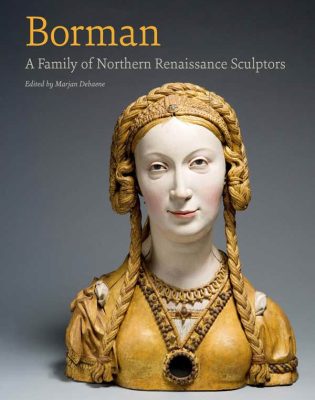
For several decades, art historians, such as Brigitte D’Hainault-Zveny and Catheline Périer-D’Ieteren, have contributed much to our understanding of this family of sculptors. Much literature on the Bormans, however, has appeared in recent years, spearheaded by the exhibition dedicated to the family in Leuven in 2019: Borman: A Family of Renaissance Sculptors, curated by Marjan Debaene and accompanied by an excellent catalogue. Although I was a member of the scientific committee for the exhibition and contributed an essay to the catalogue, due to a varied opinions on the issues addressed, I will present my own evaluation of the exhibition and catalogue in this essay.
Additionally, a series of publications on individual Borman altarpieces – in Güstrow, Errenteria, and Liège – appeared in recent years. Last year a further study addressed a newly discovered altarpiece by Jan II in Milan. And in 2025 a collection of essays, Borman in Context, treats several aspects of the family’s sculpture.
The first new study of 2025 is the monograph on the altarpiece of The Adoration of the Magi in a church in Milan, edited by Emmanuelle Mercier, Cathline Périer-D’Ieteren, and Sacha Zdanov. Long attributed to German sculptors, that work was correctly aligned with the Borman workshop by several authors in 2014. Two years later Myriam Serck-Dewaide attributed the altarpiece to Jan II Borman himself. This attribution is confirmed by Dr. Périer D’Ietern in her stylistic study of the altarpiece as she places the work within the oeuvre of Jan II Borman. Her comparisons to the altarpiece on the high altar in Strängnäs Cathedral (Sweden), and the fragments of the altarpiece dedicated to St. Adriaen in Boendael (Brussels) are convincing and help place the Milan Adoration of the Magi to the early 1490s. Emmanuel Mercier then compares the Milan altarpiece to the St. George Altarpiece of 1493, signed by Jan (II) Borman. Mercier examines the case with its Brussels guild marks and its traces of hinges for lost painted wings. She analyzes the figural groups, their construction, their placement, and their relationship to like elements in the St. George Altarpiece in Brussels and the fragments of the St. Adriaen Altarpiece. In these comparisons, she addresses the degree of finish in the carving beneath the polychromy. Mercier also dates the Milan altarpiece to the first half of the 1490s. A dendochronological analysis by Pascale Fraiture, Christophe Maggi, and Armelle Weitz discloses that the earliest possible date for the altarpiece is 1486, the last discernable felling of one of the constituent trees.
Nevertheless, it is obvious that the spatial configuration of the figures in the Milan altarpiece differs considerably from that in Strängnäs and Boendael. This distinction suggests that a different artist designed the altarpieces in Strängnäs, Boendael, and Brussels. All three situate figures in an expansive spatial environment, often arraying them in a semi-circle around a central figural group. But the Milan Adoration packs the figures close together. In the wings the Magi’s attendants are arranged in ever higher tiers that signify greater distance and are carved essentially in relief, following a much older schema favored in Brussels. Either Jan II Borman had not developed his trademark spatial arrangement by this time – and the Milan altarpiece should be dated slightly earlier, in the late 1480s – or else a separate artist, perhaps a painter, designed the work. This collaboration would not be unusual. Even at the height of his career, Jan II Borman carved works designed by other artists.
The altarpiece was brought to the Royal Institute for Cultural Heritage at Brussels, where it was expertly restored between 2018 and 2023, revealing its original brilliant polychromy. It stood presumably on the high altar of the chapel dedicated to the Magi in the Milan church but is now shorn of its painted wings that once framed the carved shrine.
Un trésor dévoilé contains several essays in French and Italian. Carlo Cairati contributes a paper that identifies the patron, Protasio Bonsignori, a Milanese businessman, who supported a devotion to the Magi and acquired the altarpiece for the Magi’s chapel in the Milan Church. Bonsignori traveled widely in Europe, visiting Antwerp in 1510. But since the Borman altarpiece dates two decades earlier, this trip could not have been the occasion of the commission. Either Bonsignori made an earlier visit to the Netherlands, or else he acquired the work through intermediaries, knowing about Brussels’ reputation for the expert crafting of these altarpieces.
An excellent, highly useful article by Hans Nieuwdorp and Sacha Zdanov treats the iconography of the Borman altarpiece, showing that its marginal scenes were carefully chosen and dependent on varied texts referring to the voyage and visit of the Magi. Jan van Boendale’s fourteenth-century work, Der leken spiegel, seems to have provided a central text.
Claire Dumortier analyses the inscriptions on the robes of the figures and finds that several times they refer to the sanctity of the Virgin and the private devotion to the Magi. She also detects the initials “J C” and “I C”, which she identifies with the painter Jan II van Coninxloo, the putative polycromer of the work. The Coninxloo family enjoyed continued relations with the Borman family of sculptors. Jan I van Coninxloo painted and signed the wings on the Nativity Altarpiece in Jäder (Sweden), presumably carved by Jan III Borman. Cornelis van Coninxloo polychromed and signed the nativity altarpiece in Skepptuna (likewise Sweden), probably carved by Pasquier Borman.
Philip d’Arschot authors a short article on the goldwork simulated in the Milan altarpiece, the fictional gold vessels presented by the Magi to the Christ child.
The virtuoso polychromy is treated by several authors. Emmanuelle Mercier and Violette Demonty address the restauration of the altarpiece, especially revealing the original polychromy. Mercier and Jana Sanyova analyze techniques of the polychromy and its various pigments. This is an important article on the specialized nature of this art, which gained sophistication at the end of the fifteenth century in the Netherlands. Ingrid Geelen adds a shorter piece on the applied brocades used in polychromy of the figures. These prefabricated embroidery patches were prepared in a mold filled with wax, resin, or foil, then lifted and applied to the figures. Geelen detects similarities in the applied brocade and polychromy on the Milan altarpiece with that of other Borman works on which the polychromy was initialled “I T”, which may signify the Brussels painter Jan I Tons. Geelen surmises that the Milan polychromer was close to this master “I T”.
The other major publication of 2025 on this family of sculptors, Borman in Context, was edited by Marjan Debaene and Hannah De Moor. This collection includes an article on the Milan altarpiece by Catheline Périer-D’Ieteren, Emmanuelle Mercier, and Myriam Serck-Dewaide that serves as abridged English version of the French and Italian volume discussed above. Magali Briat-Philippe authors a sizeable paper on alabaster statues, statuettes, and the altarpiece in the monastery church at Brou that Margaret of Austria founded. Briat-Philippe finds that Pasquier and Jan III Borman heavily contributed to the sculpture at Brou; Pasquier is sensibly considered the carver of a few figural groups in the Altarpiece of The Seven Joys of the Virgin. But what clearly emerges is the fact that the Borman workshop was quite large with several assistants (journeymen or apprentices) participated in the sculptural program.
Marjan Debaene and Claire Dumortier give a look at the documents concerning the Borman family in Leuven, the city from which they arose. Perhaps most interestingly, Jan I Borman, the dynasty’s founder, is recorded as a joiner, a schrijnwercker. In a document of 1459, he is recorded as making a bed and a seat in carpentry. Both he and his son, Jan II, are documented designing the brass choir screen for St. Peter’s Church in Leuven in 1489. Since this work is largely ornamental, it makes sense that a joiner would play a significant role in its design. Joiners or schrijnwerckers might also design tabernacles, the miniature architectural baldachins in carved altarpieces, as we know from the career of the Leuven schrijnwercker Jan Petercels. But it is highly questionable whether they carved figures, the usual domain of the beeldsnijder. I will come back to this later when I address the catalogue of the 2019 Borman exhibition in Leuven.
Hannah De Moor discusses the Swedish patrons for Netherlandish carved altarpieces now in that country. She analyses the written evidence, the coats of arms or portraits of donors, and the customizing of altarpieces for local Swedish churches. Kort Rogge, the important bishop of Strängnäs Cathedral, ordered two carved altarpieces from Brussels, including the magnificent Passion high altarpiece, partly by Jan II Borman. Other Swedish churchmen in the region followed with additional commissions for Brussels’ ateliers.
Ragnhild Bø writes about the subject of Christ’s appearance to his mother after his Resurrection. She traces an essential composition from the workshop of Rogier van der Weyden through later representations throughout Europe but especially found in Netherlandish sculpture. Michel Lefftz traces the reception of designs from Rogier van der Weyden to the putative figural oeuvre of Jan I Borman. Adam Harris Levine and Emilio Ruis de Arcaute Martínez treat the bust reliquaries of female and male saints produced in the Borman workshop in the 1520s. Levine traces the commission of these busts to patrons close to Charles V and locates four of them originally in the Sacra Capilla de El Salvador in Úbeda, Spain.
Ria De Boodt and Elisabeth van Eyck consider a series of painted panels that have been altered to form an altarpiece but were originally wings of a sculptured shrine. Theirs is the only essay that deals primarily with the paintings that formed such an important element of the carved altarpieces.
Ingrid Geelen offers an extremely useful chapter on the polychromers of Borman altarpieces. She identifies several primary hands that applied the paint and gilding to figures and cases. By the late fifteenth century, polychromy had become a specialized activity, requiring skills not usually employed in creating panel paintings. Her essay complements the chapters dedicated to polychromy in Un trésor dévoilé – including the one by Geelen herself. And Seppe Roels and Marieke Van Vlierden contribute a chapter on the various marks on sculpture attributed to the Borman workshop.
Finally, Christel Theunissen writes on a series of choir stalls, including those in the church of St. Sulpitius in Diest that were formerly attributed to Jan II Borman. Theunissen questions that attribution and notes that these stalls were designed to refer to three other sets of stalls in Brabant.
Regarding the catalogue of the 2019 exhibition of the Bormans in Leuven’s M-Museum, Marjan Debaene deserves great credit for organizing the exhibition and editing the accompanying catalogue. This publication was helpfully reviewed by Kim Woods in the Historians of Netherlandish Art Review of Books: https://hnanews.org/hnar/reviews/borman-a-family-of-northern-renaissance-sculptors/. The catalogue contains important articles on the reputation of the Bormans, their workshop, Leuven as a center of sculpture, narrative techniques of the Bormans, the functions of figural sculpture in late medieval cities, bronze works designed by the Bormans and other topics. The authors include many well-known commentators on these works, such as Brigitte D’Hainaut-Zveny, Emmanuel Mercier, Claire Dumortier and others, including Debaene herself, who contributes a number of essays to the volume.
A critical part of the catalogue, which underlay the exhibition, is Michel Lefftz’s construction of oeuvres for the various members of the Borman family. This was a daunting task, and it must be said that Professor Lefftz does an impressive job of distinguishing between the various hands at work, especially those of Jan II, Jan III, and Pasquier Borman, the three most consequential sculptors of the clan. Lefftz sensibly states that the resulting corpus is tentative and deliberately sidesteps the problem of the journeymen’s participation in the workshop. He had previously written simply of the “Borman Group,” but for the 2019 catalogue he attempts to distinguish the hands of the principal sculptors, complications notwithstanding. Lefftz’s approach is Morellian, taking note especially of drapery patterns and hair styles. All in all, he attributes around 300 works to the Borman workshops, which is an astonishingly large percentage of surviving works of quality. Of course, the Bormans remained dominant in Brussels, and their workshops were constantly active. Still, they influenced other sculptors, in Antwerp as well as Brussels, and some readers may find some of the attributions questionable.
For Jan II, Jan III, and Pasquier Borman Lefftz’s attributions are largely acceptable. It became clear through the exhibition that the Lombeek altarpiece is largely by Pasquier Borman; his signed statue of St. Paul is quoted literally in one of the Lombeek compartments. I would also attribute the Skepptuna altarpiece to Pasquier Borman; it differs from the similar altarpiece in Jader, attributed credibly by Leffts to Jan III, exactly in its more subtle carving and varied facial types that occur in Pasquier’s signed Altarpiece of Crispin and Crispianus in Herentals.
Lefftz’s attributions to Jan I Borman, the father of the famous Jan II, however, is highly tendentious. Jan I is documented only as a joiner, a schrijnwercker, not as a carver of figures, a beeldsnijder. He was naturally charged with making the cases of altarpieces and likely also with fashioning the tabernacles placed above statues and statuettes. The one documented work of Jan I, a brass door for which he collaborated with his son in crafting the wooden model, evinced tracery patterns that would seem to lie within the compass of a schrijnwercker.
Yet Lefftz attributes to Jan I a large oeuvre of statues and figural reliefs. This canon comprises many of the best works of Netherlandish sculpture from the second half of the fifteenth century, including such works as the Arenberg Lamentation (Detroit, Institute of Arts) and The Virgin and Child of Pietribas (Paris, Musée de Cluny). Not only is there no documentation for any of these sculptures, but the works themselves differ greatly from one another. Despite Lefftz’s wise caution against attributing complex works solely to individuals, he seems to fall victim to a Romantic need to personalize a great deal of anonymous work.
Readers might also quibble with the attributions to Maria Borman, daughter of Jan II, for whom there are likewise no documented works. She may have run an independent shop or have taken part in the workshop of her father and brothers, Jan III and Pasquier. But the tendency to attribute to her only the weaker examples of the later Borman production seems symptomatic of a patronizing attitude toward female artists.
Through the research of these numerous scholars, the Bormans emerge as principals in Netherlandish sculpture. Through the export of their works, they created paradigms for altarpieces in foreign lands, especially along the Baltic. These new publications significantly increase our understanding of this family of sculptors and of Netherlandish sculpture in general during the late medieval and early modern period.
Ethan Matt Kavaler
University of Toronto