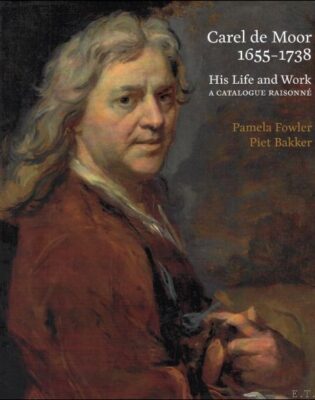
Over the past few decades, publications and exhibitions on Dutch art of the late seventeenth and early eighteenth centuries have slowly but steadily transformed our understanding of this transitional period. Solo exhibition catalogues have appeared on Nicolaas Verkolje, Godefridus Schalcken, and Gerard de Lairesse, and monographs with catalogues raisonnés on Caspar Netscher, Eglon van der Neer, and Jan van Mieris, among others.[1] Such publications have gradually brought to light a closely interconnected milieu, one in which painters, collectors, art dealers, and writers on art both honored the legacy of the great masters of the preceding age and pursued new artistic directions in their own era. The first monograph dedicated to Carel de Moor (1655–1738), written by Pamela Fowler and Piet Bakker, is therefore a most welcome and seminal contribution to the field, one that brings the picture of this dynamic transitional period into sharper focus.
The monograph consists of an introduction, four chapters, a catalogue raisonné – comprising 118 accepted paintings, 6 drawings, and 20 prints, alongside problematic and rejected works and a large body of paintings known only through description or reproduction – and two appendices, the latter including a family tree of De Moor and two hundred archival records related to his life, his family, and members of his social networks. The first chapter focuses on the life of the artist; the second deals with his relationships with clients; the third examines his artistic development, with separate discussions of portraits, history paintings, pastoral scenes, genre scenes, and still lifes. The fourth chapter traces the history of De Moor’s critical reception from the eighteenth century onward, both at home and abroad. The book is lavishly illustrated, largely in color.
Even those who are already familiar with De Moor’s name through recent advances in scholarship may find themselves surprised, upon reading this monograph, by the extraordinary honors and acclaim he enjoyed among his contemporaries. His reputation is best illustrated by the prestigious portrait commissions he received from aristocrats and royalty across Europe: a self-portrait for Cosimo III de’ Medici’s gallery in Florence; a double portrait of Prince Eugene of Savoy and the Duke of Marlborough, commissioned through Count Philipp Ludwig Wenzel von Sinzendorf – a work that so impressed Holy Roman Emperor Charles VI that he bestowed a knighthood upon De Moor in 1714 – and portraits of Tsar Peter the Great and his wife Catherine I of Russia. The contemporary painter and writer Jacob Campo Weyerman, as discussed in the fourth chapter, goes so far as to claim that since the deaths of Titian, Peter Paul Rubens, and Anthony van Dyck, no painter has come closer to these masters than “the Knight Karel de Moor” (p. 144). While the superbly illustrated portraits in this monograph do indeed reveal a breathtaking elegance and subtlety of expression, such a comparison with illustrious masters nevertheless strikes the modern viewer – as the authors themselves repeatedly note – as rather excessive. How, then, did De Moor come to command such extraordinary recognition? It is precisely this question that the monograph convincingly answers, by reconstructing the artist’s life, his environment, and his relationships with clients; analyzing the stylistic development of his work; and tracing the fortunes of his reputation.
To account for De Moor’s success, the authors open with a discussion of the life of his father, Carel de Moor (I), to illuminate the world into which the younger De Moor was born and that shaped his path to becoming a painter. An Antwerp émigré, De Moor (I) worked in Leiden crafting ebony picture frames and, from the mid-1670s, dealt in paintings as well. Holding important posts in both the Joiners’ Guild and the Guild of Saint Luke, he occupied a meaningful place within the city’s artistic community. This environment, which the authors reconstruct in convincing detail from archival records, proved a considerable advantage for the young Carel de Moor – all the more so given that, in the wake of the Rampjaar of 1672, economic hardship and a stagnating art market had taken their toll on the art scene in the Dutch Republic. It was in such circumstances that Carel trained under some of the most distinguished masters of the preceding generation: Gerrit Dou, Abraham van den Tempel, Frans van Mieris, and Godefridus Schalcken. By the time he registered with the Leiden Guild of Saint Luke in 1683, most of these teachers and older colleagues had passed away; yet he had already acquired the necessary skills and connections – drawing also on the networks of his teachers – that would enable him to rise swiftly to prominence, receiving a steady stream of commissions from notable local figures as well as public bodies such as the city of Leiden.
One of the primary reasons for his success, as the monograph consistently stresses, was his achievement as a portraitist – a fact borne out by the catalogue raisonné itself, in which eighty-four of the 118 accepted paintings are portraits. In the second chapter, the authors demonstrate that another key to this achievement lay in the close networks he cultivated with his clients – elite families, linked by marriage, who commissioned portraits across multiple generations in cities such as Leiden, Amsterdam, The Hague, and Haarlem. By patiently connecting one document to another, the authors deftly reconstruct the ties within and among these families and their dealings with the painter, in the process identifying or reidentifying some of his sitters. Particularly illuminating is the case of the Ruysch and Paets families: no fewer than eleven members from both families were portrayed by De Moor. The four portraits he painted for Coenraad Ruysch – of Ruysch himself (cat. no. PA26), his wife Maria Cunaeus (cat. no. PA27), and her parents (cat. nos. PA28, 29) – reveal, in particular, how flexibly De Moor adapted his work to his clients’ expectations. The portraits of Ruysch and his wife reflect the most fashionable style of the 1680s, depicting elegant dress and fanciful settings with classicizing architectural elements, while the superb rendering of the Venetian needle-lace cravats and cuffs is clearly reminiscent of Schalcken, who had also portrayed Ruysch in 1674, when De Moor was training under him in Dordrecht.[2]
The portraits of Maria Cunaeus’s parents are, by contrast, more subdued: her father, already dead when the commission was received, was modeled on a group portrait by Van den Tempel – De Moor’s other teacher. The restrained, serene character of that work was adapted by De Moor with evident ingenuity into a pendant pair, forming a quietly dignified counterpart to the more fashionable likenesses of the younger couple.[3] The authors further show that on the Paets side, posthumous portraits of Willem Paets’s parents (cat. no. PA54, 55) were likewise modeled on existing likenesses by Adriaen Hanneman, with the mother’s dress updated in contemporary fashion. Taken together, these examples attest to the skill and sensitivity with which De Moor met his clients’ wishes. Considering how much it mattered to wealthy citizens to assemble a unified dynastic gallery, coherent in authorship or artistic lineage, it is hardly surprising that De Moor, presenting himself as a legitimate successor to the preceding generation, earned considerable admiration among his clients. Significantly, Ruysch acted not only as a client but as an intermediary: the authors suggest he may have helped secure De Moor’s prestigious self-portrait commission from Cosimo III de’ Medici, showing how local connections could lead to wider fame.
Building on this account of client relationships, the third chapter traces De Moor’s stylistic development through sustained comparison with his contemporaries. The authors elucidate how De Moor’s remarkable versatility as a portraitist was shaped by his keen responsiveness to the leading portraitists active in Leiden, Amsterdam, The Hague, and Dordrecht. His early small, miniature-format works follow the Leiden masters Dou and Van Mieris as well as Bartholomeus Van der Helst, Hanneman, and Van den Tempel; his life-size compositions reflect the grand manner of Jan de Baen; his cabinet-size works, introduced by 1684, engage with the fashionable style of Netscher; and his allegorical portraits, emerging in the 1690s, respond to Nicolaes Maes and Jacob Toorenvliet. What is striking, however, is that beyond this versatility, De Moor was exceptionally skilled at capturing the individual character of each sitter – a quality the authors aptly highlight in comparing him with Arnold Boonen, whose sitters tend to share certain generic qualities. As Weyerman notes, De Moor knew how to “choose postures proper to the persons” and to “show a good form in it, without detracting from the likeness” (p. 147). This sensitivity to each sitter’s likeness, evident in the individualized physiognomies reproduced throughout this monograph, helps account for the extraordinary esteem in which the artist’s contemporaries held him.
The authors rightly observe that “De Moor’s success story cannot be separated from the social status of those who appreciated his talent and favored him with assignments” (p. 147). This is especially true of portraiture, a genre in which, as they note, clients judged a work less by its “artistic merits” than by its “representativeness.” As the authors conclude, it was by answering this demand so adeptly that De Moor secured his place among the elite. Once this fact is recognized, the lavish comparisons his contemporaries drew between his portraits and those by Titian, Rubens, and Van Dyck become somewhat easier to comprehend.
Although this review has concentrated on De Moor’s portraiture, his genre scenes – the largest category of his output after his portraits – deserve brief mention. Here too, the authors’ careful comparison of his genre paintings with those of his contemporaries convincingly identify his sources of inspiration. Surveying his oeuvre as a whole, one is struck by his recurring preference, not particularly emphasized by the authors, for outdoor settings: figures placed in the foreground, before or beneath leafy trees, while the space behind them opens up onto an expansive landscape stretching into the distance. Such settings are usual in his history paintings and pastoral scenes, yet throughout his career De Moor featured them in his genre scenes as well, from The Duet (cat. no. NPA16) of 1674 to Woman Smelling a Rose (cat. no. NPA29) of the 1720s. By transposing onto everyday subjects a setting more typical of history painting and the pastoral, De Moor seems to have endowed them with a narrative and bucolic resonance in tune with the rise of classicism and the growing vogue for the pastoral. This intriguing feature might have been explored further in comparison with works of the 1680s and 1690s – such as those of Eglon van der Neer or Jan and Willem van Mieris – rather than the earlier examples to which the authors chiefly turn.[4] The authors themselves acknowledge the difficulty of analyzing De Moor’s eighteenth-century output, given how comparatively understudied the painting of this period remains; even so, this is a dimension of his art – and perhaps of his innovation – that one wishes had been pursued more fully. As scholarship on this period advances and more of De Moor’s eighteenth-century works are identified, our picture of this painter whose career bridged two centuries will surely come into fuller focus.
Junko Aono
Keio University, Tokyo
This research was supported by JSPS KAKENHI Grant Numbers JP23K00180 and JP25K00416.
[1] Paul Knolle and Everhard Korthals Altes, eds., Nicolaas Verkolje 1673–1746: De fluwelen hand (Enschede, 2011); Anja K. Ševčík, ed., Schalcken: Gemalte Verführung (Cologne, 2015); Josien Beltman, Paul Knolle, and Quirine van der Meer Mohr, eds., Eindelijk! De Lairesse: Klassieke schoonheid in de Gouden Eeuw (Zwolle, 2016); Marjorie E. Wieseman, Caspar Netscher and Late Seventeenth-Century Dutch Painting (Doornspijk, 2002); Eddy Schavemaker, Eglon van der Neer (1635/36–1703): His Life and His Work (Doornspijk, 2010); and Margreet van der Hut, Jan van Mieris (1660–1690): His Life and Work (Zaandijk, 2021). On the state of research and publications in this field prior to the early 2010s, see Junko Aono, “Out of the Shadow of the Golden Age: Recent Scholarly Developments Concerning Dutch Painting of the Late Seventeenth and Early Eighteenth Centuries,” in The Ashgate Research Companion to Dutch Art of the Seventeenth Century, ed. Wayne Franits (Routledge, 2016), 286–301.
[2] For Schalcken’s portrait of Ruysch, see Guido M. Jansen, “Portret van Coenraet Ruysch (1650–1731), vóór mei 1674,” in Schalcken: Kunstenaar van het verleiden, ed. Anja K. Ševčík (Dordrecht 2016), cat. no. 35. For Schalcken’s rendering of lace, see his portraits made from the 1670s to the early 1690s, for instance, cat. nos. 36, 44, 47, and 49 in the same catalogue.
[3] Since the father, taken from the group portrait, faces left, De Moor ingeniously decided to turn the mother to the right while having the two figures incline gently toward one another.
[4] For comparison, see Eglon van der Neer, Two Boys Playing in a Landscape (c. 1680–95) and A Boy and a Girl Hunting Birds (1691), in Schavemaker 2010 (cited in n. 1), cat. nos. 111 and 116; for Young Woman Holding a Dog in a Landscape, see Van der Hut 2021 (cited in n. 1), cat. no. 27; and Junko Aono, “A Woman Holding a Dog in a Landscape” (2017), in The Leiden Collection Catalogue, ed. Arthur K. Wheelock Jr. and Elizabeth Nogrady with Caroline van Cauwenberge, 4th ed. (New York, 2023–), https://theleidencollection.com/artwork/a-woman-holding-a-dog-in-a-landscape/. For a more pastoral example, compare Willem van Mieris, An Arcadian Landscape with a Shepherd Holding a Flute, Listening to a Shepherdess Playing a Cittern (1682). For the increasing narrative quality in genre paintings in relation to classicism, see Junko Aono, review of Jan van Mieris (1660–1690): His Life and Work, by Margreet van der Hut, Oud Holland Reviews, May 2022, https://oudholland.rkd.nl/index.php/reviews/74-review-of-jan-van-mieris-1660-1690-his-life-and-work-2020.html; idem, review of Wayne Franits, Godefridus Schalcken: A Late 17th-Century Dutch Painter in Pursuit of Fame and Fortune, by Wayne Franits, Oud Holland 138, no. 4 (2025), 236–40.