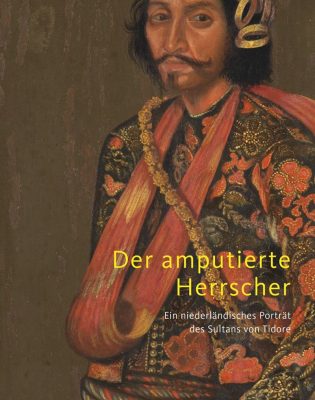
Yannis Hadjinicolaou’s new book introduces its topic, an anonymous seventeenth-century Dutch portrait of Saifuddin, Sultan of the North Moluccan island of Tidore, through the publication most of us would know it from: the cover of the 2002 exhibition catalogue De Nederlandse ontmoeting met Azië. For an object so unusual – it shows a ruler of a tiny sultanate, his right forearm missing – the portrait has received very little attention. Hadjinicolaou’s short monograph is therefore bound to spark the interest of art historians and historians as a potentially significant addition to the scholarship on global Dutch art.
With Saifuddin’s portrait at its center, Hadjinicolaou’s short book tells a story of the Dutch presence and spice trade in the Moluccan Islands, alongside diplomatic and symbolic functions of portraiture. With its vivid, often polemical style, it fits more the criteria of a long essay, organized in short sections, than a scholarly monograph. After introducing the painting and the sitter, Hadjinicolaou succinctly summarizes the history of the Dutch East Indies Company, including the corporation’s self-fashioning through the iconography and display of images of Batavia and the portraits of Governors–General in Batavia and back in the Dutch Republic. Hadjinicolaou stops short of hypothesizing where Saifuddin’s portrait would have been originally hung.
Affirming the “Dutchness” of the Sultan’s portrait’s medium, and his pose and clothing, Hadjinicolaou suggests that it might have been painted by a lesser-known VOC employee. As Marten Jan Bok and Michael North have shown, painters generally did not travel to Batavia to pursue a career in the visual arts, as the market was too small and the voyage too dangerous (pp. 29–31; for Bok and North, see p. 98, endnotes 44 and 47). Instead, they could be employed by the VOC as cartographers and merchants and occasionally dabble in painting. The book then discusses the now-contested concept of the “Dutch Golden Age,” setting the stage for the analysis of the unequal power relations between the island of Tidore and the VOC, which is central to Hadjinicolaou’s interpretation of the portrait.
Following the sparse existing scholarship on the sultan, Hadjinicolaou takes for granted that Saifuddin lost his right forearm to leprosy. His description of Saifuddin’s reddened eyes and skin, especially in the nasolabial folds, is meant to bolster the leprosy theory. However, this visual analysis is somewhat contradictory to the author’s remarks on the portrait’s awkward pictorial style, augmented by the object’s poor condition (pp. 8–9). Assuming, without examining primary sources, that Saifuddin indeed had leprosy is problematic, as the book’s central arguments hinge on this theory. The study does not attempt to answer how and when the arm was amputated – if it was indeed amputated rather than lost in one of many local conflicts or to another injury – and whether Saifuddin turned to a Dutch surgeon to perform the amputation.
Hadjinicolaou relies on secondary literature for other information as well and does not cite any of the mentions of Saifuddin and Tidore in the daily registers of the VOC. Similarly, while Tidore and its rulers are described at length in François Valentijn’s Oud en Nieuw Oost-Indien (1724), the travelogue is mentioned only in one endnote through The World of Maluku by Leonard Andaya (1993). Andaya’s own limited critical approach to primary sources renders it a problematic source of information. The only early modern travelogue mentioned by Hadjinicolaou, and only briefly, is Wouter Schouten’s Oost-Indische Voyagie (1676). While we would not find much on Saifuddin in travelogues other than the ones authored by Valentijn and Schouten, their fellow travelers nevertheless described medicinal plants and illnesses in Southeast Asia that are crucial for reconstructing the potential reasons and circumstances of Saifuddin’s disability and should have been considered.
As the title of the book suggests, in Hadjinicolaou’s interpretation, Saifuddin’s residual limb functions as both real and metaphorical. Hadjinicolaou imagines the portrait as half of a pendant and as a symbolic embodiment of Tidore’s crippled statehood. Following Michael North, Hadjinicolaou argues that Saifuddin’s portrait was made, alongside a portrait of Cornelis Speelman, to celebrate the victory over Makassar in 1667 and a treaty between Tidore and the VOC (p. 67). Hadjinicolaou then suggests that we can think of Speelman’s and Saifuddin’s portraits as pendants; Speelman occupies the side traditionally reserved for the husband. His pose, stature, non-disabled, strong body, and the staff he holds in his intact right hand dominate over the smaller, slender Saifuddin, whose residual limb is conspicuously displayed, wrapped in a cloth typically worn by women in the Moluccas (p. 69). In his argument about the crippled statehood, Hadjinicolaou revises Ernst Kantorowicz’s theory of the King’s Two Bodies and sees Saifuddin’s portrayal as “half a King’s body” (p. 77).
These complementary interpretations of the portrait explain why the book only briefly mentions disability studies as a method of scholarly interrogation (pp. 77–79). However, for an analysis of a portrait so conspicuous in its display of a residual limb, one would expect a more meaningful engagement with the field. Conversely, by reading Saifuddin’s mutilated body, further weakened by leprosy (p. 77), primarily as a site of vulnerable statehood and suppressed political and economic authority, the book contradicts itself in the possibility of a more nuanced perception of both disability and Tidore’s power in negotiations with the VOC. While Southeast Asia was a site of many colonial horrors, the VOC’s ability to secure the monopoly in the nutmeg, mace, and clove trade depended on the collaboration with local rulers, including Saifuddin. The Sultan requested gifts for himself and his subjects, and the 1667 treaty secured him the rights to the western territories and waters of Papua. While acknowledging this mutually beneficial arrangement (p. 53), Hadjinicolaou nevertheless reads the painting as emasculating and crippling the sitter.
One of the most fascinating chapters in the history of Saifuddin’s portrait was its purchase by Prince Konstanty Adam Czartoryski in the late 1820s. The prince sent the painting to his mother, Izabella Czartoryska, as she was completing an inventory of her formidable collection, titled Poczet pamiątek zachowanych w Domu Gotyckim w Puławach, published in Warsaw in 1828. To this day, the portrait can be seen in the Czartoryski Museum in Kraków. Hadjinicolaou correctly decided that the portrait’s acquisition by a Polish aristocratic family should be included in its story. However, his interpretation of the historical context and motivation for the painting’s purchase remains tenuous. In 1795, after the third partition of the Polish–Lithuanian Commonwealth by Prussia, Austria, and Russia, the country ceased to exist. The next one-hundred-twenty-three years were a period of unsuccessful uprisings, followed by waves of emigration of Polish noblemen. Among the objects sent by Konstanty Adam to his mother alongside Saifuddin’s portrait was a button, allegedly from Washington’s robe. The same list of objects received in 1828 includes two other Washington memorabilia, sent not by Konstanty Adam but by Eliza Parke Custis, the president’s granddaughter (not mentioned by Hadjinicolaou). Among the 1531 objects recorded by Czartoryska in her inventory, Hadjinicolaou singles out not only Washington’s memorabilia but also a portrait of Jeanne d’Arc and an arrow of Wilhelm Tell.
According to Hadjinicolaou, the inclusion of Washington, d’Arc, and Tell memorabilia in the same collection would establish Saifuddin as a symbol of independence of a small Moluccan nation against the VOC’s might, akin to the Polish resistance against its powerful partitioners (pp. 90-91). In Polish dreams of sovereignty, George Washington indeed featured prominently, alongside two Polish heroes of the American Revolutionary War, Kazimierz Pułaski and Tadeusz Kościuszko (with whom several in the collection were associated). But to extend the same aspirational identification to a tiny seventeenth-century sultanate with no historical ties to the Polish-Lithuanian Commonwealth is difficult to imagine. Ultimately, this tenuous suggestion is a product of the same neglect of primary sources as the deficiencies in the earlier sections on Southeast Asia.
Der amputierte Herrscher is a concise, accessible, and well-illustrated book that can be of interest to a non-specialist reader seeking to learn more about the seventeenth-century spice trade, Dutch-Moluccan relations, visual propaganda, and the functions and types of political portraiture. However, it does not deliver on its promise to reconstruct Saifuddin’s life, the perception of a disabled ruler by his contemporaries, and the possible display and reception of the portrait at the time of its creation. The book’s failure to engage with VOC’s documents and travelogues published ca. 1700 consolidates its status as an introductory read aimed at a popular audience. This is, of course, a perfectly reasonable ambition. However, as the first monograph dedicated to such a unique object, one would hope for its more thorough and critical discussion.
Barbara A. Kaminska
Sam Houston State University