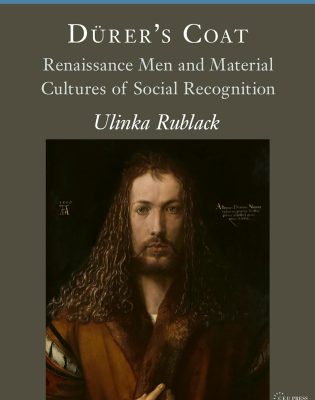
In a letter written from Venice on September 8, 1506, two of Albrecht Dürer’s garments said hello to the humanist Willibald Pirckheimer: “My French mantle greets you and my Italian coat also.” Renaissance coats had much to say, according to Ulinka Rublack’s new book Dürer’s Coats: Renaissance Men and Material Cultures of Social Recognition, available both as a paperback and ebook. (Unfortunately, the title is incorrect on the book’s cover, with Coats misprinted in the singular.) Rublack, professor of Early Modern European History at the University of Cambridge and author of Dressing Up: Cultural Identity in Early Modern Europe (2010), argues that men’s outerwear communicated status and identity to facilitate bonds of social trust and establish rapport among wearers. In that context of rapidly increasing consumption and consumerism, new, globally sourced materials became available, so social strivers like Dürer could purchase bespoke fashion suited precisely to their tastes and aspirations.
Rublack’s analysis centers how clothes operated with agency not only for the wearer, but also for those with whom the wearer interacted. She investigates how material culture more generally was involved in “complex processes of shaping early modern subjectivities” (14). Engaging with Judith Butler’s writings on the performative work of identity, Rublack posits that the identities of men like Dürer and his contemporaries remained fundamentally in flux and primarily stemmed not from any internally fixed sense of self, but from being seen by others. This subjective nature of the self therefore demands conscientious curation, an idea that Stephen Greenblatt already developed for the Renaissance era as “self-fashioning” over four decades ago.
This concise volume stems from the Natalie Zemon Davis Memorial Lectures at Central European University in Vienna, where Rublack spoke in March 2024. As such, the book is organized as a series of interrelated but independent chapters, reflecting the original three-lecture format.
Following a preface, the first chapter, “Albrecht Dürer’s Material Renaissance,” introduces the reader to Albrecht Dürer both as person and persona, and sets out the author’s methodology. A brief biographical overview of Dürer highlights his uncertain social status as a German artist living through the transition from being a mere Handwerker to an esteemed Künstler in his hometown of Nuremberg. Dürer’s own writings are also foregrounded – an angry letter to Jakob Heller, drafts for his manual Underweysung der Messung, a moralizing poem – which predict the deeper dives into the artist’s Venetian and Netherlandish writings in chapters 2 and 3. Rublack also asserts that her “theoretical focus […] shows how historians can explore materiality and object worlds as forces that have shaped the politics of everyday life through the interplay of material qualities and social practices” (23). Her overarching thesis for the book is that Dürer’s “enactment of wearing coats was an embodied emotional practice, interlinked with his unconscious and generated by the material culture and social conventions of his time” (18-19).
“Cloaks that Talk,” the second chapter, finds Dürer in Venice in the years 1505 and 1506, writing to Pirckheimer, working on commissions, and soaking up the sartorial atmosphere of the Italian city. The differences between Italian and Northern dress would have held particular interest to the artist, who was something of an amateur ethnographer both at home and abroad. Rublack discusses evidence of the kinds of clothing worn by Italian artists, who enjoyed a social status among their peers superior to that held by artists in Germany, before she turns to coats as a particularly gendered item. She describes cuts, materials, decorations, and dyes – modern color swatches created using Renaissance dye recipes are presented in an illustration (61). A few portraits (not by Dürer) depicting men wearing fabulous attire demonstrate the breadth of styles that were available throughout the first decades of the sixteenth century. Rublack also dissects instances of prosopopoeia in Dürer’s letters to Pirckheimer, when his coats “speak” to his absent friend and adorn Dürer’s own self-presentation while wearing a fur-lined Huseck-style coat in The Feast of the Rose Garlands.
The third chapter, “Painting Fur and the Analysis of Style,” focuses on Dürer’s time in Antwerp in 1520-1521. Fur in particular is “linked to visual performances by Renaissance men in highly contested social environments such as courts and cities, which encouraged behaviors such as rivalry, intimidation, deception, and conformity” (86). The Antwerp luxury market was bustling, thanks in part to its ties to the Habsburgs’ global trade networks. Locally, textiles (including luxury furs) were an increasingly important commodity for elite men. Lengths of fine cloth were gifted between men and from men to women as wedding presents. Rublack allows Matthäus Schwarz center stage, discussing and providing illustrations from the Fugger accountant’s remarkable clothing diary, in which he drew and described 137 of his outfits. Exuberant cultivation of a personal fashion aesthetic as a mark of social ascent is nowhere more clearly seen than in Schwarz’s book. Thus, the following section on Dürer’s scant recordings of cloth purchases in Antwerp seems something of a letdown. However, the chapter closes with Dürer’s drawings of how to make a huik, a Netherlandish woman’s cloak, which constitute “the first pattern drawings ever to have been copied from a tailor” (123), a sign that Dürer’s fascination with fashion was not limited to how an item could appear on the body but also how it was constructed “behind the seams.”
Dürer, of course, is the main player in this book, and Rublack mines his writings and extant artworks for insights about his relationships with his clothes. He stares out from the book’s cover, touching the fur lining of his coat in his 1500 Munich self-portrait, while inside the book his other two isolated self-portrait paintings are illustrated, along with others where he appears in assistenza, such as The Martyrdom of the Ten Thousand and The Feast of the Rose Garlands. His letters to Pirckheimer from Venice and his Netherlandish diary provide documentary evidence about the kinds of clothes he owned and how much he spent on cloth. Dürer’s fascination with costuming has long been a subject of scholarly study, and Rublack likewise analyzes both his sketches of ladies’ attire and his portraits of men (painted, drawn, and engraved).
The book is strongest in sections that clearly foreground the materials of material culture. Rublack discusses the financial implications of various types of fur, the colors and clothing styles worn by different social classes and professions in Venice, and how gifting a garment would have functioned during a time of sumptuary laws. In so doing, she offers fascinating examples of how material objects convey socio-cultural meaning. Those sections that overtly psychologize Dürer and connect his clothing choices to an anxious mind, however, tend to be the least convincing. Rublack suggests that Dürer’s coats were “potent transitional objects that allowed the artist to manage emotional passages from places that afforded him high recognition to those referencing his life back home” (22). She also claims that they “unconsciously functioned as transitional objects, reinforcing his fragile sense of achievement” (77). In both instances, the garments are implicitly compared to a child’s stuffed animal or blankie. Or: the properties of a heavy coat “provided [Dürer] a protective sphere against fears of disintegration, fragmentation, and physical frailty through age and disease” (23). While Dürer’s occasional emotional distress is amply documented in some of his own writings and can be inferred through some of his artworks, Rublack’s almost Freudian assertions about Dürer’s unconscious relationship with his coats feel gauzy compared to the thick cloth of her other observations that prioritize the materials of material culture.
Overall, however, Rublack provides an insightful and informative look at how many ways men’s outerwear could express concepts far beyond its mere materiality. Viewed through the lens of Albrecht Dürer’s own artwork and writings, this book makes a valuable contribution not only to the voluminous scholarship on the artist but also to Renaissance material culture and dress history more broadly.
Catharine Ingersoll
Virginia Military Institute