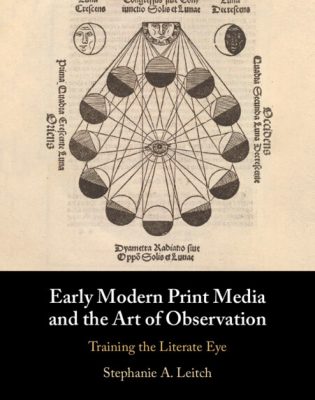
Few topics have attracted more attention in recent literature on the intersections of early modern art, science, and intellectual history than the “epistemic image.” This is a type of visual culture that scholars, starting with Bruno Latour and more recently, Lorraine Daston, Alexander Marr, and Ruth Noyes, characterize as having played central roles in the development of key forms of early modern knowledge production.[1] The publication of the collection of studies entitled Picturing Knowledge: Philosophical Problems Concerning the Use of Art and Science marked a turning point in consolidating intense cross-disciplinary research on what Bert Hall called the “towering question” that historians of science have been unable to address on their own, namely, “How did images acquire their power to persuade? What happened in the cultural shift from medieval to Renaissance modes of communication to enable pictures to be vested with intellectual authority?”[2] Stephanie Leitch’s Early Modern Print Media and the Art of Observation: Training the Literate Eye contributes to this discussion with an investigation of illustrated printed books in which cosmography and physiognomy play central roles as epistemic principles. Leitch characterizes these books as sites of innovation in a novel vernacular culture of “do it yourself” knowledge grounded in practices of observation, measure, and the cultivation of visual acuity.
Readers of this journal will be familiar with Leitch’s extensive studies of printed images in relation to early modern thought including important essays and books on Hans Burgkmair’s Peoples of Africa and India, Dürer’s omnipresent Rhinoceros, and the effects of Vespucci’s voyages on cartographic practice.[3] Early Modern Print Media and the Art of Observation takes these projects forward with a major contribution to advancing the state of research on the epistemic image. For Leitch, epistemic images in early modern print are characterized by a salient duality. They are at once experimental and also figure centrally in setting out and then stabilizing the ambitions of new fields of scientific knowledge. The epistemic images of special interest in Leitch’s book are self-consciously intended to serve significant technical functions as tools, which in turn become themselves “artefacts” or “objects” of inquiry. Leitch interprets this duality in light of debates over whether the term “epistemic” should be used only to refer to “images that can replicate a natural process” or whether it can also refer to images that “serve as functioning tools,” as theorized by Daston (196). Leitch argues that the epistemic images central to her book can be both and more. Notably, in her account, the term can also be used to refer to images that facilitate the “acquisition of new skills,” along lines emphasized by Horst Bredekamp and his colleagues.[4] For Leitch, a key question is how the “sovereignty” of an image, by which she means its particular authority, “can adjudicate its epistemic potential” (196).
The choice of case studies Leitch made is highly relevant to the purposes of her richly illustrated investigation. The printed books she examines, more specifically the images within them, provide information about how readers used such multi-media objects to make discoveries for themselves in such fields of knowledge as cosmography, physiognomy, geometry, optics, and more. Ideal readers, in Leitch’s account, used the images they encountered in these publications as tools for becoming skilled in systematic searches for what they envisaged as highly practical purposes. In Chapter One, the book’s introduction, Leitch stresses how important it is to see early modern cosmography and physiognomy as paired enterprises, both rooted in “predictive astrology” (7), in order to understand the significance of the illustrated publications by the German mathematician Peter Apian and others she examines. Her introduction also provides links among her various chapters and how they relate to her argument that the “visual program” of those early modern forms of print culture “mandated a systematic visual engagement with the world.” This culture, in her account, can be seen as “the root genealogy of books available today for purchase in hardware and drug stores: astronomy manuals, astrology charts, travel guides, and how-to manuals on a host of esoteric topics. They all share a desire to instruct and most of them place a premium on delivering and organizing that information visually.” (6)
The second chapter focuses on cosmography through close examination of how Apian used images in his Cosmographicus Liber (1524) to repackage Ptolemaic knowledge for an emergent class of consumers interested in new forms of learned texts. Leitch characterizes her approach as art historical in her project’s emphasis on the powerful agency exerted by printed images in their original contexts. According to Leitch, the images in Apian’s Cosmographicus transformed hitherto largely inaccessible aspects of academic astronomy into pictorial tools which offered their users a high degree of autonomy in pursuing their own epistemic interests through visual engagement. This suggests that Apian’s Cosmographicus Liber can be seen as a “how to” guide to star-gazing as well as to “training the literate eye.” Leitch studies evidence of the work’s reception to show how it was understood and promoted. She notes that the first French translation (1553) includes a verse where the editor extols how Apian’s work uses “diagrams and figures” to show the relationship between the “the perfect heavens” and “regions of the habitable earth” to the “naked eye” (36).
For Leitch, one of the most novel features of Apian’s book is that it includes pictures for readers’ eyes to follow that contain images of the eye itself as a highly active agent. In her account, Apian often placed depictions of eyes into his woodcut images to guide the viewer in how to look. A famous example of this appears in a set of images related to Ptolemy’s distinction between the mathematic practice of geography and the artistic approach of chorography (38-39). In Apian’s adaptation, while geography’s circumspection of the globe is likened to a portraitist’s rendering an entire head, chorography’s detailed description of place is compared with picturing a disembodied eye and ear. Leitch stresses that this comparison has frequently been highlighted in studies of early modern visual practices. For instance, in The Art of Describing, Svetlana Alpers interpreted Apian’s image as an emblem of a new self-consciousness in observation practices associated with a distinctly northern European visuality.[5] In Leitch, Apian’s interpretation of Ptolemy’s comparison relates to his own aims to offer readers tools for cultivating skills in visual acuity and rationally purposive observation This suggests that Apian may have been motivated by insights that (to borrow Daniel Dennetts’s terms) to use pictures as tools constitutes “a two-way … intelligence: not only does it require intelligence to recognize and maintain a tool (let alone fabricate one) but a tool confers intelligence on those lucky enough to be given one.”[6]
Drawing on arguments by Kathleen Crowther and Peter Barker, Leitch explores how printed images began to condition how users envisioned otherwise invisible relationships between the earth and heavenly bodies.[7] In this connection, Leitch turns to Suzanne Karr Schmidt’s work about complex paper volvelles, or moveable parts, which appear in some her own books, and she turns them into tools for skilling sight itself as an active, kinetic practice.[8] For Leitch, such “mechanical pictures” (55) gave their users embodied, personal experiences of observation as an individual process of gaining knowledge of the cosmos. The section of Leitch’s book on the wider influence of how Apian “updated” Sacrobosco’s extremely influential De Sphaera (1538) (58) offers a wonderful example. She uses a zenith-horizon dial with an intricate volvelle from a Wittenberg edition of Sacrobosco (fig. 2.11) as evidence for how Apian’s popular innovations motivated their appropriation by his contemporaries for their own purposes.[9] The movable paper instrument in question bears an inscription “Nulla dies sine linea” (“No day without its line”) (59-60). This quote from Pliny’s well-known reference to Apelles’s drawing practice here becomes a model for understanding the linear foundations of contemporary celestial measurement. The inscription may have been intended to foster readers’ appreciation of the antiquity and epistemic authority of these new “mechanical pictures.” The humorous figures portrayed on the dial itself are caught in the process of attempting to measure the cosmos with an armillary sphere and right edge and show the advantages of paper versions of such instruments, which make them portable and accessible to new audiences of curious observers. These diminutive observers underscore that Apian’s update of Sacrobosco, like his other publications, interpreted observation itself as a phenomenon in print.
Although the Cosmographicus Liber was promoted in Latin and diverse vernacular editions, Apian never produced a German translation. According to Leitch, Apian may have seen his vernacular editions of other works as making a German Cosmographica unnecessary. Other important factors may have included his convictions concerning the authority of Latin, “the inability of Middle High German to handle scientific vocabulary,” and, finally, the efficacy of Cosmographica’s pictures themselves (62-63) Leitch suggests that, for Apian, the significance of images went far beyond enhancing understanding its texts. They offered a pictorial vernacular which enabled users to see and investigate processes and connections that lie beyond written descriptions and ordinary perception. These factors relate to the conception of the early modern “epistemic image” that Leitch develops in her book. For Leitch, the capacities of such images vastly exceeded any serving functions of illustrating texts. Readers were encouraged to use them as instruments for training the visually “literate eye” to pursue the “art of observation” for their own epistemic purposes. Leitch draws attention to interesting annotations in copies of the Cosmographica as further proof how readers personalized their books, making them tools of their very own (90-91).
Leitch’s third chapter starts with reference to the famous case of imposture, misrecognition, deception, and false charges of murder and adultery, the focus of Natalie Zemon Davis’s The Return of Martin Guerre, and the two popular commercial films.[10] With the arresting case of Guerre as an exemplum of the moral-political significance and of the historical contingency of identity, Leitch explores how physiognomy became a pervasive social preoccupation through illustrated “complexion books.” Leitch turns to one peculiar example, entitled In diesem Biechlin wird erfunden von Complexion der Menschen (1515), which addresses the reader directly: “Do you want to become a physiognomer? [If so] then you must learn and wisely observe everything noted in these chapters, so that you can be certain in your judgements” (122-24). Physiognomy would later become a widely debunked science, but it played pivotal roles in the histories of “observation” in early modern sciences, including those associated with Galileo Galilei (15, 311). Leitch argues that physiognomy became a field in which theories about different forms of seeing emerged. She discusses an important period distinction between mere perception (Anblick) and forms of scrutiny needed to undertake closer investigation (Augenschein) (143-144).
Scholars have noted the close relationship between visual representation of physiognomy in printed texts and the newly popular antiquarian practice of numismatics.[11] They have suggested that the study of repetitions or reappearances of facial features in standardized coinage since antiquity became a precedent for this early modern science. Leitch’s approach, by contrast, stresses the importance of printed images to the several roles “facial profiling” played as “evidentiary work in archaeology, history, natural philosophy, and physiognomy” (130). She focuses on the importance of physiognomy for such prominent figures as Leonardo da Vinci and Albrecht Dürer (147-157), focusing in particular on Dürer’s representation of facial types in his drawings, treatises, and famous prints, namely his engraved Melencolia (1514) and woodcut Rhinoceros (1515). The latter “portrait” of a heavily armored creature became a key pictorial paradigm in Giambattista Della Porta’s De Humana Physiognomonia. One engraving in Della Porta’s popular work juxtaposes the profiles of the Florentine poet Angelo Poliziano with “Dürer’s” now menacing rhinoceros as paired physiognomic types in the service of character assassination. This suggests that physiognomic works by prominent artists may have shaped how interspecies relations came to be caricatured along lines that Maria Loh has termed “faciality.”[12] This chapter relates most closely to art historians’ concerns. To contextualize Leonardo da Vinci’s and Dürer’s famous studies of the human face foregrounds the importance of printed images to the roles of physiognomic comparison in early modern ethnography. Such comparisons formed the foundations of early modern “stereotypes” that supposedly represented racialized differences in physiognomic terms (171-74).
The fourth chapter centers on the Liber Quodlibetarius, a manuscript compiled around 1524. The primary manuscript is now in Erlangen University Library, with a contemporary variant in the Jagiellonian Library in Cracow that offers valuable evidence of the reception of such projects. Printed woodcut images, collected by the manuscript’s compilers, served as the basis for the Liber’s most outstanding features According to Leitch, this belated example of manuscript culture shows that such images “brokered a shift toward visual sovereignty,” solidified by print. She suggests that the intent of such projects may have been to foster “new cognitive potential in the reader” by “empowering observation as a mode of gathering and remembering knowledge” (191).
Some historians might characterize the Liber Quodlibetarius as “miscellany,” a collection of images and ideas compiled from disbursed sources that does not generate anything new. However, Leitch sees them as “customized or composite entities with sovereign and independent intellectual concerns” (193). For Leitch, projects like the Liber were produced to be useful to readers’ everyday lives as “handy tools” (210), and they reveal their compilers’ appreciation of the value of vernacular knowledge for that purpose. This chapter also draws interesting attention to parallels between the format of such projects and the arrangement of the early modern Kunstkammer.[13] The possibility that such “epistemic objects” as the Liber might be seen as portable, affordable miniature versions of such opulent collections supports Leitch’s interpretation of the former as collections of “searchable data” (200).
Chapter 5 begins with a question from the title of one of its key examples: “What do you see?” This question appears on a 1538 oblong woodcut by Erhard Schön, which belongs to the genre of optical distortion which scholars now call “anamorphosis.”[14] Such images, which only reveal themselves when seen from an oblique perspective, were often termed Vexierbilder, or vexing images, in their original contexts. For Leitch, the spread of the anamorphosis in print raises an important question: “Could prints interrogating the fixity of traditional perspectives have emerged from the new observational skills associated with cosmography and physiognomy?” (259). Her approach to that question centers on Vexierbilder as intricate models of cognition which call attention to the importance of “vexed viewing” for cultivating skills of critical questioning, visual discernment, and understanding the world anew.
Leitch argues that Vexierbilder may have been intended to reveal the precarious state of period claims about the certainty and authority of images. This has been argued before, both for printed images and for painted ones, such as Hans Holbein the Younger’s Ambassadors (1533), which is likely to have invited “vexed looking” through its famous placement of an anamorphic feature (a human skull) at the lower left. For Leitch, the anamorphic image, like Apian’s printed eye and volvelles, invites viewers to appreciate experiences of puzzlement and doubt for developing skills in critical questioning that go beyond passive looking (Anblick) and lead to seeing realms and connections that exceed ordinary perception (Augenschein).
In several parts of her book, Leitch explores contexts in which images’ “sovereignty” determine their “epistemic potential” (196). It bears stressing that many works in her book would have elicited a multiplicity of highly diverse experiences in their original contexts. Her references to the darker sides of, for instance, physiognomy and Vexierbilder, evidence the extent to which conflicts over religion, political affiliation, social class, ethnicity and gender would have raised deeply conflicting perspectives in which “epistemic potential” was decided by the “sovereignty” of particular powerful people.[15] Both at the beginning and the conclusion of her book (15, 311), Leitch refers to the deeply incompatible perspectives on printed images which figured so centrally in how Galileo pursued his aims to prove the veracity of his telescopic astronomy (1610, 1613). Numerous developments would have to take place before the powerful characterizations of Galileo’s images as “vexed” would lose authority.
Among many other things, Leitch’s book makes an important contribution to recognizing that there is no single answer to question posed by Hall (1996) mentioned above. The Vexierbilder that Leitch examines can throw new light on the central roles that powerful “epistemic images” of “doubt,” “error,” and “malfunction” played in shaping early modern art, science and intellectual culture.[16]
Stephanie Koerner
The University of Liverpool
Edward Wouk
The University of Manchester
[1] Bruno Latour, “Drawing Things Together,” Knowledge and Society. Studies in the Sociology of Culture Past and Present (1986): 1-40; Lorraine Daston, “Epistemic Images,” in: Alina Payne, ed., Vision and its instruments. Art, science, and technology in early modern Europe (University Park: Pennsylvania State University Press: 2015), 13–35; Alexander Marr, “Knowing Images” Renaissance Quarterly 69, no. 3 (2016): 1000-1013; Alexander Marr and Christopher Heuer, “Editorial introduction: The Uncertainty of Epistemic Images,” Inquiries into Art, History, and the Visual 1, no. 2 (2020): 251-55; Ruth Noyes, ed, Reassessing Epistemic Images in the Early Modern World (Amsterdam: Amsterdam University Press, 2023).
[2] Bert Hall, “The Didactic and the Elegant,” in Brian S. Biagre, ed., Picturing Knowledge: Philosophical Problems Concerning the Use of Art and Science (Toronto: University of Toronto Press: 1996), 3-39.
[3] Stephanie Leitch,“Burgkmair’s Peoples of Africa and India (1508) and the Origins of Ethnography in Print,” The Art Bulletin 91, no. 2 (2009): 134-159; idem, “Vespucci’s Triangle and the Shape of the World,” in: A. Cardoso and L. Villas Bôas, eds., Cadernos de Letras 29 (2015); idem, “Dürer’s Rhinoceros Underway: The Epistemology of the Copy in the Early Modern Print,” in: Debora Cashion et al., eds., The Primacy of the Image in Northern European Art, 1400-1700: Essays in Honor of Larry Silver (Boston: Brill, 2017), 241-55.
[4] Hors Bredekamp, Vera Dünkel, and Brigit Schneider, eds., The Technical Image: A History of Styles in Scientific Imagery (Chicago: The University of Chicago Press, 2015).
[5] Svetlana Alpers, The Art of Describing: Dutch Art in the Seventeenth Century (Chicago: University of Chicago Press, 1984), 133-36. See also Bronwen Wilson, The World in Venice: Print. The City and Early Modern Identity (Toronto: University of Toronto Press, 2017), 191-210.
[6]Daniel Dennett, Kinds of minds: towards an understanding of consciousness (London: Weidenfeld and Nicolson, 1997), 99-100.
[7] Kathleen M. Crowther and Peter Barker “Training the Intelligent Eye: Understanding Illustrations in Early Modern Astronomical Texts,” Isis 104, no. 3 (2013): 429-70
[8] Suzanne Karr Schmidt, Interactive and Sculptural Printmaking in the Renaissance (Boston: Brill, 2017).
[9] Johannes de Sacrobosco, Ionnis De Sacrobosco Libellus, De Spahaera: Eiusdem Autorios Linnellus Cuius Titulus Est Computus. Eruditissimam Anni & Mensium Descrptionem Continens (Wittenburg: Joseph Klug, 1538).
[10] Natalie Zemon Davis, The Return of Martin Guerre (Cambridge, MA: Harvard University Press, 1983).
[11] For instance, Larry Silver “The Face is Familiar: German Renaissance Portrait Multiples in Prints and Medals,” Word & Image (2003) 19:1-21.
[12] Maria Loh “Renaissance Faciality,” Oxford Art Journal 32, no. 3 (2009): 341-63.
[13] For instance, Horst Bredekamp, The Lure of Antiquity and the Cult of the Machine. The Kunstkammer and the Evolution of Nature, Art and Technology (Princeton: Markus Wiener Publishers, 1995).
[14] Jurgis Baltrusaitis, Anamorphic Art, translated by W.J. Strachen (Cambridge, UK: Chadwyck Healey, 1977).
[15] Most recently, Susanna Berger, Deformation: Attention and Discernment in Catholic Reformation Art and Architecture (Princeton: Princeton University Press, 2025).
[16] For instance, Peter Galison “Ten Problems in History and Philosophy of Science,” ISIS (2008) 99, no. 1: 111 – 24.