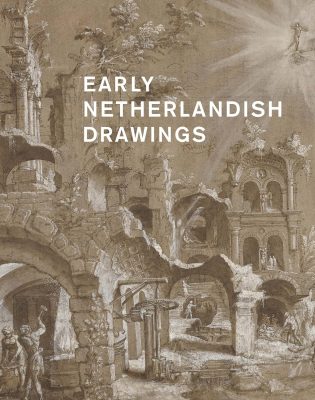
Accompanying an exhibition of its spectacular holdings of Netherlandish drawings, the British Museum has issued its richly illustrated definitive catalogue of collection highlights, the first in almost a century (Arthur Hind, 1915-32; A.E. Popham, 1932). After John Rowlands and Giulia Bartrum provided a similar 1988 catalogue of German drawings (1400-1550), this new analysis fills a major lacuna, complementing Lorne Campbell’s Netherlandish paintings catalogues for the National Gallery (1998, 2014). The product of five years of research, using technical examinations, these holdings span the full two centuries of Netherlandish drawings. Principal authors are, respectively: Horbatsch, Curator of Dutch, Flemish and German Prints and Drawings, and Wytema, IMAF Project Curator. Additionally, an all-star international roster of art historians and conservators wrote individual entries: Stijn Alsteens, Susanne Bartels, Yvonne Blyerveld, Flora Clark, Joanne Dyer, Stefaan Hautekeete, Anne van Oosterwijk, Rebecca Snow, Emma Turner, Ilja Veldman, and Edward Wouk.
Foundational essays open the volume. After Horbatsch’s brief Introduction, Wytema follows with a political outline of the region’s Burgundian and Habsburg rulers. Then a pair of essays probe drawings more specifically.Horbatsch looks to drawing production in the workshop and the range of drawing types, by purposes and by medium. Next, Blyerveld focuses on diverse Netherlandish art centers: Antwerp for stained glass and prints, Brussels for tapestries, and Leiden and Amsterdam in Holland, with close attention to individuals (Heemskerck and Goltzius), plus late sixteenth-century emigrés from South to North Netherlands as well as Netherlanders abroad (Rome and imperial capitals). Finally, the conservation team outlines materials, techniques, and the use of modern imaging for close analysis of drawings. These essays form a primer suitable for drawings scholarship through brief capsules displaying our state of knowledge.
But of course, the meat of the publication and its lasting contribution is its fresh analysis, drawing by drawing, of a collection rivaled only in Vienna, Berlin, and Paris. British Museum strengths provide core holdings of multiple images for several major artists (and their workshops): Rogier van der Weyden, Lucas van Leyden, Pieter Bruegel, and Hendrick Goltzius. However, Goltzius’s magnificent late Sine Baccho et Cerere Venus Friget is omitted (dated 1599; 1861,0810.14), here called a “grisaille sketch” (p. 302), even though the museum website classifies it as a drawing on paper – perhaps because it also uses brush and oils for its subtle modeling, “painting in black and white.”[1]
Out of more than 1200 drawings from this period in the collection, this catalogue examines 180 works, of which a selection of 110 appeared in the London exhibition itself. Entries include material description, watermarks, provenance, and selected literature. In such a brief review, only a few major drawings can be addressed.
To begin, the rarest surviving early drawings were purposeful studies for either as workshop preparation or as preservation of compositions. The Arrest of Christ (no. 1), a remarkable silverpoint on prepared green paper from shortly after the turn of the fifteenth century, stems from the International Style fashioned in Burgundian and French courts. It likely served as a compositional ricordo or modelbook template, close to the Eyckian “hand G” manuscript illuminator or the Limbourg Brothers.[2]
Another spectacular silverpoint, the only accepted autograph drawing by Rogier van der Weyden, Young Woman (no. 10) offers delicate modeling within outlined contours; its echo in reverse appears as Rogier’s early painting, Young Woman (ca. 1440; Berlin). But two other silverpoints (nos. 11-12) of the exquisite Magdalen from the Braque triptych (Louvre, ca. 1450-52) show workshop usage, though one work (no. 11) was formerly considered preliminary to the painting, made by Rogier himself, until underdrawing on the Paris panel revealed an initial difference before the final veil form, recorded in that silverpoint. Several other Rogier workshop silverpoints (nos. 13-16) adorn the BM collection, as well as a pair of pen drawings (nos. 18-19). Another silverpoint portrait of a man in chaperon (ca. 1440-60; no. 17) has long been associated with Jan van Eyck, but it differs from the one authentic drawing by his hand (Old Man, Dresden, ca. 1435-40),[3] and also shows affinities with the Rogierian workshop.
A cluster of later fifteenth-century pen drawings aligns with designs for other media: stained glass (no. 21); tapestry (nos. 22-23); manuscripts (no. 24), and early engravings (after Master FVB; nos. 26-29). Several drawings also show influence from leading painters: Hugo van der Goes (nos. 30, 32, 37); Geertgen tot sint Jans (no. 31), Hans Memling (nos. 34-36); and, notably Jheronimus Bosch (Entombment, no. 39). This latter work, long considered an autograph drawing in ink and brush, was recently reassigned by Koreny to a definable Bosch workshop artist, dubbed the Master of the Prado Haywain Triptych.[4]
Shortly after the turn of the sixteenth century, assigning artist’s names to their characteristic drawings becomes clearer. Jan de Beer’s core identifying work is a British Museum signed study drawing of heads (no. 42) in brush and ink on brown prepared paper.[5] Other BM drawings are associated with De Beer and his prolific workshop (nos. 41-46) as well as with contemporary painting studios, collectively known as “Antwerp Mannerists” (nos. 47-52, 84).[6]
Only some thirty drawings survive by Lucas van Leyden, but eight of them, diverse in medium, are in the BM. Several close-ups in black chalk are either portraits (nos. 54), half-length studies for figures in paintings (Man Drawing, no. 55; Virgin and Child, no. 60), or both (no. 58). Others, akin to independent works, include engraving-like pen compositions: David and Goliath (no. 56) and Jael and Sisera (no.59), plus a mysterious allegorical silverpoint of two male nudes on a globe above a cloud (no. 57), one of the earliest Netherlandish nude studies from a model (see also Jan Gossart’s contemporary Women’s Bath (no. 68). Other drawings stem from the Leiden circle of Lucas or his Leiden teacher, Cornelis Engebrechtsz (nos. 53, 61-64). Among the few rare landscape drawings associated with Lucas’s older contemporary, Jan van Scorel (nos. 65-66), one provides a view of Bethlehem from the artist’s own pilgrimage to Jerusalem (ca. 1520-21).
Best known for his designs for stained glass, Dirk Vellert is well represented with roundel ink drawings (1523, nos. 69-72; two stages of a single design, c. 1532, nos. 73-74; plus another, no. 75). Tapestry design also continues with five Barnard van Orley designs for a History of David (ca. 1525-30; nos.79-83), plus cartoon fragments by his successor, Pieter Coecke van Aelst, from a Life of St. Paul (ca. 1530, nos. 86-88). Another ink modello by Coecke outlines a project for a John the Baptist triptych (with wings on the verso, no. 89). Another designer for both woodcuts and glass, Jan Swart van Groningen, made a dated, ink-and-brush, arched Pentecost, dated 1533 (no. 91); in addition, a set of four Virtues and Vices (nos. 92-95), a Tobit (no. 96), and four Joshua scenes (no. 97) provide a range of Swart designs.
Around mid-century, major artists began to make designs for professional engravers to execute as prints. Michiel Coxcie’s ten Loves of the Gods, derived from Roman models (nos. 100-109), begins this practice, which expanded in the prolific collaborations of Maarten van Heemskerck with the publishing house of Hieronymus Cock in Antwerp (nos. 113-14).[7] Heemskerck’s own visit to Rome (1532-36/37) also resulted in celebrated topographical drawings of ruins as well as imagery of classical sculpture collections (no. 111),[8] plus adaptations of both in images such as his Ruins with Vulcan’s Forge (1538; no. 117), pen and brush on grey prepared paper, created after his return home. Two meticulous pen drawings by master engraver Johannes Wierix were prepared on vellum (nos. 158-59).
One of the great treasure troves of the British Museum is its collection of Pieter Bruegel drawings, most of them print designs for Hieronymus Cock, which can also stand as independent works. Building on the narrative figurated landscapes of Matthijs Cock (no. 118), Bruegel produced Alpine settings as both presentation drawings but also print designs (nos. 120-22). He also created inventive woodland settings that would inspire his young painter son, Jan Brueghel (nos. 123-24). For Cock, Bruegel’s print designs included a Bosch-inspired set of the Seven Deadly Sins (Avarice, 1556; no. 125) and a related image of self-seeking, Elck (“Everyman,” 1558; no. 126). Yet a decade later a pen and wash allegory, The Calumny of Apelles (ca. 1565, no. 127) offers one of his rare ventures into classical subjects, based on Lucian and annotated by the artist himself.[9]
Bruegel’s lasting influence reappears in the drawings of both Roelant Savery (nos. 169-72) and David Vinckboons (nos. 173-76), both artists who emigrated to the North Netherlands for religious reasons around the turn of the seventeenth century. Prominent later sixteenth-century artists appear in characteristic drawings: Frans Floris (no. 129), Joachim Beuckelaer (no. 130), Joris Hoefnagel (nos. 131-32), Hans Vredeman de Vries (no. 138), Hans Bol (nos. 139-40), Dirk Barendsz (no. 142), and Maarten de Vos (no. 165). Moreover, the pen and wash design for an iconic print of the emerging Italian Accademia, The Practice of the Visual Arts, was fashioned by emigré artist Jan van der Straet (alias Stradanus; 1573, no. 141).
Hendrick Goltzius culminates all these sixteenth-century trends. As a master engraver in his own right, he used or adapted drawings by Bartholomeus Spranger (nos. 148-49), while also fashioning portraits, often in colored chalks, even like his Dromedary (no. 151), but here his self-portrait is a silverpoint with graphite (no. 150). His mastery of the human body and of classical subjects finds its epitome in Goltzius’s pen allegory on vellum with Olympian gods, Sine Cerere et Baccho friget Venus (no. 152). His younger acolyte, an even more dedicated draftsman, Jaques de Gheyn II, is well represented by a remarkable range of subjects: Rest on the Flight; Black Man with a Turban; Deathbed of Countess Anna Walburgis (in bodycolor); and Design for a Grotto (nos. 154-57).
From those earliest drawings arising out of manuscript illumination to large, virtuoso “pen works,” independent creations in their own right around 1600, the British Museum exhibition and catalogue explore a full range of drawing in the Low Countries across two transformative centuries. Finally comprising self-conscious displays by named artists, Netherlandish drawing tradition will soon turn to future achievements by the likes of Rubens and Rembrandt.
Larry Silver
University of Pennsylvania, emeritus
[1] E.J.K. Reznicek, Die Zeichnungen von Hendrick Goltzius, Utrecht, 1961, cat.no.130; Huigen Leeflang, Ger Luijten, and Nadine Orenstein, Hendrick Goltzius (1558-1617: Drawings, Prints, and Paintings (New York/Amsterdam/Toledo, 2003): 230-233, no. 83.2; Lelia Packer and Jennifer Sliwka, Monochrome: Painting in Black and White, London, National Gallery, 2017, cat. no. 22.
[2] Recent entries appeared in Stephan Kemperdick and Friso Lammertse, The Road to Van Eyck (Rotterdam. 2012), 181; and Fritz Koreny, Early Netherlandish Drawings (Antwerp: Rubenshuis, 2002), 26.
[3] No longer identified securely with Cardinal Albergati; Stephan Kemperdick, “The Blessed Albergati,” Simiolus 46 (2025), 5-16.
[4] Koreny, Early Netherlandish Drawings, no. 47. More recently Koreny, Hieronymus Bosch. Die Zeichnungen (Turnhout, 2012), 224-29, no. 15, plus nos. 16-18. Koreny bases his attributions on Bosch underdrawings and on the left-handed orientation of this artist’s hatches. The subject also appears in no other Bosch image.
[5] Dan Ewing, Jan de Beer (Turnhout, 2016), 77-87, no. 28.
[6] Peter van den Brink and Maximiliaan Martens (eds.), ExtravagAnt! A Forgotten Chapter of Antwerp Painting, 1500-1530 (Antwerp: Koninklijk Museum, 2005).
[7] The largest ensemble of Heemskerck print designs is in Copenhagen, Statens Museum for Kunst, catalogued by Jan Garff, Tegninger af Maerten van Heemskerck (Copenhagen, 1971). An article on Heemskerck’s print design development is in preparation by Art DiFuia and this reviewer.
[8] Arthur DiFuria, “Maerten van Heemskerck’s Collection Imagery in the Netherlandish Pictorial Memory,” Intellectual History Review 20 (2010) 27–51.
[9] On the subject, Jean Michel Massing, La Calomnie d’Apelle et son iconographie (Strasbourg, 1990); David Cast, The Calumny of Apelles (New Haven, 1981).