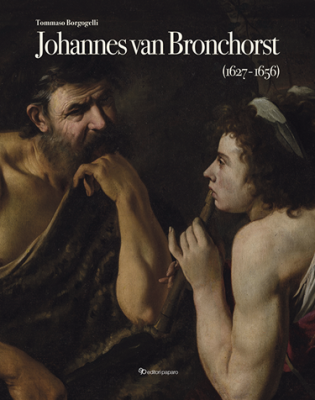
Tommaso Borgogelli’s new study of the art of Johannes van Bronchorst is the first comprehensive analysis of this artist’s oeuvre since the appearance of Thomas Döring’s indispensible monograph of 1993, though that latter work was dedicated to the art of the entire Bronchorst family: Jan Gerritz. (1603–1661), Johannes (1627–1656) and Gerrit (c. 1636–1673). Borgogelli considers his book an update to the section of Döring’s earlier publication dedicated to Johannes; indeed, it is, and a thorough one at that. While Döring’s monograph will probably always remain foundational, it is now over three decades old. Much has changed since then within the field of seventeenth-century Dutch painting in general and the study of the so-called Dutch Caravaggisti in particular. With great perspicacity, Borgogelli assesses Johannes Bronchorst’s art within the overall context of these developments. This short but well-illustrated book is divided into a brief Introduction, followed by four chapters without a formal Conclusion. Thereafter, Borgogelli presents an updated check list of Johannes’s oeuvre (including a separate list of problematic works), versus the German scholar’s full catalogue raisonné of the paintings of Johannes, his father, Jan, and brother, Gerrit.
Following a helpful introductory survey of historiographical matters, Borgogelli’s first chapter explores the critical reception and Nachleben of Johannes’s art and career. Following Döring, he rightly outlines longstanding confusion between father Jan and son Johannes, the latter, who unfortunately for later specialists was baptized as Jan at his birth. Once again, historiographical issues come to the fore. Borgogelli convincingly argues that the artist’s premature death at the age of twenty-nine, the limited number of surviving pictures, and the seemingly continual mix-up of the names of father and son had served to eclipse the latter’s memory and very reputation (11-12). In fact, the first attempts to reintroduce Johannes into the canon would not occur until the 1950’s, three centuries after his death (13). Further concrete steps would have to wait until the grand exhibition on Dutch Caravaggist painting held in Utrecht and Braunschweig in 1986-1987, with noted scholars Albert Blankert and Leonard J. Slatkes primarily responsible for the accompanying catalogue (14). This compelling exhibition generated renewed interest in the Dutch Caravaggisti, thereby spurring further scholarship (including Döring’s essential book) that continues to this day.
Chapter Two, entitled Utrecht 1627–c.1648, initially takes on the all-important task of clarifying father Jan’s work to provide a basis for understanding his son, Johannes’s, who was also his pupil. These clarifications are made against the background of broader artistic developments within the family’s native town, Utrecht, that is, before they resettled in Amsterdam around 1651–1652. Borgogelli propounds an expert overview of Utrecht (Caravaggist) painting in the decades following the deaths of two of its leading practitioners: Hendrick ter Brugghen (1588–1629) and Dirck van Baburen (c. 1592/93–1624). He insightfully observes that the earlier Caravaggesque elements within Utrecht painting never disappeared completely but lived on, subsumed within a growing classical idiom (21ff.). Borgogelli then presents a wide-ranging and masterful discussion of many Utrecht painters in the forefront of these developments (along with artists from other cities affected by Utrecht painting) who exerted an impact upon Jan, ranging from Cornelis van Poelenburgh (1594/95–1667), Jan van Bijlert (1597–1671), and Gerrit van Honthorst (1592–1656) to the enigmatic Paulus Bor (1605–1669) and Jacob van Campen (1596–1657) – the latter the subject of a new study by Jan Niessen – along with Abraham Bloemaert (1566–1651), his son, Hendrick (1601–1672), and even the short-lived Johannes Moreelse (1603–1634).
This is an excellent chapter that sheds much light on Utrecht painting during the 1630’s and 1640’s. It also affords Borgogelli an opportunity to gently critique Döring’s older arguments concerning the reasons for Jan’s success. The latter claimed a supposed artistic impasse in Utrecht caused by its increasingly moribund artistic and economic centrality, which, in turn, afforded opportunities to the talented Jan. To the contrary, Borgogelli persuasively argues that “Bronchorst’s success was not the product of an impoverished context, but rather the result of his artistic intelligence, his ability to grasp and reinterpret new tendencies with originality, and his capacity to engage actively within a still vital urban fabric” (43).
Johannes initial steps as an artist, before his departure for Italy in 1648, are also addressed in Chapter Two, but more fully amplified in Chapter Three: Rome and Venice c. 1648–after 1652 (before 1655). This chapter opens with a discussion of Johannes’s relation to the fascinating poet, humanist, and bon vivant, the Dutch nobleman Matthijs van Merwede (1613–1664), whom he met in Rome and for whom he painted a wonderful triple portrait, now in a Sienese private collection (fig. 40). As has long been known, Johannes is mentioned briefly in Van Merwede’s brash account of his lusty Roman adventures, published in the Dutch Republic in 1651 under the title Rommsche Min-triomfen. There we learn of the artist’s work on a portrait of the infamous literato (49).
Borgogelli proceeds to survey Johannes’s artistic output in Rome and then in Venice, to which he probably resettled around May of 1650 (53ff.). He points out that it is difficult to argue that most of the so-called Roman works (beyond the Van Merwede triple portrait, that is) were painted in Rome itself and, in fact, surmises that most were probably executed in Venice (68) despite being imbued with Roman naturalism. For example, a series of portrayals of musicians preparing for a concert – though to this reviewer, fig. 43 appears to be a pure allegory of music — relate to the work of Bernardo Strozzi (1581-1644; 67-68, fig. 60), who had died in Venice a few years before Johannes’s arrival.
Most significantly, Borgogelli revises Döring’s interpretation of Johannes’s artistic development in Italy (53ff.). While acknowledging its abiding value, he faults Döring for placing the artist within a moment of naturalist revival in Rome that ran counter to prevailing Baroque taste. Much as he did with Utrecht’s artistic scene in Chapter Two, Borgogelli expounds upon the complex phenomenon of Roman painting at mid-century, calling attention to what has recently been defined as “Baroque in chiaroscuro” (55 and note 144): “Johannes’s position is best understood, in alignment with a line whose most significant points of reference are Pier Francesco Mola (1612-1666) and Mattia Preti (1613-1699). Their personal reworking of naturalism, nourished by a vibrant luminism and a heightened dramatic intensity, provides the horizon against which both Johannes’s adherence to a renewed naturalism and his distance from the dominant taste and poetics of the time can be fully appreciated” (55). Said to be central as well to Johannes’s development are his interactions with additional Italian masters such as Spadarino (1585–1652) and Pasquale Chiesa (ca. 1630–1654), among others.
The fourth and final chapter of the book examines Johannes’s Amsterdam period, from after 1652 to the artist’s untimely death in 1656; there is a special focus here on public commissions. The tremendous potential of patronage induced his father, Jan, to quit Utrecht for bustling Amsterdam. In January 1652 he obtained his poorterschap (76). By that year, he had already tasted success: Jan had already received a prior lucrative commission to replace the fire-damaged stained-glass windows in the Nieuwe Kerk. There followed the spectacular assignment to decorate the shutters of the church’s new organ and a few years later, in 1658, the city fathers entrusted him to paint an overdoor in the north council chamber of the Stadhuis (107ff). It was during these years that Johannes and his brother, Gerrit, returned to the Netherlands.
Borgogelli’s extended discussion of Jan’s public accomplishments in Amsterdam leads to his analysis of the complex relationship between father and son, as the Nieuwe Kerk organ commission testifies (91ff). Döring theorized that Jan must have had assistance with this work given its sheer scope. Yet, in the end, he attributed the entire project to the elder artist. To the contrary, his careful and sensitive examination of the paintings led Borgogelli to recognize, convincingly in my view, the hand of Johannes in several of the figures. Moreover, Johannes was enjoying his greatest career successes in the mid-1650s (95), including a prestigious commission for the Amsterdam Stadhuis. Just as in the earlier chapters in this book, Borgogelli contextualizes Johannes’s pictures within broader artistic developments, in this instance, those of Amsterdam around mid-century. This serves to present a deeper understanding of his art and its specific features and enables us to separate his hand out from other artists (especially Jan’s) with which it has sometimes been confused. Borgogelli argues rightly that Johannes’s brief Amsterdam period pictures (given his premature death in 1656) continue to evidence the imprint of Italy and the example of late Roman Caravaggism but this Italian idiom was modified by the formal clarity of contemporary Dutch developments, along with the vestigial impact of his father’s work (83). This can be readily observed in Johannes’s most accomplished paintings of this period, for example, the Rotterdam Jacob and Laban of 1655 (fig. 90). To a certain extent, Jan’s work continued to inspire Johannes’s but in these last years, their respective roles were sometimes reversed in an ongoing complex artistic dialogue of appropriation (115ff).
Throughout this fine book, Borgogelli’s sharp eye and his close readings of the paintings afford him repeated opportunities to adjust attributions, the Nieuwe Kerk organ-shutter commission providing a case in point, as does the Liechtenstein St. Bartholomew (fig. 42) which he rightly considers the prime version over a canvas presently in a private collection (fig. 61). (He also manages to clarify the work of Johannes’s lesser known and apparently less accomplished brother, Gerrit.) In sum, Johannes van Bronchorst (1627–1656): Naturalism and Classicism in the Dutch Golden Age is a superb study along very traditional connoisseurial lines. This approach may not appeal to all readers, but publications of this sort remain essential in a field where culturally contextual scholarship currently predominates.
Wayne Franits
Syracuse University