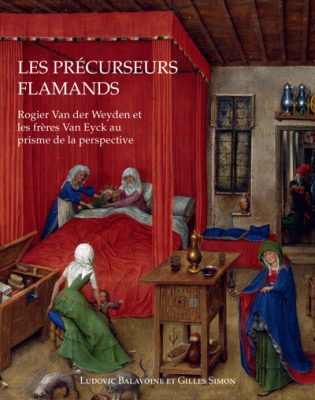
While art history has long been anchored in the “Italian myth” – crediting Brunelleschi with the empirical invention of linear perspective around 1413 and Alberti with its formal theorization in 1435 – the traditional narrative often portrays the Flemish Primitives as technically lagging, relying on mere “intuitive” realism. The work by Ludovic Balavoine and Gilles Simon, Les Précurseurs Flamands: Rogier Van der Weyden et les frères Van Eyck au prisme de la perspective, seeks to challenge this long-standing North-South hierarchy.
Against the backdrop of the fifteenth century, as the perception of the urban and religious worlds underwent a radical shift, the authors explore how Northern painters strove to represent space and achieve a realistic testimony of their environment. Far from being mere followers of Italian innovations, the Flemish masters are presented as true pioneers of geometric depth. By re-examining iconic works such a, as they havs the Ghent Altarpiece, this study argues that the Van Eyck brothers and Rogier van der Weyden should be understood not as figures detached from Italian innovationse often been portrayed, but as contributors to a broader European evolution of perspective shaped by parallel developments and artistic exchange.
The study focuses on three primary protagonists: Hubert and Jan van Eyck, along with Rogier van der Weyden – effectively four, if one includes the anonymous Master of Flémalle, whom the authors propose to identify with one of the aforementioned masters. The volume is divided into eight chapters, though they favor a series of focused thematic investigations over a strictly chronological progression. The first chapter centers on the Ghent Altarpiece, while the second examines how the use of the vanishing point serves a divine iconography; the authors conclude that such a mastery of space implies that these artists must have necessarily traveled to Italy. The investigation then shifts to Jan van Eyck’s methodology, suggesting his potential use of a tavoletta similar to Brunelleschi’s, while highlighting Rogier van der Weyden as another major artist who potentially worked in his workshop. Furthering this line of inquiry, the book explores Van der Weyden’s Italian connections, proposing the hypothesis of an initial initiatory journey in the early 1420s. During this trip, he would have learned the foundations of central-point perspective, subsequently applying them to the Ghent Altarpiece or the Fountain of Life in the Prado. The latter half offers a reflection on Flemish portraiture with a re-examination of the figure of the Master of Flémalle, proposing an identification with Hubert van Eyck, a revised analysis of the Turin-Milan Hours, and a final inquiry into the elusive figure of Hubert himself.
Ambitious in its scope, this study utilizes the analysis of central-point perspective construction to formulate innovative hypotheses regarding the lives and professional activities of these artists. Crucially, the authors aim to demonstrate that, contrary to long-standing historiographical belief, central-point perspective did not first appear in the Burgundian Netherlands with Petrus Christus in the mid-fifteenth century – specifically in his Virgin and Child with Saints Jerome and Francis (1457).[1] Instead, they argue for a much earlier mastery of these geometric principles by the founding masters of the school. On this point, the endeavor is successful; notably, the re-examination of the spatial construction of folios from the Turin-Milan Hours – the earliest work associated with Van Eyck’s workshop – demonstrates an early quest for the rationalization of space.
The remainder of the demonstrations, however, invite more caution. The meticulous analysis of the corpus leads the authors to the certainty that these artists had direct contact with contemporary Italian production. Finding no evidence of Italian painters active in Flanders during this period, they argue that it was necessarily the Flemish masters who made the journey. Indeed, they note that travel and pilgrimages to the South were frequent for Northerners, the routes well known, and the artists were particularly mobile. While there is no principled objection to the idea that these painters traveled, caution is required when a hypothesis transforms into an assertion without documentary evidence. The authors themselves admit, particularly regarding Rogier van der Weyden’s journey in 1423, that “the supposition, which is nearly an affirmation, is based on no historical source. It is the result of a body of evidence which, when combined, leaves no other conclusion” (applying the same logic to Hubert and Jan van Eyck).[2] This leap remains open to some reservation. In fact, the authors’ own demonstration may suggest a more nuanced interpretation. A closer examination of the vanishing lines highlighted in these studies appears to reveal a noticeable discrepancy: these Flemish precursors almost systematically avoided the monofocal perspective favored by the Florentines. Instead, their works generally feature two or even three vanishing points. This situation suggests an attempt to achieve similar visual results to the Italians without necessarily mastering their “secrets.” It also raises a pivotal question: did they truly travel to Italy, or did they encounter these perspectival notions through other means – perhaps via intermediaries? Such a scenario would more readily explain the distinct difference in technical treatment.
Another essential point of this study is the proposed identification of the Master of Flémalle as Hubert van Eyck – a hypothesis cautiously suggested decades ago by Elisabeth Dhanens.[3] This attribution is based on an analysis of spatial conception and the perceived reuse of motifs between the Ghent Altarpiece and the Flémalle Altarpiece, particularly regarding the features of the Virgin. Only time will tell if this demonstration proves more convincing than that of their predecessor; nonetheless, it represents a commendable effort to re-evaluate a figure who, despite his fame, remains enigmatic due to a lack of documentary evidence. However, this constitutes a challenging proposition. Recent findings from the restoration of the Ghent Altarpiece suggest that distinguishing between the hands of Hubert and Jan van Eyck is nearly impossible; consequently, assigning specific credit for technical innovations remains difficult. Furthermore, in this pursuit of identity, a significant member of the Van Eyck workshop appears to have been overlooked: Lambert, the third brother, who is known to have taken over the Bruges workshop after Jan’s death. Lambert’s role seems to be minimized in favor of Rogier van der Weyden, whom the authors describe as the “third man” of the Eyckian workshop. Indeed, they credit Van der Weyden with the spatial design of the Fountain of Life in the Prado – a work which, chronologically, might more plausibly be associated with Lambert’s tenure.
Despite these points of debate, such reservations in no way diminish the work achieved by Balavoine and Simon. Their analysis and reinterpretations provide a refreshing perspective on the Northern Renaissance, effectively reopening dialogues that had long been considered settled. Ultimately, Les Précurseurs Flamands stands as a substantial contribution that will undoubtedly stimulate the debate.
Elsa Espin
Fondation Périer-d’Ieteren, Brussels
[1] It is worth noting that Myers – whose study is absent from the book’s bibliography – identifies Christus’s first attempt at this technique as occurring earlier, in 1452, with the Berlin Annunciation. See Marshall Neal Myers, Observations on the Origins of Renaissance Perspective: Brunelleschi, Masaccio, Petrus Christus (Ph. D. diss., Columbia University, 1978), pp. 133–34.
[2] The authors notably propose an Italian itinerary for Jan van Eyck in 1425–1426, predicated on the service he rendered to Philip the Good at the time. While the “secret journeys” carried out by the artist under ducal orders allow for extensive conjecture regarding his travels, the presence of Burgundian embassies in Valencia during the Duke’s matrimonial negotiations must be taken into account. It is likely that Van Eyck was attached to these missions, following the precedent of the embassy in Portugal in 1428. For further discussion, see especially Bart Fransen, “Van Eyck in Valencia,” in Christina Currie, Bart Fransen, Valentine Henderiks, Cyriel Stroo, Dominique Vanwijnsberge (éds.), Van Eyck Studies. Papers presented at the eighteenth symposium for the study of underdrawing and technology in Painting, Brussels, 19-21 September 2012 (Paris – Louvain – Bristol CT: Peeters, 2017), pp. 469–78.
[3] While the historian is indeed included in the book’s bibliography, it must be noted that her specific study on this point is absent: Élisabeth Dhanens, “Tussen de van Eycks en Hugo van der Goes,” Academiae Analecta 45, no. 1 (1984), pp. 1–98.