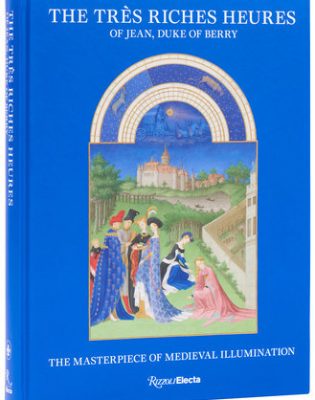
The Château de Chantilly justifiably billed its exhibition as a landmark show, and for early modernists and medievalists, it was the most anticipated exhibit of the year. The famous manuscript has been exhibited to the public only twice in the last century. I was one of those who made a pilgrimage to Chantilly in 2004, where I reverently viewed a not-so-famous opening. This year, the Château de Chantilly pulled out all stops in their mission to appeal to a wide audience, ranging from professional art historians to the general public. Not only could visitors gaze upon what the didactics call “the Mona Lisa” of manuscripts, but we could inspect each of the disbound calendar pages, including those iconic folios familiar not only from art history books but also from popular media and so much merchandising. Visitors were privileged to see the results of the meticulous restoration work, and an edifying glimpse into the careful decision-making and skilled techniques involved. As if this were not enough, the exhibition brought together dozens of other relevant objects – many nearly as eye-popping as the headliner – including all six extant Books of Hours known to have been commissioned by the Duke of Berry. The sumptuous catalogue makes a handsome souvenir, including wonderful illustrations and useful essays by established scholars about the manuscript, its patrons, artists, later history, and restoration.[1] It was, as advertised, an astonishing once-in-a-lifetime event. Given the riches on offer, I feel quite curmudgeonly for the misgivings I have gathered about the show, which are only reinforced by the supporting publications.
My objections are that the exhibition seems determined to persuade the public, often not very subtly, to see this singular work through the lens of the collectors, to give them credit as visionaries, to admire their taste, to accept art as a way of promoting aristocratic values by burnishing the reputations of prominent patrons, to perceive the very fact of having the wherewithal to purchase luxury goods as a virtue – to identify with the patrician class. To do so, they must ignore, minimize, and dismiss important scholarship on the social implications of the Très Riches Heures by Erwin Panofsky, Millard Meiss, Lynn Jacobs, Jonathan J.G. Alexander, Michael Camille, Gerald Guest, and others.
The exhibition begins by introducing us to the manuscript’s nineteenth-century owner, Prince Henri d’Orléans, Duke of Aumale, fifth son of the “citizen king” Louis-Philippe, who built a faux Renaissance château in Chantilly not far from the exhibition space in the Jeu de Paume. We learn about the history of his acquisition alongside a wall-sized photo of the dapper aristocrat in his study, shown beneath a quotation in which he congratulates himself for making a good purchase: “This book occupies a significant place in the history of art; I dare say it has no rival.” In the accompanying volumes, the duke’s judgment is highlighted as an epigraph in a headline font. The catalogue sympathetically chronicles Aumale’s efforts to find a role for monarchy in post-revolutionary France through collecting: Marie-Pierre Dion writes, “Aumale made a political gesture full of flair for the benefit of the sovereign nation, in response to the government and to the detriment of dynastic succession.”[2] However, the realpolitik of the bequest becomes clearer from an exchange with his brother in 1885, which indicates that Aumale’s bequest was in response to his prescient fear that he would be exiled by the Republican government – again – and his property and collections confiscated and dispersed as had happened before.[3] Following his expected exile in 1886, he revealed his grand public gesture as a way to argue for his return. The stringent conditions the Duke of Aumale imposed on the donation were meant to project the royalist stance he made through his collecting in his absence and into the future. Indeed, his ban on loans and stipulation that the paintings decorating the palace not be moved even within the château hinders Chantilly’s functions as a modern public museum.
The next gallery in the exhibition takes visitors backwards in time from Aumale to Jean de Berry, whom, the didactics inform us, was “one of the greatest collectors of his time,” “the greatest connoisseur,” “one of the most brilliant princes of his time,” and the “number one collector of works of art and precious stones of his time.” We are introduced to his portraits, his heraldry, his castles, his tomb, his jewels, and his library. Extant manuscripts from his library, “a harmonious blend of knowledge and luxury,” are divided into genres such as history, philosophy, and science. Sprinkled throughout are documents that function both to authenticate the precious items on view and highlight their worth. These include nineteenth-century shipping bills and exhibition notices as well as fifteenth-century inventories and valuations. The focus on so many of the labels is on luxury, buying, owning, how Berry acquired the manuscripts (or who gave them to him), and whether a manuscript first owned by Berry was one of those inherited by the Duke of Aumale. Repeatedly, labels favored this information at the expense of explaining the illumination on view, and sometimes they did not even identify the subject matter.
I wonder if, had I not gone to the show with the task of reviewing it, I would have been so sensitive to this emphasis and the omissions it occasioned. No doubt I would have taken much more pleasure in being able to see the featured manuscripts surrounded by contextually relevant documentation and works of art. I would have, and did, appreciate the well-planned spaces that allowed for generous access to the treasures on display, as well as the engaging interactive elements: the screens projecting stunning details of the miniatures; a video highlighting the work of restorers; and a facsimile copy of the manuscript that visitors could page through. And yet, once I noticed them, I became increasingly disturbed by the ideological implications of what seemed to be a blatant and uncritical celebration of wealth and power.
Repeatedly, the labels encouraged visitors to admire and identify with the wealthy: to marvel at their gems and castles, to appreciate their elegant clothes, to imagine participating in the aristocratic entertainments – the feasts, the tournaments – to be respectful of their “wisdom” and “profound devotion.” Occasionally, peasants are mentioned as part of the spectacle, but we are not asked to think about them sympathetically: to ponder the laborers’ lack of freedom, heavy taxes, and their backbreaking work exploited to support the duke’s lifestyle. The subheading “Monseigneur wants his people to become rich” in the exhibition catalogue’s introduction to the Van Lymborch Brothers by Mathieu Deldicque uncritically advances the argument presented by the duke’s treasurer, whose job it was to advocate for Berry when called before the king to explain the duke’s notoriously excessive taxes.[4] There is plenty of evidence that Berry was not beloved by his people, which is brushed over in the romanticized history the exhibition seems to stand behind. During Berry’s lifetime, the chronicler from St.-Denis reported that Berry’s subjects only reluctantly participated in a religious procession staged to garner prayers for the duke in the face of a life-threatening illness, and that instead of praying, many cursed the duke and complained about his burdensome taxes.[5] Berry had reason to fear rebellions from his discontented people, and he made a point of brutally suppressing and imposing ruinous fines on those associated with uprisings against him.[6] The label for the February scene encourages us to take the point of view of the sovereign, to see the “simple life of the peasants in contrast to the magnificent January feast,” to peer into their hovel and gawk at the genitals of the young couple who “warm themselves without shame” in front of the fire (jeunes gens se réchauffent sans pudeur).
The fact that peasants are so often depicted in undignified ways that pointedly contrast with flattering images of graceful aristocrats enjoying the fruits of their serfs’ labor was the subject of a meaningful disagreement between two art historical titans of the twentieth century who concerned themselves with this manuscript: Millard Meiss and Erwin Panofsky. Even though both scholars are much cited in the exhibition catalogues, there is silence on this important exchange. Panofsky, in his foundational work on Early Netherlandish Painting, wrote of the Très Riches Heures that a “sharp distinction is made between the nobles and the poor,” resulting in “an antithetical characterization of divergent milieus.”[7] He asserts that for painters at this time, “including the Limbourg brothers, a naturalistic mode of presentation was not as yet a general principle of art; as far as human beings are concerned, it almost amounted to a class distinction.”[8] Thus, naturalism was reserved for peasants and animals in a way that equated them, whereas aristocrats were elevated by rendering them in the elegant and mannered “International Style.” Meiss, determined to counter the charge that these works mirror the “values of the aristocracy alone” made the case that the artists were influenced by the writings of Jean Gerson, the prominent theologian and Chancellor of the University of Paris. [9] Meiss characterized Gerson as full of compassion for the “simple folk” and argued that these values must have permeated the attractive pastoral scenes in the duke’s famous Books of Hours. Although Gerson did indeed concern himself with the “simple folk,” his attitudes about them are not so simple: they involved not only compassion and admiration, but condescension and a stern expectation of obedience to church authority.[10] Furthermore, Meiss bolstered his argument on attributing to Gerson a text, La Vie de Nostre Benoit Saveur Jhesus Crist, that Berry had had translated into French, thus allowing him to argue the Limbourg brothers (or brothers Van Lyborch) likely had direct access to Gerson’s ideas – he and even made a point of publishing it (with Elizabeth Beatson).[11] It has been shown that this attribution does not hold up.[12]
Panofsky’s observations have been taken up in several studies that examine the representation of agricultural labor in the Très Riches Heures, and which are addressed nowhere in the exhibition or its companion volumes. Lynn Jacobs’s analysis of how peasants are placed in the calendar pages – inside and outside, juxtaposed with animals or aristocrats – “as an instrument of social differentiation and as a vehicle for asserting social class ideology.”[13] Jonathan J.G. Alexander situates the peasants in the calendar pages of the Très Riches Heures within a broad network of negative literary and visual representations of peasants in cultural products designed for aristocratic consumption.[14] He makes the case that the nudity of the peasants in the Très Riches Heures is ”an ideological representation showing the peasants as un-cultured, boorish, and vulgar.”[15] He writes, “whereas Berry can be seen today as a cultivated and by implication ‘innocent’ lover of art” – the position the Chantilly exhibition leans into – “or his contemporaries the connection between the taxation exacted by an individual whom [the chronicler] Froissart called ‘the most avaricious man in the world’ and his art collecting was clear.”[16]
In a much cited-article, Michael Camille took up the issue of the Duke of Berry’s ravenous desire for things – both exploring the psycho-sexual dynamics of fetishizing objects and the consequences when a powerful man feels entitled to treat people like things.[17] Among the latter is the abduction and forced marriage of a young girl, recorded in a text first discussed by Millard Meiss, which documents an incident in which Berry sent his men to break into a Parisian townhouse and seize “a bible, breviary, a belt and other things, and a little girl” – a listing that baldly equates things and people the duke apparently thought were his to take.[18] The eight-year-old heiress in question was Gillette de Mercier, whom Berry thought would make a good gift for his favored illuminator, Pol de Limbourg/Van Lymborch. This incident was not mentioned in any of the exhibit’s didactics – it certainly does not fit the narrative they were constructing about the duke. However, Mathieu Deldicque does address it in his essay in the accompanying publication; he concedes that it was “a particularly gruesome abduction,” but that after the distressed mother went to the king, “an arrangement was reached between the parties.”[19] In the next paragraph, apparently without irony, Deldicque lauds the duke for being “generous with his servants.”
Whether or not one agrees with Michael Camille on every point, he did make us think in productive and nuanced ways about connections between art and desire: “Desire seems to have been expressed for him [Berry] in the act of collecting and exchanging, giving and possessing things rather than in physical interaction with the things in themselves. This is why collecting, even at its most sexually charged, is always, in this sense, social rather than solipsistic.”[20] In contrast, Deldicque wrote, “by no stretch of the imagination could one put all these predatory acts on the same footing and equate Jean of Berry’s delight in parchment with his delight in carnal pleasures”; in the note, he writes, “This is what Camille 2001 suggested in a grotesque and rather extreme article.”[21] In my view, this is an egregiously reductive misreading of Camille. Given Deldicque’s summary dismissal, it is not surprising that neither the exhibit, nor its accompanying publications acknowledge other scholarship that attempts to read hegemonic works like the Très Riches Heures against the grain – that call on theories influenced by postcolonialism to help us consider the subaltern, and/or that take up feminist and gender queer approaches. One thoughtful example that does not appear in the bibliography of the catalogue is Gerald Guest’s examination of the Adam and Eve miniature (fol. 25v), which observes that the “iconography of the Très Riches Heures is dominated by images of men,” and follows up with an analysis that identifies Adam’s body as a “key figure in the psychodynamics of devotion in the manuscript.”[22]
I realize that grand public exhibitions are not necessarily the place to present complicated ideas about the nature of collecting and desire (though perhaps I underestimate the public in saying so). I realize that historical realities such as the fact that Jean de Berry exploited his subjects to pay for his collections and had a little girl kidnapped and delivered as a child bride to reward his artists may not enhance a family-friendly day out. Writing from the United States, I am painfully aware that teachers are being fired for acknowledging that LGBTQ people exist or for relating details about the horrors of slavery that make some white students feel implicated. Museum curators are being threatened with firing and withdrawal of funding for mounting exhibits that relay reliable, well-researched information about subjects like genocide, gender, sexuality, and race. However, coercion by repressive regimes is not the only explanation for self-censuring or even propagandistic history and art history that look away from uncomfortable truths.
It is difficult to deny that art history is an elitist discipline, starting with the fact that most art of the kind one finds in art museums was commissioned as luxury objects for the pleasure of the rich and powerful. Paradoxically, encouragement to identify with elites may make enjoyment of the wonders of a work like the Très Riches Heures feel less fraught, more crowd-pleasing, more popular. Being told that the aristocratic owner being valorized for rediscovery and promoting the manuscript is “famous for his military achievements in Algeria” is less demanding on our consciences than knowing that Henri d’Orléans played key roles as a military commander and as Governor General (1847) of a colony subdued through what historians now identify as a brutal, genocidal campaign.[23] We are better primed to appreciate Duke of Berry’s “profound devotion” if we are not reminded that he was a main force behind the edict to expel the Jews from France in 1394, and that his devotional books contain hate-inciting images of Jews and dark-skinned Africans torturing Christ.[24] Activist groups like the Guerrilla Girls and Alice Procter’s “Uncomfortable Art Tours” make us aware that silence about such issues is not neutral, and that blinkered interpretive frameworks can otherize and exclude diverse visitors.
Even what may seem a very minor point, what to call the most famous of the artists associated with the Très Riches Heures can evoke longstanding political tensions between French and Dutch speakers in the Low Countries. There is, in fact, a telling inconsistency to the way it is addressed in the exhibition. The English version of the catalogue includes a “Note to the Reader: Maelwael – Van Lymborch, The Standardized Form of their Name,” by Pieter Roelofs, who, with Rob Dückers, edited important publications connected to exhibitions in 2005 dedicated to the artists.[25] Based on original sources, Roelofs makes the case for referring to the illuminators as the brothers/frères from Lymborch (Van Lymborch).[26] The English volume follows this convention, but the preface is omitted in the French version, where the brothers are referred to as Van Lymborch only in the essay on crosscurrents between Nijmegen and France, contributed by Roelofs. Old habits die hard, and most of the labels in the exhibit were not translated into English, and both the labels and the Château de Chantilly website use “frères de Limbourg” and/or “Limbourg Brothers.”
Indeed, it can be a challenge to properly assess the international politics involved in studying artists from Nijmegen who worked for a French prince at a time of the Armagnac–Burgundian Civil War, and whose posthumous reputation was commandeered to promote the post-revolutionary royalist aspirations of the nineteenth-century scion of the Orléanist faction, who – in order to ensure the legacy of his aristocratic identity – bequeathed what became their best-known work along with his neo-Renaissance palace to the Institut de France (established under the direction of the National Convention of 1795, reorganized to serve the empire under Napoleon I, and now under the protection of the Fifth Republic), both of which are now maintained by an infusion of international capital in the form of a forty-million-Euro donation by Aga Khan IV.
Thus, the exhibit should make us reflect on important issues concerning who controls our shared artistic heritage and whose interpretations are amplified in prominent venues. Such issues are especially pertinent to this manuscript, which has become famous for being inaccessible. The expensive, limited-edition facsimiles of 1984 and 2011, are, as acknowledged in the labels and the exhibition catalogue, “beyond the reach of most libraries and readers, while the publisher’s advertisements warned that the Très Riches Heures would never be on public display again.”[27] This aura of exclusivity adds a special frisson to the experience of turning the pages of one of these high-quality facsimiles made available to visitors of the exhibition, as if we were, if not the Duke himself, at least one of the modern-day patricians who could afford to own a luxury copy. The fantasy is encouraged by a billboard-like wall panel featuring an acrylic “vitrine de presentation,” accompanied by gushing marketing patter: the vitrine “permits the facsimile to display these admirable miniatures in the form of a painting,” it is “made by hand and very easy to mount on the wall,” and it “harmonizes perfectly with all styles of furnishing.”[28] This baffling focus on a vitrine seems to be advertising the new version of the luxury facsimile announced for 2026 – all of which brings up questions both about the aura of the original and the function of copies.
There is a way in which the oversized exhibition catalogue, with its lavish illustrations and flashy blue fore-edges, is a facsimile of a facsimile. It begins by providing glorious reproductions of the binding followed by the calendar pages in order. These are interrupted by essays, and, in the English version, many details blown up to take up entire openings. Unfortunately, this means that imagery is awkwardly cut off and/or sunk into the gutters of the book. An appendix in the English version provides illustrations of every folio, but in miniature, that is, eight bifolios to the page – too small to simulate the experience granted to visitors who paged through an ersatz Très Riches Heures in Chantilly. It seems a lost opportunity, since merely by reorganizing the pages already devoted to the Très Riches Heures, the catalogue could have provided an affordable facsimile-like experience of all the pages with miniatures and 85 more. One cannot but suspect this layout was favored in order to preserve the uniqueness of the forthcoming facsimile, which, like the earlier edition, will no doubt be priced out of the reach of most libraries and readers. Thankfully, the website of the Château de Chantilly provides a wonderful digitized version of the manuscript, enabling telescopic viewing of all of the miniatures. But of course, our digital experiences remove us even further from the embodied, sensory experience of paging through a medieval manuscript.
In an important article not cited in the catalogue of the Chantilly show, Michael Camille echoes Walter Benjamin’s famous essay by investigating the Très Riches Heures in “the age of mechanical reproduction.”[29] His work forms the basis for the history and meaning of the afterlife of the manuscript, which is so prominent in the exhibition.[30] The wall label introducing the last section of the show is entitled, “The Most Famous Manuscript in the World.” This section chronicles and celebrates the fame of the manuscript through examples of prominent reproductions, school textbooks, magazine articles, and film posters; through its association with the Disney castle; through admiring quotes from prominent figures written on the gallery wall in gold. Although it is exhilarating to share in the exultant celebration of this manuscript’s aura, I wonder if we should check ourselves as Camille advises: “we need to be wary of our referents, their reproduction and ideological displacement in the present, and how technical forms of reproduction are linked to institutional power and control. . . .That object [the Très Riches Heures] has ascended into the realm of pure form and only visually exists as a large number of zeroes on an insurance document, like the invisible money that keeps afloat our simulacra postcapitalist economy.” [31] Camille wrote these worrisome but prescient words before the advent of the even more invisible cryptocurrency that masks even more the operations of wealth and power. He wrote them before the Très Riches Heures and indeed, the majority of artworks could be infinitely reproduced via zeros and ones, whose expressive power might be activated by AI that is programmed with undisclosed goals, or which just unthinkingly replicates and magnifies the biased, harmful, dangerous aspects of so much human cultural production. When it comes to images from the Très Riches Heures, should we permit ourselves to celebrate – as the Château de Chantilly exhibit encourages us to do – their “incomparable beauty, their evocative power, and the unique moment they represent in the history of art?”[32] Yes, we should. But should we be wary? Indeed, we should.
Sherry C.M. Lindquist
Western Illinois University
[1] It should be noted that these French and English versions have some significant differences: the English version has a preface on how to refer to the de Limbourg/Van Lymborch brothers, additional images throughout as well as a miniature facsimile in the end (8 bifolios per page). The French version lacks these but has expanded essays, additional appendixes on the codicology of the Très Riches Heures and fate of Berry’s library after his death, and two indexes (of persons and works). There is also a German version that I have not consulted: Das meisterhafte Stundenbuch des Duc de Berry – Die Très Riches Heures (Stuttgart: Belser, 2025).
[2] Marie-Pierre Dion, “From Genoa to Chantilly: The Invention of the Très Riches Heures of the Duke of Berry,” 120-35 (at 305).
[3] Tom Stammers, “Materializing France in Exile: Henri, duc d’Aumale, the Orléans family and the Transnational Politics of Collecting c. 1848–80,” French History 37, no. 4 (2023): 442-67 (at 465).
[4] Mathieu Deldicque, “The Ultimate Masterpiece of the Van Lymborch Brothers,” The Très Riches Heures du Duc de Berry, 157.
[5] Bernard Guenée, “Liturgie et Politique. Les Processions spéciales à Paris sous Charles VI,” in Saint-Denis et la royauté études offertes à Bernard Guenée, ed. Françoise Autrand, Claude Gauvard and Jean-Marie Moeglin (Paris: Éditions de la Sorbonne, 1999), 23-49 (at 45).
[6] Samuel Kline Cohn, Lust for Liberty: The Politics of Social Revolt in Medieval Europe, 1200-1425: Italy, France, and Flanders (Cambridge, Mass: Harvard University Press, 2008), 21.
[7] Panofsky, Early Netherlandish Painting: Its Origins and Character (New York: Harper and Row), I: 66.
[8] Panofsky, Early Netherlandish Painting, I: 71.
[9] Millard Meiss and Elizabeth Beatson, La vie de nostre benoît Sauveur IhesusCrist and La Saincte vie de Nostre Dame: translatee a la requeste de tres hault et Puissant Prince Iehan, duc de Berry (New York University Press for the College Art Association of America, 1977), xii.
[10] Daniel Hobbins, “Gerson on Lay Devotion,” in A Companion to Jean Gerson, ed. Brian Patrick McGuire (Leiden; Boston: Brill, 2006), 41-78.
[11] Meiss and Beatson, La vie de nostre benoît Sauveur.
[12] Geneviève Hasenohr, “A propos de la Vie de Nostre Benoit Saveur Jhesus Crist,” Romania 102 (1981): 352-91.
[13] Lynn F. Jacobs, Thresholds and Boundaries: Liminality in Netherlandish Art (1385-1530) (London: Routledge), 61-62.
[14] J. J. G. Alexander, “Labeur and Paresse: Ideological Representation of Medieval Peasant Labor,” Art Bulletin LXXII, no. 3 (1990): 436-52.
[15] Alexander, “Labeur and Paresse,” 439.
[16] Alexander, “Labeur and Paresse,” 440.
[17] Michael Camille, “’For Our Devotion and Pleasure’: The Sexual Objects of Jean, Duc de Berry,” Art History 24, no. 2 (2001): 169-94.
[18] Millard Meiss, French Painting in the Time of Jean de Berry: the Limbourgs and their Contemporaries (London: Thames and Hudson, 1974), I: 4.
[19] Deldicque, “The Ultimate Masterpiece,” 157-58.
[20] Camille, “‘For Our Devotion and Pleasure’,” 190.
[21] Deldicque, “The Ultimate Masterpiece,” 158, 169, n. 33.
[22] Gerald B. Guest, “Embodiment and Devotion in the Très Riches Heures (or, the Possibilities of a Post-Theoretical Art History),” Different Visions 6 (2020): 1-16 (at 6, 9).
[23] Deldicque, “From Genoa to Chantilly,” 298. On the genocide in Algeria, see William Gallois, “The Genocidal French Conquest of Algeria, 1830–1847,” in The Cambridge World History of Genocide: Volume 2: Genocide in the Indigenous, Early Modern and Imperial Worlds, from c.1535 to World War One, ed. Ned Blackhawk, Ben Kiernan, Benjamin Madley and Rebe Taylor, The Cambridge World History of Genocide (Cambridge: Cambridge University Press, 2023), 361-82.
[24] Béatrice Leroy, Les édits d’expulsion des juifs, 1394-1492-1496-1501 (Biarritz: Atlantica, 1998); on prejudicial images of Jews and Africans, see the Flagellation scenes by the brothers de Limbourg/Van Lymborch in the Belles Heures (New York, The Cloisters, Accession # 54.11a,b, fol. 132r); and by the Master of the Parement of Narbonne in the Très Belles Heures de Notre Dame, (Paris, BnF, nouv. Acq. Lat 3093, fol. 197r).
[25] See Rob Dückers and Pieter Roelofs, eds., The Limbourg Brothers: Nijmegen Masters at the French court, 1400-1416 (Nijmegen, Holland: Ludion, 2005); Rob Dückers and Pieter Roelofs, eds., The Limbourg Brothers: Reflections on the Origins and the Legacy of Three Illuminators from Nijmegen (Leiden; Boston: Brill, 2009).
[26] “Limburg” and “Limbourg” are unnecessarily confusing, he argues, because the former can refer to a province in modern Belgium, and the latter to a Belgian town that is not the birthplace of the brothers.
[27] Marie-Pierre Dion, “From ‘Wonderful Book’ to Mythical Manuscript,” 314-15.
[28] My translation. “Elle permet de montrer ces admirables miniatures à la façon d’un tableau”; “réalisé à la main en verre acrylique;” “Cette vitrine s’harmonise parfaitement avec tous les styles d’ameublement.”
[29] Michael Camille, “The ‘Très Riches Heures’: An Illuminated Manuscript in the Age of Mechanical Reproduction,” Critical Inquiry 17, no. 1 (1990): 72-107. Cf., Walter Benjamin, “The Work of Art in the Age of its Technological Reproducibility,” in Walter Benjamin: selected writings. Volume 3, 1935-1938, ed. Howard Eiland and Michael William Jennings (Cambridge, MA; London: Belknap Press of Harvard University Press, 2002), 101-40.
[30] As acknowledged by Marie-Pierre Dion in her catalogue essay, “From ‘Wonderful Book’ to Mythical Manuscript,” 309.
[31] Camille, “The ‘Très Riches Heures’: An Illuminated Manuscript in the Age of Mechanical Reproduction,” 107.
[32] Dion, “‘Wonderful Book’ to Mythical Manuscript,” 320.