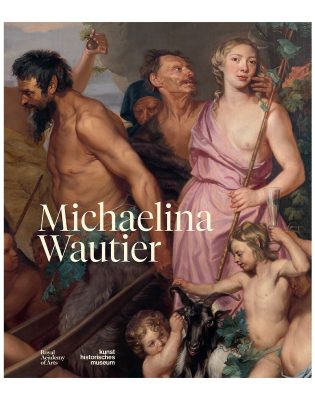
Michaelina Wautier, Malerin presented some true delights for the specialist visitor familiar with the oeuvre of an artist little known before the groundbreaking Antwerp exhibition of her work in 2018. The presentation at the Kunsthistorisches Museum in Vienna complemented a wide range of holdings and museum loans with, depending on exactly how one counts, some 15 works from private collections as well as her signed The Five Senses series, rediscovered only after 2018, making this the most complete presentation of Michaelina Wautier’s (1604–1689) oeuvre to date. Its accompanying publication complements this selection with informative essays, though not with a full catalog apparatus for the works, meaning that scholars will perforce need to consult the 2018 and 2025 publications concurrently to have all basic facts in view.[1]
Beyond the rare chance to inspect and compare across the oeuvre, the show offered some notable discoveries. The artist’s widely celebrated portrait of the Jesuit missionary Martino Martini, for instance, was presented with the types of Chinese attire whose sheen and visual interest – next to the bold handling of the sitter’s features – make the picture so captivating. Indeed, the show was complimented throughout by textiles and objects – a dazzling contemporary pocket watch matching that found in Michaelina’s self-portrait, for instance – which enlivened the show and capitalized on Vienna’s courtly collections. Next to the Martini portrait, the visitor found both winter and summer robes along with winter and summer hats. For Michaelina seems to have combined them carefully for her portrait; she took the color of the winter silk but the patternless shine of the summer variant, while very clearly combining the form and fur of a winter hat with a gathered silk treatment typical of its summer counterpart. Through such splicing of seasons, the exhibition suggests, Michaelina positions Martini in a timeless in-between befitting his world-covering missionary aims and with a subtlety reflecting his status as a connoisseur of Chinese traditions. Though these matters are not addressed in the exhibition’s accompanying catalog, this new interpretation evinces a fairly robust exchange between the artist and her sitter in Brussels, one that could have afforded her not only knowledge about textiles and adornments brought with him from the East but also the time to capture their visual effects. Michaelina thus stands out against her Flemish peers, for whom it has been difficult to definitively pin down this kind of encounter.[2] The visual evidence used to secure this point is a remarkable reminder of the importance of pressing on this artist’s pictures to yield history, given how little can be said with certainty about her life and career.
Be that as it may, the show and catalog also traced important archival discoveries. Gerlinde Gruber’s sleuthing made clear how Michaelina’s half-length treatments of male saints were altered and displayed in the Habsburg collections in the eighteenth century and were, at this and later points, still firmly attached to her hand and name, clearly known by artistic cognoscenti in Vienna. Most striking was seeing, in Frans Storffer’s 1730 pictorial inventory of the collection in the Stallburg palace, the St. Joachim of Michaelina directly counterposed with Rubens’s Het Pelsken. In this presentation, two women – Michaelina and Helena Fourment – step out of the long shadow cast by Rubens. Jean Bastiaensen also went on the archival hunt, revealing a number of documentary traces that help more firmly establish the standing of the Wautier family in Mons and Ham-sur-Heure, Michaelina’s relationship to the court of Leopold Willhelm, and the general circumstances of her and her siblings in Brussels.[3] The show even dedicated a vitrine to the account book of the court dance master Adam-Pierre de La Grené with a 1650 entry recording the purchase of a Bacchus from “mademoiselle Wautier.” Finally, a newly discovered portrait of the court herald Jean Baptiste Maurissens by the hand of Michaelina’s brother Charles, who acted as something of a secondary focus in the show, strengthened these connections. This picture was exhibited across from a lavish blue and gold tabard matching that of the sitter.
Now, all of this may feel somewhat in the specialist weeds sitting alongside the larger narratives that were not long ago established for Michaelina. And, indeed, one of the questions with this exhibition, mounted not many years after the 2018 revelation of the artist’s varied body of work, was how it would complement or complicate that picture and present it to an audience outside Belgium. The exhibition will travel in abbreviated form to the Royal Academy of Arts in London, and there it will also have a slightly modified title, bearing only the name of the artist. In Vienna, the show exploits the German “Malerin” as a subtitle that, given the gendered nature of the language, insists on her status as not just a painter but a woman painter. This is the main thrust of the new presentation of Michaelina’s work, and it implicitly asks the questions of how Michaelina rose to prominence, what sort of audience she had for her work, and how we are to position her in relation to the many male figures, both artists and patrons, that surrounded her.
The show makes a claim for Michaelina’s ambition from the jump. An opening room centers the idea that she signed her name with the designation “invenit et fecit” on three occasions. Yet the presentation also undercuts its own aim. In the low lighting of the galleries and from the fairly substantial distance imposed by a guard rail (protecting largely unglazed paintings), it was quite literally impossible to see these signatures. In fact, I attended the exhibition on multiple occasions with a group of students who were uniformly unconvinced that such signatures existed at all. Searching and searching, it was only by using an iPhone on 2x zoom and by reaching across the barrier – setting off the alarms and drawing extra attention from the guards – to photograph these annotations, correct the color, and magnify them yet further on the screen that these students could see signatures, let alone discuss them. Beyond this, the lack of an introduction to Michaelina and her context, which would only come in the second room, made it difficult to situate the novelty of her claims to status in the first place.
The next main room positioned Michaelina in the ambit of the court of Leopold Wilhelm and in relation to her unmarried brother Charles with whom she lived and, presumably, shared a workshop. Here, Michaelina’s skill as a portraitist was on full display. Her works—particularly a bold, sympathetic handling of an older man in a buff coat, taken to be her militarily engaged brother Pierre – certainly bested those of Charles and made a good case for her skills in comparison to the court painter David Teniers II and his portrait of none other than Leopold Wilhelm himself. In general, the show seemed to be designed to position Michaelina’s work into favorable comparisons. Her striking portrait historié of an older gentleman in the guise of Jacob – a work defined by a pictorial intensity of description leveled at the sitter’s sun-stained face and creased folds around the eyes – certainly stands out next to Van Dyck’s portrait of Nicolas Lanier in which the younger man’s smooth face and studied nonchalance offered no opportunity for dramatic paint or affect. Earlier in the show, a Theodoor Van Loon felt as though it was chosen for its muddy darkness, playing up Michaelina’s use of chiaroscuro lighting effects; the work was a notable alternative to those that might have showcased Van Loon’s typically luminous, jewel-like tones and that might have also literally outshone the comparatively restrained handling of palette by the exhibition’s star. Such juxtapositions reached a climax in a final room, where Michaelina’s self-portrait could be found next to that of Rubens. This was a confident choice, indeed, but to a certain extent an unfair one: not because Michaelina’s painting falls short in contrast, but because Michaelina’s own style seems to have been forged so definitively against or away from Antwerp and its brushy impasto in favor of careful modeling achieving more plastic effects.
Asking a visitor to compare in this kind of way raises important methodological questions about what it means to stage the work of a woman artist of early modernity for contemporary audiences. The sale of Linda Nochlin’s seminal “Why Have There Been No Great Women Artists” in the gift shop room flanking the exhibition space felt ironic following a show that so clearly positioned Michaelina as one of the best and that downplayed the kind of structural limitations that Nochlin famously describes. Yet a certain triumphalism seems to have made for certain missed opportunities to push latent points or ideas further. One might have asked, for instance, if Michaelina’s mode of signing “invenit et fecit”, which the exhibition uniformly celebrated as a mark of self-confidence debunking the idea that women purely handled paint and imitated, could be placed into dialog with some of the other questions we have about her career, even some treated in the show? For example, did an insistence on both conception and execution have anything to do with workshop production in the atelier she may have run with her brother Charles? How does this signature relate to works on which the siblings are understood to have collaborated, a theme represented by several pictures in the exhibition? And how might this signature stand in relationship to print, the more common medium in which to see claims for invention and distinctions from facture, given how frequently, as seen in the show, the Wautier family designed for reproductive engraving? Indeed, Michaelina’s first known painting, a portrait of Andrea Cantelmo, is only known in the reproductive form of an engraving produced by the virtuosic practitioner Paulus Pontius.
Perhaps even more critical is the handling of a self-portrait that Michaelina is understood here to have included in her monumental Triumph of Bacchus. With only some hedging language, the exhibition asserts multiple times that the woman staring out from the right-edge of this picture must be a self-portrait by Michaelina, a point that is further emphasized in its hanging directly next to the artist’s self-portrait with palette in hand. But that juxtaposition invites visual comparison, and this comparison reveals just as many differences as similarities. Indeed, the more one looks, the less alike these two faces – of nearly totally different shapes – seem to actually be. (Though, can we imagine a woman artist baring her chest in a picture destined for a seventeenth-century court context to begin with?) But to get hung up on this factual or empirical question is perhaps to follow a mistaken path. For whether or not this figure was meant as a self-portrait, she stares out of a mythological scene, breast uncovered, to directly meet the gaze of the viewer, and this was in its own right a bold gesture for a seventeenth-century female painter. Reducing this artistic choice to a factual matter – is it, or is it not Michaelina herself – actually makes the figure less interesting that it could be and forecloses upon rather than opens up a conversation about the nuances of gendered pictorial conventions and the limits of women’s social self-fashioning in early modernity.
On a visual level, the Triumph of Bacchus was one of several master works that made the exhibition’s last room feel like the grande finale of a firework show and made Michaelina’s art still feel like a revelation. A pair of paintings of flower garlands hung between bull crania display a personal, hard-edged take on still life, unusually executed on panel, perhaps for ease of in situ installation. The Five Senses, seen alongside Michaelina’s larger body of work for the first time, was particularly inspiring, though an odd choice to invert the final two pictures from their former presentation in Boston (taste, then touch) was distracting.[4] This new hanging seems to have been chosen for a symmetrical balance of color (more fully appreciable after recent cleaning) across the five paintings instead of the traditional hierarchy of the senses; this also disrupted the formal rhyme between “sight” and “touch,” parenthetical bookends for the set, which further argues for the Boston installation.
Two of the young boys from the senses series seem to reappear as a duo in Michaelina’s Two Boys Blowing Bubbles. This picture, normally housed in the Seattle Museum of Art, took on a late change of appearance. After the catalog had been sent to press, technical analysis and X-ray revealed a skull beneath the surface; removing overpainting pushed the still life elements on the accompanying table toward a definitive memento mori. But this recalibration toward the body might be a cue for us to rethink this picture in relation to the series of the five senses in which these two figures also appear. After all, they fulfill a similar function in this picture. The young boy of Sight looks up, wondrously gauging the transparent sheen of a bubble before his eyes, while the shaggy brown-haired boy that had blown jauntily on a flute in Hearing now uses his breath to send bubbles from the end of a wooden tube. That sound is evoked by the stringed instrument lying on the table, and since one can almost smell the sulfurous tinge of the candle’s smoke, one begins to wonder if the soapy solution of the bubbles has left an acrid taste on the boy’s lips. That is, the vanitas motifs begin to stand in contrast to the enlivened senses surrounding them. This alternative reading is of course only possible if one knows and can juxtapose the senses series with the bubble blowing boys and raises the question – for an artist whose patronage is exceedingly difficult to pin down – of whether we might need to imagine these together in an influential collection, an idea undergirded by the fact that the bubble blowers is the only composition from Michaelina that we know to have been copied, and more than once.
This move to thinking in multiples is another shift implicitly signaled by the show and its corresponding publication. In 2018, it was still largely possible to think of Michaelina as an artist of one-offs, proceeding methodically through a check-list of early modern genres and producing a single, fully mature work to tick the box and move on. Yet the discovery of the five senses has built out her work in allegory; similarly, archival discoveries now indicate multiple pictures based around Bacchus. And this all suggests an artist working for a market rather than self-fashioning as a chameleon curiosity. At the same time, the show’s highlighting of not just her variety but also her incredible stylistic range – to follow on Katlijne Van der Stighelen’s important description of this diversity – does make one wonder about exactly the kind of market that was consuming her works.[5] Here, perhaps the role of Brussels, not only as a court but also as a particular artistic milieu, could have been built out. One might not even have to think past an artist like Teniers to see a kindred spirit in the sense of innovation around genre, scale, format, and painterly technique. Was Brussels not a milieu that invited this kind of personalized diversity and malleability in comparison to Antwerp’s insistence on signature style and genre specialization? Leaving the show, however, one is struck by how hard it would be to answer this question definitively and how woefully understudied Brussels remains in comparison to Antwerp. The erasures that this show then points to are multi-fold, suggesting not just the gendered biases that have structured art history but the regional ones as well. And this may be just as important a legacy of this exhibition as its continued emphasis on Michaelina as an early modern figure who can be heralded for narratives that resonate so firmly with the present.
Aaron Hyman
University of Basel
[1] Katlijne Van der Stighelen, ed., Michaelina Wautier: Triomf van een vergeten talent, 1604–1689 (Kontich: BAI, 2018).
[2] For a notably debated example, see Stephanie Schrader, ed., Looking East: Rubens’s Encounter with Asia (Los Angeles: The J. Paul Getty Museum, 2013); Thijs Weststeijn, “A new identity for Rubens’s ‘Korean man’: Portrait of the Chinese merchant Yppong,” Netherlands Yearbook for History of Art / Nederlands Kunsthistorisch Jaarboek 66 (2016): 142–69. This stands in contrast to the more robustly documented encounter with the Jesuit missionary Nicolas Trigault; see, for example, Anne-Marie Logan and Michiel C. Plomp, Peter Paul Rubens: The Drawings, exh. cat. (Vienna: Albertina; New York: The Metropolitan Museum of Art, 2005), 219–25.
[3] Jean Bastiaensen, “Eine überarbeitete Biografie von Michaelina Wautier,” in Michaelina Wautier, ed. Gerline Gruber, Katlijne Van der Stighelen, and Julien Domercq (Stuttgart: Belser, 2025), 107–22.
[4] For several discussions of this hierarchy and ordering, see Jeffrey Muller, ed., “Michaelina Wautier and The Five Senses: Innovation in 17th-Century Flemish Painting,” CNA Studies (2022): 4–105.
[5] Katlijne Van der Stighelen, “De veelzijdige hand van Michaelina: Een loopbaan zonder aanloop,” in Michaelina Wautier: Triomf van een vergeten talent, 135–53.