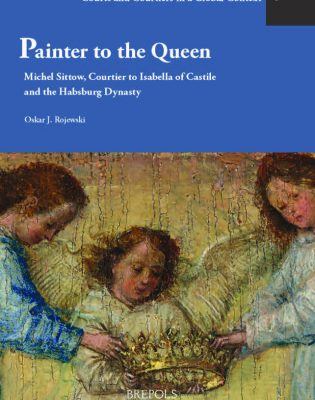
Oskar Rojewski has made an important contribution to the study of the Tallinn (Reval)-born painter Michel Sittow (1468/1469-1525), who enjoyed an extraordinary career at the courts of Renaissance Europe. His primary focus is Sittow’s time at the Castilian court, the artworks associated with this period, and the archival documentation attesting to his presence there.
Michel Sittow first acquired his artistic skills in his father’s workshop in Tallinn, followed by a probable journeyman period, which Rojewski describes as a collaboration with Hans Memling in the 1480s. While Memling and his contemporaries, such as the Master of the Legend of Saint Lucy, were producing commissions for Spanish patrons at the end of the fifteenth century, recent scholarship has suggested Sittow’s involvement in the Santiago Altarpiece of Toledo Cathedral. Rojewski deems this hypothesis unlikely, arguing that the underdrawings of works securely attributed to Sittow differ significantly from those of the altarpiece. The sources only mention Sancho de Zamora and Juan de Segovia as having made the altarpiece. He still does not exclude the possibility of his involvement altogether. Having examined the altarpiece in Toledo myself, I likewise remain doubtful. However, the current condition of the work, which has been affected by prolonged exposure to sunlight, should be taken into consideration.
In 1492, Sittow became court painter to Isabella I of Castile. According to archival records, he was among the highest-paid artists at court, receiving a salary measured in 50,000 maravedís. Through his service to the Spanish crown, he encountered Habsburg patrons, including Philip the Fair and Margaret of Austria. Later in life, he returned to Livonia to pursue a legal dispute concerning his inheritance with his stepfather, Diderick van Katwijk. Thereafter, he established a successful career in Tallinn, becoming alderman of the Guild of St Canute, which united local artisans of Baltic German origin. He died in Tallinn in 1525 and, given his position as alderman, may have been buried in St. Nicholas’s church.
Recent years have witnessed a growing interest in this exceptionally talented artist. One major contribution was the landmark exhibition Michel Sittow: Estonian Painter at the Courts of Renaissance Europe, curated by Greta Koppel and John Oliver Hand at the Art Museum of Estonia in 2018.[1] The exhibition later traveled to the National Gallery of Art in Washington. For the first time, a substantial number of works attributed to Sittow could be examined side by side. Among the highlights were The Assumption of the Virgin (Washington, DC, National Gallery of Art) and the portrait of Christian II (Copenhagen, National Gallery of Denmark), both of which are among the very few works securely attributed to the artist. An important source for reconstructing Sittow’s oeuvre has been the inventory of Margaret of Austria, which records six works by Sittow, most of which are now lost.
The exhibition generated renewed scholarly interest, prompting a closer examination of documentary evidence regarding Sittow’s presence in Tallinn. These sources have since been studied in considerable depth. New research projects have also emerged, including Michel Sittow in the North? Two Altarpieces in Dialogue, led by Merike Kurisoo at the Art Museum of Estonia, Niguliste Museum.[2] This project focused on Sittow’s years in Tallinn by placing the Passion Altarpiece (Tallinn, Art Museum of Estonia – Niguliste Museum) alongside the altarpiece of the Bollnäs church from Sweden. The Passion Altarpiece remains the only surviving artwork in Estonia attributed to Michel Sittow, as the overpainting on its outer wings has been attributed to him.
While significant progress has been made in studying Sittow’s life and work in Tallinn, Rojewski’s book centers mainly on his involvement with the Spanish court. This perspective has been taken up by art historians before, particularly in the work of scholars such as Jazeps Trizna[3] and Matthias Weniger[4]. The volume nevertheless offers a remarkably thorough analysis of archival sources, most notably the financial records of the Castilian court. Although Trizna had already published some of these documents, Rojewski compiles the present documentary corpus by presenting additional sources relating to both Sittow’s Spanish career and his relationships with Habsburg patrons.
Rojewski carefully analyses the payments made to Sittow and demonstrates that, contrary to repeated assertions in the literature, the artist did not consistently receive the oft-cited sum of 50,000 maravedís per year. While this salary was indeed comparable to that of only several courtiers, its payment appears to have been irregular. Rojewski not only publishes many of the most important documents on this issue but also analyses them in sufficient detail to enable a meaningful assessment of the financial evidence. This research is important because it sheds light not only on Sittow’s economic position relative to his contemporaries but also on his close integration into the Castilian court.
The most problematic aspect of the financial documentation, however, is that it offers relatively little information directly relevant to scholars of Early Netherlandish painting. The records contain virtually no references to the artworks on which Sittow was working and therefore contribute little to our understanding of his oeuvre. Although Rojewski identifies several artistic projects with which Sittow may have been associated, few of these connections can be substantiated with certainty. Consequently, our understanding of Sittow’s artistic production still depends largely on attribution studies and broader scholarly discussions of his work. This should not be regarded as a shortcoming of the book itself, since it reflects the nature of the surviving administrative documents.
Rojewski also addresses some of the most contested questions of attribution, offering carefully argued interpretations of his own. One such discussion concerns the portrait of an anonymous young lady (Vienna, Kunsthistorisches Museum), identified by various scholars as Mary Rose Tudor, Catherine of Aragon, or Katharina van der Lippe from Tallinn. In my view, Rojewski is justified in approaching his suggestion that the sitter may be Margaret of Austria with caution. He notes that the court portraits of Margaret by Bernard van Orley differ significantly in appearance from the Vienna portrait, making such an attribution unlikely.
At the same time, additional works could perhaps have been considered in support of this argument, including portrait busts by Conrad Meit executed in various media. Two recently identified marble busts depicting Margaret of Austria and her husband, Philibert II of Savoy (both from the Czech Republic, Frýdlant Castle), discussed in the Journal of Historians of Netherlandish Art (https://jhna.org/articles/conrat-meit-marble-busts-philibertiiofsavoy-and-margaretofaustriaportrait-busts) are particularly relevant. These works, together with the miniatures in the Sforza Hours (London, British Library), present a remarkably consistent image of Margaret. Indeed, one could argue that Margaret of Austria is readily recognizable across her portraits. It is well known that Renaissance patrons placed considerable emphasis on depicting sitters ad vivum, or from life.[5] We know, for example, that Margaret rejected Albrecht Dürer’s portrait of her father, Maximilian I, so the artist took it back. Verisimilitude was therefore a crucial factor, and court artists often established canonical likenesses that were subsequently repeated. Patrons exercised considerable control over how they and their relatives were represented. In Rojewski’s view, however, the symbolic dimension of portraiture often outweighed concerns for naturalistic appearance, particularly in the widespread practice of depicting rulers in the guise of saints. Therefore one may ask whether verisimilitude was not equally important in such cases, especially if viewers were expected to recognize a crypto-portrait of Margaret of Austria as Saint Elizabeth in the Sforza Hours.
The greatest challenge in researching Michel Sittow’s life is the disconnect between the surviving works of art and the extant documentary record. The artworks mentioned in archival documents have generally not survived, and the surviving works cannot be securely linked to specific documents. Moreover, many documents relating to Sittow’s life do not mention artworks at all. Although numerous copies and derivative works survive and may point to now-lost originals by the artist, direct evidence remains scarce.
Although Rojewski’s book is devoted to Sittow as painter to the queen, it remains difficult to identify works that can be connected to either the archival sources or his documented years in Spain. This problem becomes particularly apparent when compared to Juan de Flandes, with whom Sittow collaborated closely. Although Juan de Flandes was paid less than Sittow, his artistic activity in Spain is documented far more securely, and works produced there can be identified with considerably greater confidence. For this reason, it remains entirely justified to study the two artists together, as Matthias Weniger has done in earlier scholarship.
Despite the many challenges posed by the fragmentary survival of both documents and artworks, Oskar Rojewski succeeds in bringing together a substantial body of evidence that can now be assessed by scholars, at least outside the context of Sittow’s years in Tallinn. While Sittow’s documentary record in Livonia has likewise attracted scholarly attention, Rojewski decisively extends this research to the artist’s Spanish and Habsburg patrons. Anyone wishing to advance the field from its current state can now do so on a much firmer documentary foundation.
Kerttu Palginõmm
Institute of History and Archaeology
University of Tartu
Research Fellow of Textile History
[1] Greta Koppel, John Oliver Hand, Michel Sittow: Estonian Painter at the Courts of Renaissance Europe (Washington: National Gallery of Art, 2017).
[2] Merike Kurisoo, ed., Michel Sittow Põhjas?: altariretaablid kahekõnes = Michel Sittow in the North? : altarpieces in dialogue (Tallinn: Art Museum of Estonia, 2023).
[3] Jazeps Trizna, Michel Sittow : peintre revalais de l’école brugeoise (1468-1525-1526) (Brussels: Centre national de Recherches “Primitifs flamands”, 1976).
[4] Matthias Weniger, Sittow, Morros, Juan de Flanders : drei Maler aus dem Norden am Hof Isabellas der Katholischen (Kiel: Ludwig, 2011).
[5] Dagmar Eichberger and Lisa Beaven, “Family Members and Political Allies: The Portrait Collection of Margaret of Austria”, The Art Bulletin 77, no. 2 (Jun., 1995), pp. 225-48.