For manuscript enthusiasts, 2025 was dominated by the blockbuster exhibition displaying the calendar of the Très Riches Heures (and many related items) at the castle of Chantilly, just outside Paris. This “once in a lifetime” show has been expertly reviewed by Sherry Lindquist for HNAR here. Running parallel to this exhibition across the French border in Belgium’s Groningenmuseum was the more modest but equally fascinating (for different reasons) Pride and Solace: Medieval Books of Hours and their Readers (Trots en Troost: Middeleuuwse getijdenboeken en hun lezers). Both exhibitions offered the chance to encounter (practically) “never before seen” Books of Hours, but whereas the Très Riches Heures is a rarely seen but extremely well known luxury manuscript, the manuscripts in the Bruges exhibition were genuinely little-known gems that demonstrate the wide variety of size, decoration, and contents that can be found in these popular prayer books. Moreover, whereas the Chantilly exhibition analysed the Très Riches Heures through the lens of its high-ranking and extremely rich aristocratic owner(s), the Bruges exhibition drew attention to the many different kinds of owners and readers who were able to engage with rather more humble Books of Hours.
Popular in primarily Northern Europe largely from the thirteenth to the mid-sixteenth century, first in manuscript but then also in print, Books of Hours comprised a series of psalms and prayers to be said at the canonical hours of the day and allowed lay people to imitate the devotional practices of monks and nuns. Books of Hours were, however, much more than this, offering opportunities for self-presentation, personalised prayers, and a place to keep family records. Small and portable, they were key to private devotion and could also be passed along to other family members as gifts or legacies.
The exhibition brought together over thirty-five Books of Hours, paintings and objects from the collections of the Bruges Public Library, Bruges Museums, the Jean van Caloen Foundation, and the Government of Flanders. Some of these objects were on display for the first three months of the exhibition and were then replaced with other, equally pertinent, examples, or had their pages turned – a conservation-informed decision that also effectively created a second version of the exhibition. The display took place in just one room, the walls of which were a deep blue and covered with prayer extracts in Latin in large gothic scripts and the times of the “hours” directing the visitor around the space. The visitor was greeted with Petrus Christus’s mid fifteenth-century portrait of Isabella of Portugal, Duchess of Burgundy from the Bruges Museums. She is shown with her patron saint S. Elizabeth of Hungary, kneeling at a prie-dieu with a lavish Book of Hours open before her, demonstrating the conjunction between piety and ostentation that often characterizes late medieval Flemish devotional portraiture.
The kind of high-quality book Isabella is shown using was demonstrated by the inclusion of the Book of Hours belonging to Jacqueline of Bavaria (1401–36) and now in the Bruges Public Library (MS 321). This manuscript might have been offered to the five-year-old princess on her betrothal to John of Touraine. The page on display when I visited was the apparition of Christ to Mary Magdalene (the Noli me tangere) which for a young girl offered not only a model of a repentant woman but also a demonstration of Christ’s privileging of Mary, and by extension the female sex, by appearing to her first, before all his followers. In July, the page was changed to the Mocking of Christ, showing him being crowned with the Crown of Thorns; this image would have encouraged Jacqueline to focus on Christ’s suffering and his humility and to imitate this in her own life. Another, much smaller manuscript included for an aristocratic lady was the thirteenth-century Psalter likely made for Countess Margaret of Flanders (1202–1280) and open on the page showing the opening of Psalm 68, a large letter S, for Salvum (Bruges, Public Library, MS 820). The artist cleverly used the middle section of the letter to create a divide between the top and bottom on the image, which shows a fully clothed and haloed Christ above looking down on a naked, yet crowned, King David below, emphasizing the typological relationship between the two.
Other manuscripts on display were, however, more indicative of life and piety lower down the social scale. For example, a pocket-sized Book of Hours possibly made in Cambrai in the 1470-80s shows the owner – who has removed his hat in reverence – kneeling before a prie-dieu and an open book, before an image of the Virgin and Child (Bruges, Public Library, Collection Jean van Caloen Foundation, MS 15). The diminutive and relatively simple nature of this Book of Hours demonstrates that prompts for prayer and devotion need not necessarily be ostentatious. A similarly tiny and cheaply-produced “pocket Virgin and Child” made of silver-plated tin-lead alloy fleshes out this idea further. Excavated from the Bruges Garenmarkt, this fourteenth-century object (Bruges, Raakvlak, Collection Beuckels/1/1/A/345) would have served a protective or talismanic purpose that the exhibition curators suggest was shared with Books of Hours. Certainly, many Books of Hours were inscribed with charms or additional prayers intended to offer the reader specific protection. One such example is the Book of Hours from Northern France in which St. Fiacre is invoked for protection “against tumours and cancers ‘which doctors cannot cure’” (Bruges, Public Library, MS 328).
One of the most fascinating objects included in the exhibition relates to the practical experience – and needs – of readers engaging with Books of Hours: a volume with a cut-out shape for a pair of glasses on the back binding. The book’s owner, Loys van Boghem (1470–1540) – architect of the monastery church at Brou, built for Margaret of Austria – lived to the relatively ripe old age of 70 and thus his glasses would have been a precious means to keep reading his Book of Hours. If he lived long enough, the owner of the miniscule manuscript noted above might well have appreciated a pair of spectacles to read his tiny book.
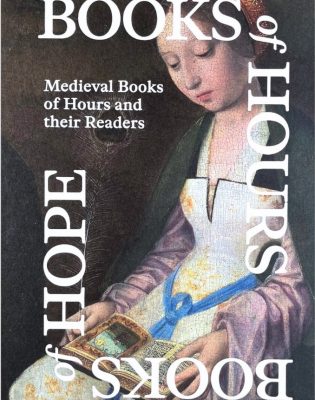
Spectacles – and images of them in paintings – are the subject of one of the chapters in the publication, Books of Hours, Books of Hope: Medieval Books Hours and their Readers. This accessible and richly illustrated publication is not a traditional catalogue but rather a stand-alone book, although many of the examples discussed and themes addressed could be found in the exhibition. Other topics covered include the origins, usage, and contents of Hours, the making of Books of Hours in Bruges in the fifteenth century, traces of owners and readers, schooling and literacy, depictions of devotional books in art, drolleries in the margins, the many means of creating light in the middle ages, and “living the hours” written by Brother John Glasenapp OSB, who considers the texts and images in Books of Hours and how they might have been understood within the context of prayer and liturgy. Hanno Wijsman and curator Evelien Hauwert’s essay on traces of owners focuses on three areas: liturgical use, explicit evidence relating to ownership, and signs of use. In addition to explaining the variations in liturgical use, they also discuss regional saints, word choice, and grammar, which might help to localise the book and perhaps give an indication of the owner’s gender. Coats of arms and portraits integrated into a Book of Hours when it was made, and handwritten notes or images added later, provide other ways of accessing past owners. As the authors note, however, Books of Hours were continually modified and “often present complex yet captivating puzzles, offering valuable insights into devotion, family life, emotions and their evolution over time” (p. 65).
Nicholas Herman’s essay on the representation of devotional books in works of art does not seek to compare those representations with actual books but rather to explore “how such painted (and a carved) books are shown in use” (p. 83). He draws attention to some of the implausibilities in certain depictions, such as Hans Memling’s painting of St. John writing in a large, already-bound tome, which contradicts actual practice, since writing would have bene done on loose sheets of parchment (fig. 56; Triptych of John the Baptist and John the Evangelist, 1479, Bruges Museums). In a miniature by the Master of the Embroidered Foliage, the infant Christ is shown “ruffl[ing] the pages of a rubricated prayer book” (p. 89). While this gesture highlights childish behavior on the one hand, on the other it also points to Christ’s awareness of his fate as he “skips ahead or flips back within the text, pointing either to the prophecies or to their fulfilment” (p. 89). In painted and sculptural representations of St. Anne teaching the Virgin to read, books function “both symbolically and as an intergenerational link, and behaviourally as a reflection of contemporary practice” (p. 96), picking up on the well-established scholarly interest in lay women’s use of Books of Hours as teaching tools for their children.
For those well initiated in Books of Hours, these and other essays cover well-known approaches regarding self-fashioning, gender and meditative devotion. For the curious reader, the essays are accessible but not overly simplistic, illustrations are well-captioned and closely tied to the texts; there are also useful footnotes and a comprehensive bibliography for following up on topics. The publication would also make a very useful introduction for students coming to Books of Hours – and devotional art more generally – for the first time.
Elizabeth L’Estrange
University of Birmingham