In the last 25 years or so, at least four major exhibitions have focused on Rembrandt’s early career. Each of these built upon the collection of the host institution(s), and each took a different approach to the radical shifts in Rembrandt’s work from the mid-1620s, late 1620s, and early 1630s.[1] Additionally, several exhibitions highlighted Rembrandt in the early 1630s in the context of Amsterdam portraiture and the art market.[2] Among these six publications, involving the most expert authors, there is understandably some overlap. It is gratifying to know that the early Rembrandt industry is thriving, and, although it can be a bit repetitive to read these six works, it is exciting to see evolving interpretations and new technical studies. The present catalogue consists of thirty-eight paintings, supplemented by illustrated comparisons.
How Rembrandt established his own approach, in relationship to and independent from his master Pieter Lastman, is a leitmotif in these and other studies. In several of his earliest paintings, Rembrandt revised his master’s histories for greater effect, and long after, he continued to regard Lastman’s compositions for his own use and workshop instruction. The present catalogue focuses on the year 1632, to demonstrate how Rembrandt turned away from his teacher’s direction, and how he maneuvered his acquaintances and finances to become a major player in the Amsterdam art world. As soon as he began to spend time in Amsterdam in 1631 and settled there a year later, the young artist asserted himself as a portraitist of the broad and wealthy middle class (60).
In the introduction, Justus Lange and Timo Trümper examine paintings by Rembrandt during the three years related to his relocation to Amsterdam: 1631: fourteen works are known; 1632: thirty-two; and, in1633, twenty-six. Quantifying is an approximate science, but it offers a helpful perspective by which to assess Rembrandt’s predominant production of portraits in these years. In Leiden, he painted mostly histories, generally on panel, along with portraits on panel and rarely on copper. In Amsterdam, he painted few histories, and larger works on canvas, while continuing to use panel for smaller pieces. The prevalence of several versions of the same painting, here, mainly self-portraits and head studies, raises questions of authenticity, connoisseurship, and technical examinations. These are often difficult to resolve, as the authors admit.
Sebastian Dohe, “Connoisseurship Through Mastery: Rembrandt and Attribution Practice as a Challenge,” provides an overview of the fluctuating oeuvre of Rembrandt in the twentieth century. The pitfalls and difficulties of making absolute judgments for authenticity had been investigated by the Rembrandt Research Project, established in 1968, disbanded in 1993, and continued by Ernst van de Wetering until 2015. Here, several cases of disagreement among scholars in the RRP and curators in museums are treated diplomatically. One example is the couple in the Metropolitan Museum of Art of 1632, identified by the museum as members of the Beresteyn family (29-30), but considered by Norbert Middelkoop to portray Thomas Brouart and Johanna van Clootwijck of The Hague (103). He outlines reasons for this identification in Rembrandt in Amsterdam (as in note 2; 146-147). This is a case in which the man’s portrait is considered by Rembrandt and the woman’s portrait by Rembrandt and workshop, so a more detailed explanation would be welcome. A larger issue to consider is the variability in paint handling within the studio, where assistants contributed to many portraits during these years.
In his essay, “Rembrandt and Portraiture in Amsterdam 1625-1635,” Norbert Middelkoop places Rembrandt in the context of his competition in Amsterdam and The Hague. The foremost portraitists in Amsterdam at this time were Cornelis van der Voort, Nicolaes Pickenoy, and Thomas de Keyser, but Rembrandt soon surpassed them with the liveliness and intensity of his art. Rembrandt probably aspired to compete with Michiel van Mierevelt, Jan Antonisz van Ravesteyn and Gerard van Honthorst in The Hague as well, as he painted portraits of Amalia van Solms, Maurits Huygens, Jacques de Gheyn III, and possibly Thomas Brouart and his wife (Rembrandt in Amsterdam, as in note 2, 139). Moreover, Constantiijn Huygens actively promoted Rembrandt and Jan Lievens to Frederik Hendrik who owned their paintings. Succinctly, Middelkoop states that Rembrandt applied the rules of history painting to portraiture in the 1632 Anatomy Lesson of Nicolaes Tulp (87). Other portraits share this approach, such as the Shipbuilder and his Wife (1633; London, Royal Collection Trust). Quentin Buvelot examines the Tulp Anatomy in terms of the x-rays of the canvas and its alterations, and the location of the original dissection (with spectators) in the renovated Weigh House. By demonstrating the workings of the hand, Tulp followed Andrea Vesalius’s famous anatomy book, in which the hand is considered the most important instrument of the surgeon (121).
Two additional essays present excursions into the flourishing economy and culture of Amsterdam, with an emphasis on Rembrandt’s neighborhoods of Vlooienburg and Breestraat. In “Europe’s Refuge and Treasury: Amsterdam 1632,” Maarten Hell discusses the city’s growing population, seafaring enterprise, political developments, and businesses. In “With Uylenburgh in Breestraat,” Leonore van Sloten and Frans Grijzenhout animate the neighborhood where Rembrandt lived, with its many artists, Sephardic Jews, and other immigrant communities.
Justus Lange discusses Rembrandt’s self-portraits that exist in multiple versions. Marina Hess examines the Raising of Lazarus by Lastman, Rubens, Rembrandt and Lievens. Friederike Schütt explores the tronies of young people by Lievens, Rembrandt, and workshop, including Dou’s Tronie of a Boy (c. 1630, Landesmuseum, Hannover; 196), oval portraits of women (Leiden Collection and Allentown Art Museum), and several works by Isaac de Jouderville.
Timo Trümper explores the many heads of older men and women by Lievens and Rembrandt as innovative character studies with various adornments, among them, turbans, silk scarves, gold chains, and fur cloaks. Nearly life-size and independent works, these paintings invoke old age as a marker of wisdom and contemplativeness. Numerous versions of such heads indicate their popularity. Two versions of the Bearded Old Man evince the rough and fine manners of paint application (Friedenstein Stiftung Gotha; Fogg Art Museum, Cambridge). The Gotha version has “pastose, sketch-like sections in [the] rough manner”, and the Cambridge panel “significantly more finesse and detail” (229). Recent technical examination of the Gotha panel revealed pentimenti in the clothing, and so it would be the apparent model for the Cambridge panel which evidences no such alterations; both were painted around 1631 and show the variety of studio styles. Justus Lange and Timo Trümper discuss copies in terms of their functions as exercises for pupils, and commodities and replicas to keep on hand: one example is the Old Man with a Gold Chain (Art Institute of Chicago) and its close copy (Private Collection).
Printmaking furthered Rembrandt’s reputation. Katrin Tenner demonstrates how a variety of subjects promoted his art. These range from The Persian of 1632, a caped man in a Rubensian posture (183), and the Rat-Poison Peddler of 1632, a street scene of an unpleasant but necessary activity (176).
Variability in technique also occurs in the artist’s impressive history paintings. Katja Kleinert discusses how The Abduction of Europa (Los Angeles, J. Paul Getty Museum, 1632) relates to two earlier paintings, The Abduction of Proserpina and Minerva (both Berlin, Gemäldegalerie and not in the exhibition). The latter two, presumably painted for the Stadholder collection, are meticulously executed with expensive lapis lazuli and underlying alterations. In contrast, The Abduction of Europa is more hastily and thinly painted, with ordinary ultramarine. It likewise features the carriage of the Proserpina and the crimson mantle of the Minerva. The red mantle reappears in the much larger Heroine from the Hebrew Bible (Ottawa, 1632-33). The very same round-faced blonde model recurs in these four paintings.
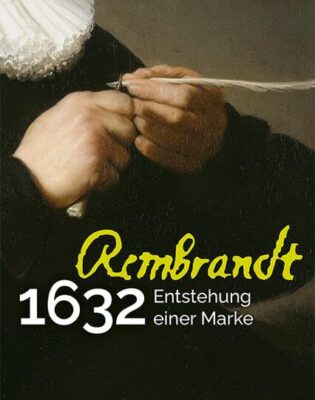
Christiane Ehrenforth, Thomas Kraemer, and Timo Trümper add observations on technical studies of the Bearded Old Man (Gotha; Cambridge, 247) and the three versions of the Self Portrait with Shaded Eyes (Kassel; Amsterdam; Tiverton). At some point, the canvas of A Man Trimming His Quill (Kassel) was folded over and its signature, close to the canvas edge, became hidden. A recent restretching of the canvas revealed the date of 1632. The painting is here temporarily reunited with its presumed pendant, Portrait of a Young Woman (1632; Vienna, Akademie der Bildenden Künste). In this presumed portrait pair, the figures are seated in postures that complement one another: the man sharpens his quill pen and the woman leans forward in her armchair. Rembrandt has subtly illuminated the surrounding space so that their three-dimensionality offers a convincing illusion. As they confront the viewer with steady gazes, they are inwardly animated and fully present, foretelling Samuel van Hoogstraten’s reaction to the Nightwatch : “…all the other pieces in the hall stand beside it like playing cards.” We may plausibly imagine that this pair would have exerted a similar effect on contemporary Amsterdam portraiture.
The catalogue is in German and English, with the texts laid out in parallel columns. This conveniently follows the current trend to make exhibition catalogues less cumbersome. The general reader is privileged, yet the specialist, who may wish for more extensive analyses, may consult the related publications (notes 1 and 2).
Amy Golahny
Boston College
Richmond Professor Emerita, Lycoming College
[1] Alan Chong and Michael Zell, eds., Rembrandt Creates Rembrandt: Art and Ambition in Leiden 1629-1631, Isabella Stewart Gardner Museum, Boston. Zwolle: Wanders, 2000; Ernst van de Wetering and Bernhard Schnackenburg, eds., The Mystery of the Young Rembrandt, Staatliche Museen Kassel/ Museum het Rembrandthuis. Amsterdam, 2001; reviewed by Paul Crenshaw in HNAR, November 2004; Christopher Brown, An Van Camp and Christiaan Vogelaar, Young Rembrandt, Museum De Lakenhal, Leiden/ Ashmolean Museum, Oxford, 2019-2020; Jacquelyn Coutré, ed., Leiden circa 1630: Rembrandt Emerges, Agnes Etherington Art Centre, Queen’s University, Kingston, 2019; reviewed by David de Witt in HNAR, September 2020. For amplification and further analyses of related issues, see Artmatters: International Journal for Technical Art History – Special Issue #2, 2025, open access on line.
[2] Friso Lammertse and Jaap van der Veen, eds., Uylenburgh & Son: Art and commerce from Rembrandt to De Lairesse, 1625-1675, Museum het Rembrandthuis, Amsterdam/ Dulwich Picture Gallery, London. Zwolle: Waanders, 2006; reviewed by Rebecca Tucker in HNAR, April 2008; Stephanie S. Dickey and Jochen Sander, eds., Rembrandt in Amsterdam: Creativity and Competition. National Gallery of Canada, Ottawa/ Städel Museum, Frankfurt. New Haven and London: Yale University Press, 2021; reviewed by Amy Golahny in HNAR, September 2021.