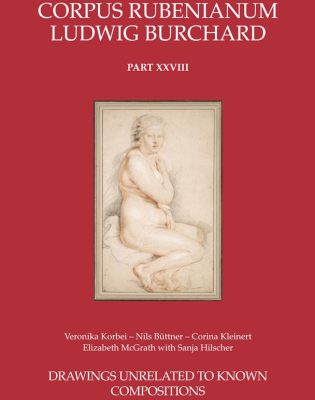
This slim volume of the Corpus Rubenianum Ludwig Burchard, which was published in late 2025, is devoted to a special isssue within Rubens’s oeuvre: thirty-nine of his drawings that could not be linked to any of the artist’s paintings, whose purpose therefore remains unclear, complemented by four drawings that have been disattributed.[1] Ludwig Burchard (1866 Mainz – 1960 London) already had created a folder for this small segment of Rubens’s drawings. He labelled it with the charming German pronoun “Allerlei” (“Miscellaneous”) – a term that has long since disappeared from modern German language. Most of the drawings that he classified as “unclassifiable” at the time remain so to this day. The volume reviewed is based on Burchard’s approach to labelling and organizing these drawings. It is inevitable that this volume’s content overlaps with that of the Catalogue raisonnée of all of Rubens’s drawings (The Drawings of Peter Paul Rubens. A Critical Catalogue), the third and final volume of which was published just recently by Anne-Marie Logan and Kristin Lohse Belkin, who place these drawings within the broader context of the artist’s entire body of work (reviewed in this journal: https://hnanews.org/hnar/reviews/the-drawings-of-peter-paul-rubens-a-critical-catalogue-vol-iii-1621-1640/).
Since the compiled drawings cannot be clearly assigned to any of the artist’s paintings, contextualization is replaced by a comprehensive introductory essay on Rubens as a draughtsman, written by Veronika Korbei. The drawings discussed by her and the other authors in the catalogue span nearly the entire course of Rubens’s artistic career. The earliest sheets were created during his stay in Italy, the latest around 1635 (cat. 39: A Battle of Horsemen and Indistinct Studies of Three Women, c. 1632–35, London, The Courtauld Gallery). We find studies of figures, heads, arms, legs and animals (cat. 19: Willem Paneels after a probably lost drawing by Rubens, Studies of a Tortoise, before 1628, Copenhagen, Statens Museum for Kunst). Most of the sheets are executed in pen and black ink as well as in black chalk, only a few are done in red chalk or in combination of different colored chalks.
What distinguishes some of the figure studies is that they seem to be used in paintings from various periods – albeit in ever-changing form. Given their multifaceted nature, certain motifs seem to consistently elude any definitive classification. Sometimes, generations of scholars have shortlisted various paintings as possible matches. One of these exceptionally versatile works is undoubtedly the Study for a Male Figure Descending; A Hovering Angel? (cat. 13, c. 161–14, London, Victoria & Albert Museum): we see a young, half-naked male figure, depicted headfirst and in a highly foreshortened perspective with masterful, dynamic energy, spinning around his own axis, extending the right arm straight down. Like a master key, this figure study – drawn in black chalk and heightened in white – fits into a wide range of pictorial contexts. Here, as in other examples, it becomes clear what Veronika Korbei describes as a challenge in tracing the migration of motifs across Rubens’s oeuvre. For precisely the opposite reasons, other drawings still cannot be associated with any painting. This applies to the drawing of a seated female nude, presumably of the artist’s second wife, Hélène Fourment (cat. 38: Study of a Seated Nude Woman, Turning to the Right, c. 1633–35, Paris, Musée du Louvre).
Carefully modeled with different colored chalks, it is a finely worked drawing. Unlike cat. 13, this study is not conceived as a figure that can be adapted to different contexts. Rather, it suggests an intimate situation between the artist and the sitter – one that can be found only in this single work of Rubens’s oeuvre of drawings. Given its high quality, it is impossible to determine whether the drawing was intended as an autonomous work of art or served as a preliminary study for a planned painting that was never realized. Its finished quality is all the more surprising given that, as Korbei reminds us, the artist tended to regard solely his paintings as autonomous works of art. In a few cases, the reviewer wondered whether the category “unclassifiable,“ which forms the basis of this volume, were truly appropriate: this applies to the red chalk drawings depicting a nude, young male figure in the pose of a famous ancient sculpture – the Roman spinario.
From the reviewer’s perspective, the Spinario drawings may originally have been created simply as figure studies – inspired by a famous ancient sculpture – without any prior intention of creating a painting based on them (cat. 2, 3: Two Variants of a Youth attending His Foot and Two Variants on the Spinario, ca. 1601–08, London, British Museum, and Dijon, Musée des Beaux-Arts). Another category of drawings has remained unclassified because they are hard to decipher. Pyrrhus Threatening Priam’s Family (cat. 15, c. 1615–16, Oslo, Nasjonalmuseet for kunst, arkitektur og design) is one of the most challenging examples. Its complexity stems from the few, quickly applied brushstrokes, which reveal little more than figures fleeing and pursuing one another. Furthermore, the legibility of the sheet is impaired by a drawing in red chalk by another artist – a small child lying on its back – over which Rubens then superimposed his own sketch. Finally, the volume also includes several drawings that the authors no longer attribute to Rubens himself, but rather either to Anthony van Dyck, to Rubens’s studio, or anonymous artists. This is the case with the elegant, double-sided pen and ink drawing A Horse and Turbaned Rider (cat. R4 recto and verso, c. 1617–21, Antwerp, The Phoebus Foundation), which was only discovered in 2016 and was at the time attributed to Rubens by Anne-Marie Logan. It is now attributed to the young Van Dyck, who during this period was still moving closely within Rubens’s orbit, both thematically and in terms of drawing style and technique.
Although, as noted above, the content of this volume overlaps with that of the Catalogue raisonnée by Anne Marie Logan and Kristin Lohse Belkin, examining this selection of drawings – removed from a broader contextual framework – particularly highlights Rubens’s masterful draftsmanship in terms of speed, precision and economy. It also illustrates his at times almost cinematic approach to developing figurative compositions (cat. 1 recto: Ten studies of Two Men Embracing, c. 1601–02, Paris, Fondation Custodia). The fact that only thirty-nine drawings cannot be linked to any of the master’s paintings attests to the artist’s tremendous efficiency.
Hans Jakob Meier
Stuttgart
[1] The title is somewhat misleading since there are many drawings of which the final composition is unknown or was never intended, such as several of the studies of Rubens’s wives and children or the late landscapes. In these cases, the drawings are discussed in the respective CRLB volumes by Hans Vlieghe (Part XIX, II) or Wolfgang Adler (Part XVIII, I).