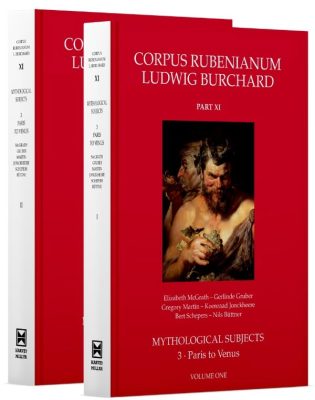
The publication of this two-volume study of Rubens’s works inspired by classical mythology is the final installment in the three-part series on this subject within the catalogue raisonné of his work, which now comprises more than forty individual books. The first part of the Corpus Rubenianum devoted to the artist’s engagement with classical mythology, published in 2016, encompassed works ranging alphabetically from “Achilles” to the “Graces”. Rather than authored by a single scholar, as had been the case with numerous earlier parts of the catalogue over the years, it was a product of a collaboration among a group of Rubens specialists: Elizabeth McGrath, Gregory Martin, Fiona Healy, Bert Schepers, Carl Van de Velde, and Karolien De Clippel.
This was followed in 2023 by the next volume in the alphabetical sequence, covering subjects from “Hercules” to “Olympus.” The authors of this publication included several scholars who had worked on the first part, such as Elizabeth McGrath, Bert Schepers, Fiona Healy, and Gregory Martin, as well as Nils Büttner, Eveliina Juntunen, and Jeremy Wood.
This third and final part of the mini-series is likewise the product of a collaborative effort. Organized into a number of subcategories taking us from “Paris” to “Venus,” it represents another remarkable achievement, bringing together a staggering amount of information concerning the provenance, exhibition history, and scholarly reception of a diverse body of works attributed to Rubens, those showing different degrees of participation of his studio assistants, or those created by followers.
Each of these subcategories is introduced by a general essay summarizing the most important aspects of the relevant group of images. The opening section on works inspired by the story of the ill-fated Judgment of Paris was written by Gregory Martin (Nos. 101–106), who also contributed entries on works related to the myth of Cupid and Psyche (Nos. 113–114).
Works featuring Venus and her loves (Nos. 130–139) comprise another major portion of the publication. Written by Gerlinde Gruber of the Kunsthistorisches Museum (KHM) in Vienna, these entries, which comprise close to hundred pages, read almost as a study in their own right.
Other major sections of the catalogue, such as the one devoted to satyr subjects, were written jointly by Koenraad Jonckheere of Ghent University and Bert Schepers of the Rubenianum. That portion of the catalogue (Nos. 115–120) extends to nearly one hundred pages as well.
Not surprisingly, the largest segment of these satyr-themed works concerns Silenus, whose profoundly ambiguous character inspired some of the most memorable and perplexing of Rubens’s mythologies. Although one might expect these images to be treated together with other works featuring satyrs, the sheer number and complexity of these works justify their distinct grouping. It is also especially fitting that the author of these entries, which extend to more than one hundred pages (255–372), is Elizabeth McGrath, known for her ability to decode complex iconography. In addition, she contributed entries on works deriving from the stories of Phaeton, Cephalus and Procris, and Proserpina.
Nils Büttner, Chairman of the Centrum Rubenianum, wrote on paintings and preparatory studies related to the myth of Prometheus, a striking allegory on Mars and Venus (Cat. 132), as well as the drawing of Vertumnus and Pomona from Berlin (Cat.140) – widely accepted these days as a work of Van Dyck but accorded an entry in this volume in a show of respect for Burchard’s attribution to Rubens. Together with McGrath and Gruber, he also contributed to the final portion of the catalogue, dedicated to rejected attributions (Nos. R1–R5).
By its very nature, this volume of the still unfinished catalogue raisonné represents a synthesis of the available knowledge – rather than a study one goes to for new interpretation of the oeuvre of one of the most prolific artists in the history of western art. Furthermore, given the stream of publications on Rubens, from scholarly articles to catalogue essays and exhibition entries, the task of bringing all of this material together in such a systematic fashion requires extraordinary dedication and attention to detail.
At the same time, we are continuously reminded of the many aspects of Rubens’s oeuvre deserving further study. Thus Gregory Martin draws our attention to the fact that even someone of Rubens’s renown might draw criticism from his contemporaries, using the example of the Judgment of Paris from the National Gallery in London (Cat. 105). He also adds a very useful appendix of excerpts from letters exchanged between two prominent art dealers concerning the sale of this painting to the 2nd Duc de Richelieu. Similarly, Nils Büttner notes the many open questions regarding such famous work as the Philadelphia Prometheus Bound (Cat. 111) – including concerning its date of completion and physical modification, or the oft-mentioned involvement of Frans Snyders as the artist who painted the eagle attacking the hero. Elizabeth McGrath offers new and more nuanced readings of the African characters in two major paintings: the Munich Drunken Silenus and His Retinue (Cat. 126) and the Venus before a Mirror, subtitled Venus of the Night from the Liechtenstein Collections in Vienna (Cat. 131). In a similar vein, Gerlinde Gruber makes us aware of the ways in which even a single line inscribed on a drawing such as that of Venus Lamenting Adonis from the National Gallery of Art in Washington (Cat. 137b) can carry the memory of multiple literary sources, in much the same way as a formal motif that takes us both to an ancient sarcophagus and a painting by Titian.
Although each contributor necessarily brings an individual perspective to this project, the volume displays remarkable consistency in both methodology and argumentation. These scholars are also to be commended for their attentiveness to Rubens’s visual language. In addition to careful description of the works under consideration, they invariably point to many unresolved issues, be it regarding dates of paintings, the circumstances of their creation, their physical modifications, and the degree to which they can be attributed to the master himself, his assistants, or followers. Equally notable is their scrupulous and respectful engagement with earlier scholarship: even when reaching different conclusions, they present prior opinions in a measured and non-judgmental manner.
Like the other publications in this ongoing project, this two-volume study is a gold mine of information for any Rubens scholar, especially those interested in the most fundamental questions surrounding his oeuvre: the authorship and iconography of his works, as well as the way in which his pictorial practice was shaped by his deep engagement with the visual tradition extending back to antiquity.
Given the current global turn among early modern art historians and the emphasis on new methodological approaches, be it forms of postcolonial discourse or ecocriticism, such questions may appear less relevant today than they did at the time of the earliest volumes of the Corpus Rubenianum. Yet no serious work on Rubens (even one that might focus on aspects of material culture such as the dress fashions of his time), can be undertaken without consideration of the various facets of the making of his paintings: whether those fully executed by himself, produced in collaboration with other artists, by workshop members, or followers. Nor can one come close to understanding his endless assimilation and interpolation of “ancient” and “modern” models without comprehensive studies such as this one, which by bringing together so many versions of his works allows for fresh insights into his creative process.
Aneta Georgievska-Shine
University of Maryland, College Park