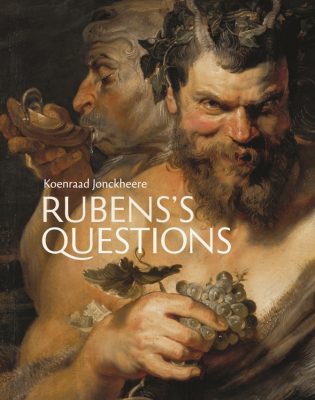
Rubens’s Questions: Religion, Paragone, and the Ontology of Painting, is arguably one of the most intellectually engaging contributions to the literature on the artist published in recent years. Though its title may seem too ambitious, each of the words is used with a very specific meaning in mind. The term questions (Latin quaestiones) refers to the notion of inquiry (Latin quaestio, Dutch questie) into the meaning of a concept or a proposition at the heart of an argument. This form of questioning a thesis, as Jonckheere shows, was ubiquitous in the humanist discourse, including in the Low Countries. Taking his own study as a questie, Jonckheere proposes that Rubens and his contemporaries applied similar principles of inquiry to create paintings whose “visual questioning syntax” could accommodate a multiplicity of meanings – sometimes even seemingly contradictory ones. As he also suggests, given the currency of this “open-ended mechanism of thinking” in humanist pedagogy means that any interpretation should consider how pictorial arguments responded to audience expectations – rather than focusing solely on the artist’s intent (p. 23).
Similarly, the term paragone in this study is used to describe an issue central to the religious debates of Rubens’s time: the dichotomy between graven or sculpted images (ghesneden beelt or sculptile) whose idol-like status made them an obvious target of iconoclasts, versus painted ones that can only be beheld (eenighe ghelyckenisse or similitudines), thus presenting a more complex issue for Protestants and Catholics alike. What he investigates in particular is how the debates around these different categories of images led over time to a more “nuanced analysis of the ontology of painting, sculpture, and other visual media” (p. 21).
Furthermore, while Jonckheere recognizes the importance of Rubens’s lifelong engagement with both the visual and literary legacy of antiquity, as well as the Italian Renaissance, his goal is to situate him more closely within the Netherlandish context – and discourse shaped by heated debates over devotional images. As a result, his study incorporates a wealth of sources seldom discussed in the literature on this proverbially cosmopolitan artist, with focus on religious and political tracts by authors from both sides of the religious divide. However, as he also maintains, even in this polarized environment, Rubens used his ingenium and pictorial skill not so much to push a particular ideological position, but to question assumptions about the nature and role of pictorial representation – creating paintings that could be acceptable to audiences with dramatically different views on an issue.
Each chapter is structured around a specific topic examined through close readings of works created during the decade following Rubens’s returns to Antwerp from Italy in 1608, a period characterized by particularly active debate on the uses and abuses of religious images. He begins with a discussion of one of the most monumental accomplishments of the artist from this crucial point in his career, the 1609 Adoration of the Magi. Created for the Town Hall of Antwerp in the year of the Twelve-Year Truce, this painting was taken to Spain shortly thereafter, where the artist had an opportunity to see it again during his diplomatic mission of 1628-9, and modify it by including additional elements, most notably his self-portrait.
In addition to new observations about the formal and iconographic aspects of Rubens’s re-staging of this episode from the life of Christ, Jonckheere considers this painting as an allegory addressing crucial tenets of Christianity: specifically, how this “adoration” would have been received by audiences holding opposing views in debates on the veneration of religious images. In this process, he draws our attention to a wide range of contemporary publications, from polemical texts by Calvinists for whom the richly decorated robes of the Magi would signal everything they abhor about Papist luxury, to those of Catholic apologists, for whom material splendor is itself an instrument for spiritual instruction.
Chapter two contains an excellent overview of the role of quaestio (questie) in argumentation – from its origins in the Socratic dialogue, to its changing uses throughout the Middle Ages and its particular currency in the intellectual discourse of the Renaissance. Jonckheere also reminds his readers that as the scholastic emphasis on dialectic gave way to a premium on rhetoric, the goals of argumentation changed fundamentally. Rather than pursuing an objective theological or philosophical truth, humanists focused on expanding ways of seeing and interpreting phenomena, where the ultimate conclusion depends on one’s judgment.
The next chapter expands upon this point by a closer examination of the “strategies” used by Rubens and his contemporaries to structure the “visual quaestio syntax” of their compositions (p. 59). Taking a little-known double portrait of Seneca and Nero by Rubens as an example, Jonckheere proposes that the artist consciously subverted iconographic conventions in order to turn this composition into a visual quaestio on the nature of true nobility. He also points out earlier Netherlandish examples of juxtapositions of figures based on perceived similarities or contrasts, especially among artists working during the religious turmoil of the later sixteenth century.
More importantly still, he relates this practice to the early modern uses of ontological trees as means of analyzing and mapping out reality: where every concept is treated as a quaestio broken down into smaller sub-concepts (branches) that illuminate various components of its meaning. This parsing, as he also points out, is not necessarily aiming to lead to a firm conclusion, but to generate further questions and answers that can enrich the thought process itself. The result is comparable to the rhetorical copia codified by classical authorities like Quintilian and prized by the likes of Erasmus for its capacity to amplify the semantic content of literary and pictorial compositions alike.
Jonckheere’s interest in various strands of the intellectual discourse of the period is amply on view throughout this study. In Chapter four, he relates the formal and iconographic features of several of Rubens’s paintings to the syncretistic approaches of contemporary writers, who could seamlessly blend “biblical, Greco-Roman, and occult knowledge” in developing their arguments (p. 100). Though Rubens’s own tendencies towards syncretistic thinking have become more readily recognized in recent years, this chapter is a welcome reminder of the prevalence of this mode of thinking within intellectual circles of the Republic of Letters.
Chapter five features a new reading of the famous allegories on the senses created through a collaboration between Rubens and Jan Brueghel. Building upon earlier interpretations, Jonckheere proposes that these compositions can be understood as tightly structured quaestiones as well. His analysis of their visual syntax goes beyond the commonly identified dichotomies of sight and insight, or the material and the spiritual, to emphasize what he sees as the ontological distinctions between categories of images. Here too, he draws on numerous period sources, ranging from works of Reformed thinkers such as Petrus Bloccius (1530-1585) and Willem Teelinck (1579-1629), to those of their Catholic opponents such as the influential Jesuit writer, Johannes David (1545-1613).
The ontology of images is also the focus of the next chapter, where the author takes a closer look at Rubens’s free-form interpretation of Titian’s canonical image of Venus at the mirror (c. 1555, NGA, Washington). Here he offers an excellent overview on the changing perspectives on image categories and their associated terms, from the Greek eidos, eikôn, and eidôlon, to the Latin prototipus, exemplaer, similitude, and simulacro. As he points out in the following section as well, those ontological distinctions became even more complex in the second half of the sixteenth century as the influx of classical sources opened the “floodgates of allegory.” Though Rubens’s own embrace of allegory for hermeneutic purposes is well rehearsed in the literature, Jonckheere emphasizes how this mode of thinking expands the semantic field of his pictorial inventions, often across “seemingly unrelated paradigms or epistemes” (p. 192).
Chapter eight turns to the question of the use of images or the context in which they are beheld. Here, his main example is The Tribute Money (c. 1609), a composition whose popularity was attested by numerous painted copies and reproductive engravings. As Jonckheere demonstrates by citing both Protestant and Catholic sources, this theme was frequently invoked in discussions of civil versus religious functions of images. However, as he also notes, Rubens deliberately structured his painting not so much as an argument advocating a specific position, but as a catalyst for conversation regarding those ongoing controversies.
The final chapter extends this reading to the famous altarpiece, commissioned by Nicholas Rockox, where the scene of the doubting Thomas is flanked by side panels featuring half-length portraits of the patron and his wife. Much like the narrative of the Tribute Money, this episode of testing the faith was used in widely different ways by Catholic and Protestant writers. And just as in his earlier analyses, Jonckheere focuses on the ambiguity in this work as an essential aspect of its role as a questie capable of generating an array of different responses concerning the relationship between seeing and believing, or the role of religious art in general (p. 228). In this context, the author proposes that the absence of a visible wound in the side of Christ’s body, which has generated numerous different interpretations, is the crucial element of this inquiry regarding the role of physical sight and touch, and that it echoes contemporary Catholic sermons that explain Thomas’s unbelief through the difference between corporeal and spiritual vision.
In his coda, Jonckheere restates the key premise of his study: that the most sophisticated thinkers of Rubens’s generation responded to the pervasive uncertainties of the period by examining every assumption, be it the nature of art or its function for devotional purposes.
Jonckheere’s study accords with other explorations of the broader epistemic crisis at the turn of the seventeenth century by both historians of ideas and of the arts. His most important contribution to this topic comes from his consideration of so many period writings from the Low Countries representing both sides of the religious divide, a much-needed expansion of the classical and early modern literature typically included in discussions of Rubens’s oeuvre.
Nonetheless, this focus on the religious polemics within the artist’s milieu can sometimes lead to overdetermined conclusions. Take the example of The Adoration of the Magi, presumably installed in the States Room of the Town Hall of Antwerp, where the peace treaty was signed in 1609. We simply do not know whether the Dutch delegates who attended the signing of this treaty saw this painting and were “left speechless” by its emphatically Catholic approach to the theme (p. 25). Later in this chapter – filled with intriguing observations – the author reiterates the same point, adding that for those Dutch delegates, this painting would have been “a bomb of emotional and cognitive considerations and associations,” intended to provoke a consideration of the crucial distinction between devotion and idolatry (p. 46). Whatever the validity of this assertion, the author’s emphasis on this potential reception of the work by Protestant viewers risks drawing attention away from its primary audience, both at the Town Hall of Antwerp and, later, at the court of the most intensely Catholic European monarch.
In line with his overriding assumption that Rubens’s paintings, especially those created during the decade following his return from Italy, are to be understood as questies intended to encourage intellectual flexibility and pragmatism, Jonckheere leaves most of his own readings open-ended as well. Given his fine analytical skills, however, his tendency to suggest possible meanings without a sufficient follow-through can sometimes be frustrating. For example, while he convincingly shows that Reformist writers invoked the idea of adultery to speak of idolatry, that in itself does not mean that Rubens created a painting such as the Brussels Christ and the Woman Taken in Adultery primarily as an apologia for the use of religious images.
Similarly, though one can appreciate the author’s link between Diana and Her Nymphs Departing for the Hunt (c. 1615; Cleveland) and emblematic representations of this goddess as Dialectica, where the quaestio is pictured as the bow that propels the arrow of the argument, this observation could have become more persuasive by a closer look at the mixed messages exemplified by the actions of the satyrs and nymphs surrounding the main character.
Nonetheless, Jonckheere is to be commended for his ambitious goal: to bring us deeper into Rubens’s immediate social and cultural milieu. His emphasis on the rhetorical and pedagogical conventions of the period, and his use of so many contemporary writings that have received remarkably little attention to date, constitute an important contribution to the literature on the artist. One can only wish for a comparable level of engagement with the history of ideas among more art historians working on Netherlandish art.
Indeed, as Jonckheere acknowledges in the preface, even if his approach may “falter” at times, what he hopes for is that the questions he has raised will stimulate readers to keep asking other questions – in the spirit of the humanist debate.
Aneta Georgievska-Shine
University of Maryland, College Park