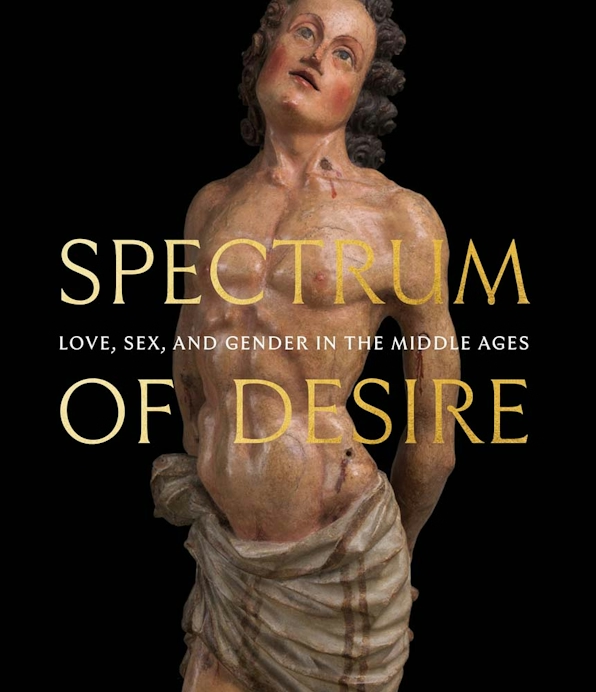
Spectrum of Desire: Love, Sex, and Gender in the Middle Ages, edited by Melanie Holcomb and Nancy Thebaut, was designed to accompany an exhibition of the same title at The Cloisters in New York. Rather than serving as a traditional catalogue with entries for each artwork, this richly illustrated, well-written volume consists of four essays and five short analyses of a single object. The works that are discussed were produced in western Europe from the fourteenth through sixteenth centuries. Most were drawn from The Metropolitan Museum of Art, but some belong to other collections, mainly from the Northeast. They include a wide range of fascinating objects: panel paintings, illuminations, drawings, sculpture, leather and ivory boxes, writing tablets, a purse, a goblet, a belt, and even a saddle. The essays address the meaning and reception of these objects, sometimes invoking a text to shed light on an artwork, but more often exploring its materiality, relying not only on the sense of sight, the traditional focus of art history, but also on the sense of touch.[1] The visual and tactile analyses of these works are often quite brilliant.[2] But the issue that lies at the heart of this volume is queer theory.
In the opening chapter, “A Queer Middle Ages,” the editors define queer theory as “the capacity to operate against the presumption of modern heterosexuality,” and instead embrace an expansive understanding of sexuality and gender that includes “ways of being that do not neatly fit into predetermined categories, either medieval or modern” (p. 20). For Holcomb and Thebaut, the word “queer” is synonymous with non-normative. Their volume focuses on works of art that collapse such binaries as “secular/devotional, male/female, friend/lover, or marital/mystical” (p. 23). To do this, the first essay explores a range of objects and issues, including the resemblance between Christ’s side wound and a vulva, a badge showing phalluses carrying a vulva, and the ecstasy of St. Catherine of Siena as she becomes one with Christ.
The second essay, “Bodies in Flux” by Thebaut, explores the mutability of bodies in art produced north of the Alps. The author discusses gender performance in a Rhenish tapestry of Solomon and Sheba; an illumination of the Ethiopian eunuch Simeon Bachos; an ivory plaque of the Fountain of Youth, which causes the old to become young again; and gender fluidity in images of St. Wilgefortis, who grew a beard to avoid suitors, and St. Marinos, who, although assigned female at birth, lived life as a monk.
“Medieval Erotica” by Holcomb, the volume’s third essay, examines medieval belts, boxes, combs, writing tablets, and an aquamanile. Through a close reading of a box adorned with the Prodigal Son, she notes with surprise that the moralistic ending was never included. She also subtly and effectively discusses how engaging medieval objects through the viewer’s multiple senses must have produced erotic feelings.
The final essay, by both editors, explores marital and mystical unions. First, it discusses how images influenced expectations of marriage, especially the roles that husband and wife should perform. Then it examines images of coitus (which generally avoid explicitness) before concluding with images of mystical marriages. Much of the discussion concerns images of same-sex intimacy, especially between Christ and St. John.
Four short “object encounters” follow. Karl Whittington investigates ways in which the sense of touch was critical to how artists and viewers perceived an object, in this case a late-fifteenth century polychromed sculpture of St. Sebastian. In an idea he develops further in his recent book Queer Making, he concludes here that the “artist’s touch on Sebastian’s body, through gestures both gentle and violent, are another site where desire could have erupted” (p. 106).[3] Emma Pouésard’s “Flirtation, Violence, and Domination on an Ivory Casket,” explores a small carved fourteenth-century French box used to store small, intimate possessions. Besides discussing the queer aspect of its sexual themes, Pouésard also analyzes the role played by the whiteness and sensuousness of the ivory from which it is carved. Bryan Keene’s “Queer Connections with Christ’s Body,” discusses Michele Giambono’s Man of Sorrows, which includes in the middle ground a small figure of St. Francis, his hands clasped in prayer. Keene posits the seductiveness and sensuality of this work, noting that St. Bernardino condemned an individual who masturbated before an image of the crucified Christ. Next, Clovis Maillet discusses a miniature of the crossdressing St. Jerome in the Belles Heures, which he justly terms a “queer moment” (p. 117). Finally, Scott Miller explores a painting of a couple in terms of the restraint exercised by courtly lovers. He contrasts that to the lack of control that the elite believed was characteristic of those lower down on the socio-economic scale. Miller relates the panel’s reverse, a memento mori that shows the same couple as aged, to the idea that older women were believed to retain their sex drive, whereas aged men were believed to lose it.
It may be difficult for today’s scholars to imagine how challenging it was decades ago to adopt a feminist or gay studies approach to the history of sexuality. As recently as the 1990s, some lost their academic positions for doing so.[4] By contrast, Spectrum of Desire explores all sorts of sexualities and genders in a fearless manner. In fact, one of my few quibbles with the volume is why the word “queer” is not part of the title of the book since it plays such a major role in it. I also remain unconvinced that in a German sculpture, dated 1300-1320, Christ and St. John “mimic the standard pose of marriage with the joining of right hands and Christ’s protective reach around John’s shoulder” (p. 99). Indeed, medieval viewers may well have associated the pair with mystical marriage; Carolyn Diskant Muir has amassed medieval texts that describe the relationship between Christ and St. John in this way.[5] But their pose in the German sculpture is not the “standard pose of marriage,” which as a rule shows standing figures. Should we conclude that putting an arm around another figure implies a “queer bond” (p. 99)? In 1997, Pamela Sheingorn demonstrated that such embraces had a range of meanings and cautioned against viewing the embrace through contemporary culture, which so often interprets such gestures as erotic.[6]
Numerous art historians have explored love, sex, and gender in the Middle Ages. Over the last fifty years scholars have been deeply affected by successive waves of feminist, gay, and queer studies.[7] Although a new approach can build on a previous one, it can also conflict with it. In 1992, Simon Gaunt cautioned that “a successful alliance between the two [feminism and gay studies] must be the result of careful negotiation and involve a critical awareness of where the interests of women and gay men (in particular) have converged and diverged in the past, as well as where they may diverge in the future.”[8] An example of one such divergence may be seen in interpretations of rape scenes.[9] In 1976 Ilene Forsyth contended that violence and terror characterized a twelfth-century capital at Vézelay of the rape of Ganymede, which she argued served as a warning against monks who sexually abused oblate boys.[10] By contrast, four years later the gay studies specialist James Boswell referred to the capital as an abduction rather than a rape, and downplayed the suggestion that the capital referred to contemporary abuse of boys.[11]
Similarly, if most early feminist scholars, working in a male-dominated, sexist field, viewed gender primarily in binary terms and sex as essentially heterosexual, today, by contrast, queer theorists focus on the non-normative. An example of the first approach is H. Diane Russell’s groundbreaking exhibition catalogue Eva/Ave: Woman in Renaissance and Baroque Prints, which was published more than thirty years ago, and, as its title suggests, organized images of women around two polar opposites: saintly women who passively and piously resisted sexual contact and lustful women who were powerful agents who lured men to commit sin.[12] By contrast, the goal of The Cloisters exhibition was instead to present a spectrum of sexualities, including, among others, virginity, sex within marriage, erotic religiosity, same-sex desire, and courtly love.
Ralph Waldo Emerson noted, “for everything you gain, you lose something.”[13] What has been lost in the emphasis on non-normative gender, desire, and sexuality? In Russell’s catalogue, an entire section is devoted to the Power of Women topos.[14] Her discussion, which focuses on women, notes that in these stories, “women tempt the men with their sexual attractiveness in order to triumph over them” and that most images in the exhibition “demonstrate men’s vision of women’s power”[15] Russell further links prints of the Power of Women to images of witches (p. 147). This approach is radically different from that of Holcomb, who describes an acquamanile of Phyllis riding Aristotle as “drawing laughs” and “demonstrating either the dangers or the triumph of love” (p. 67). What is lost is any sense that the Power of Women theme was sexist, that it denigrated women, or that it imagined women, who in reality had less power than men, as possessing enormous power through their sexuality, which they used to harm men. While queer theory should be lauded for dismantling rigid gender and sexual binaries, it is sometimes criticized for its erasure of both gender binaries and a range of specific identities.[16]
But, to return to Emerson’s thesis, this volume makes clear what is gained through queer theory. Spectrum of Desire successfully argues that medieval Europeans were just as complex in the way they expressed love, gender, and desire as people today. This is important to state not simply because it is a historic truth, but also because some elements in today’s society believe in a mythical past when all women were submissive, gender was always expressed in a normative fashion, and sexual acts and desires never strayed from heteronormativity. Spectrum of Desire effectively dismantles these deceptive suppositions.
Diane Wolfthal
Rice University, emerita
[1] Kathryn M. Rudy pioneered this approach. See especially her Touching Parchment: How Medieval Users Rubbed, Handled, and Kissed Their Manuscripts. Vol. 1: Officials and Their Books (Cambridge, UK: Open Book Publishers, 2023).
[2] See, among others, the discussion of three statues: Joachim and Anna, a Madonna, and especially a St. Sebastian (figs. 26, 36, and 45).
[3] Karl Whittingham, Queer Making: On Artists and Desire in Medieval Europe (University Park, PA: The Pennsylvania State University Press, 2025).
[4] To cite two examples, Kathryn Gravdal and I were fired from Columbia University, which had recently become coed, for researching books on rape. See Kathryn Gravdal, Ravishing Maidens: Writing Rape in Medieval French Literature and Law (Philadelphia: University of Pennsylvania Press, 1991) and Diane Wolfthal, Images of Rape: The “Heroic” Tradition and its Alternatives (Cambridge: Cambridge University Press, 1999).
[5] Carolyn Diskant Muir, Saintly Brides and Bridegrooms: The Mystic Marriage in Northern Renaissance Art (London: Harvey Miller; Turnhout: Brepols, 2012). 67-90.
[6] Pamela Sheingorn, “The Bodily Embrace or Embracing the Body: Gesture and Gender in Late Medieval Culture,” in The Stage as Mirror: Civil Theatre in Late Medieval Europe, ed. Alan E. Knight (Woodbridge and Rochester: D. S. Brewer, 1997), 51-89.
[7] The authors readily acknowledge past queer publications. Some very recent queer publications include Whittington, Queer Making (2025) and a forthcoming collection of essays edited by Gerald B. Guest and Maeve K. Doyle.
[8] Simon Gaunt, “Gay Studies and Feminism: A Medievalist’s Perspective,” Medieval Feminist Newsletter 13 (Spring 1992):6.
[9] Diane Wolfthal, “An Art Historical Response to “Gay Studies and Feminism: A Medievalist’s Perspective,” Medieval Feminist Newsletter 14 (Fall 1992): 16-18.
[10] Ilene Forsythe, “The Ganymede Capital at Vézelay,” Gesta 15 (1976): 241-246.
[11] James Boswell, Christianity, Social Tolerance, and Homosexuality: Gay People in Western Europe from the Beginning of the Christian Era to the Fourteenth Century (Chicago/London, 1900), figs. 7-13, 143 n. 27, 251-52.
[12] H. Diane Russell with Bernadine Barnes, Eva/Ave: Woman in Renaissance and Baroque Prints (Washington: National Gallery of Art and New York: The Feminist Press, 1990).
[13] Ralph Waldo Emmerson, Emerson’s Essay on Compensation, intro. by Lewis Nathaniel Chase (Sewanee: University of Sewanee Tennessee, 1906), 5.
[14] Russell, Eva/Ave, 147-75. For the Power of Women theme, see Susan L. Smith, The Power of Women: A Topos in Medieval Art and Literature (Philadelphia: University of Pennsylvania Press, 1995).
[15] Russell, Eva/Ave, 147.
[16] See, for example, Susan Feldman, “Reclaiming Sexual Difference: What Queer Theory Can’t Tell Us About Sexuality,” Journal of Bisexuality, 9 (2009): 259–78 and Cross-purposes: Lesbians, Feminists, and the Limits of Alliance, ed. Dana Heller (Bloomington, IN: Indiana University Press, 1997). .