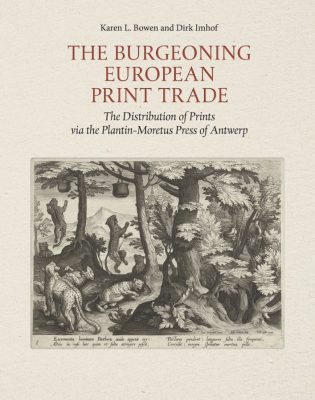
After long domination of early Netherlandish art by the study of paintings, recent decades have inspired interest in another major innovation of the era, the medium of prints. Around midcentury in both Italy and the Netherlands, professional print publication emerged, led by firms of Salamanca and Lafreri in Rome (Christopher Witcombe, Print Publishing in Sixteenth-Century Rome, 2008) and by Liefrinck, Cock, and Galle in Antwerp (Jeroen Luyckx, 2021; Joris van Grieken et al., Hieronymus Cock, 2013; Manfred Sellink and Marjolein Leesberg, 2001). Yet this intensified production lacks the specifics of audience for these affordable, mass-produced intaglio images that flooded visual culture of the latter sixteenth century.[1] A brilliant solution to this impasse emerges from a cognate discipline, history of the book, since remarkable documentation, preserved from the Plantin-Moretus printing press, offers vital information on distribution of both illustrated books and independent prints from Antwerp’s leading publication house, De Gulden Passer (The Golden Compass).
Book collectors also frequently collected prints. Thus, the scholarly team of Karen Bowen and Dirk Imhof, keeper of rare books at the Plantin-Moretus Museum, is ideally placed to bring troves of new information to the study of early print distribution from Antwerp’s printmaking presses. In addition to numerous articles, this book can be seen as an extension of their earlier book, Christopher Plantin and Engraved Book Illustrations in Sixteenth-Century Europe (Cambridge, 2008).
Their Introduction lays out established studies of elite and scholarly print collections, preserved intact in albums. But beyond those isolated instances, the Plantin-Moretus archives provide three centuries of documents itemizing print prices, shipments, and purchases as well as insights into business at the Frankfurt Book Fair. Their analysis covers the period from 1553 to 1641, from leadership by Christophe Plantin himself through his grandson Balthasar Moretus I, and it considers suppliers, middlemen, clients, and distribution networks and destinations.
A brief review like this cannot do justice to this foundational study, but some overview of its remaining chapters can suggest some key findings. Bowen and Imhof begin by noting many hand-colored prints, some by named individual “illuminators” (verlichter), especially during the mid-seventeenth century. Plantin had already sold prints from publishers in bulk, some by named designer artists. The great printer becomes the focus of the next chapter, “From Print Dealer to Middleman,” that is, from occasional, opportunistic print purchases for resale to a systematic acquisition of print lots as wholesaler over two decades after 1568. The turning point came when Benito Arias Montano, librarian for King Philip II, bought prints through Plantin, the first among other Antwerp print purchases – many from Philips Galle – for booksellers, clergy, and merchants, often directed toward Paris.
Next chapters focus on intensified print trading by Plantin’s successors, the Moretuses, who assisted local printmakers in making transactions. Lives of the successive leaders of the Press appear here as well as their close artistic links to both painters and print publishers, notably the Galle and Collaert families, derived from funeral invitation lists. Such exemplary archival thoroughness defines this study. The Moretuses not only continued a middleman role for print distribution but also used their connections to manage international prints marketing, usually arranged by size, support, and use of color. Most notably, they maintained close connections with Galle family heirs, especially with Theodore Galle, further linked to Moretus and to the Collaerts (as well as engraver Charles de Mallery) by marriage. The Moretuses also sold prints by other leading Antwerp engravers, led by the Wierixes, across Europe. Thus, this book also fills a needed gap, surveying productive printmakers and the range of their diverse works in early seventeenth-century Antwerp, including less familiar names: engravers de Mallery, Jan-Baptist Barbé, Jan Boel, and Michael Snijders; or publishers Jan Cnobbaert and Hendrik Aertssens.
Later chapters shift the focus to the demand side of the print trade. Exports to Italy and Spain – particularly those mediated through France – have already been considered in relation to the reception of Antwerp print models in New Spain.[2] The French market itself also proved active as a destination for large shipments from the Moretus press, although detailed documentation remains scarce.
Local religious purchases dominated the Low Countries market, for which documentation is abundant, encompassing the regents Albrecht and Isabella as well as various religious orders. Gdansk provided a gateway to Eastern Europe, even to the Polish court, while the Catholic areas of the Holy Roman Empire went through the incomparable Frankfurt Book Fair but also via the cities of Münster and Cologne, discussed in its own chapter. Cologne, an archbishopric with long-standing ties to Antwerp, was another major consumer of Antwerp’s religious images, especially for the Jesuits (ironically, it was also a publishing refuge for religious exiles from the Catholic South Netherlands, including Rubens’s own father Jan). Bowen and Imhof meticulously detail booksellers in Cologne as well as Antwerp-trained engraver Crispijn de Passe I and the family of Frans Hogenberg, publisher of the six-volume Civitates orbis terrarium (1572-1617), who principally ordered works by the Galles or the Collaerts.[3]
A major concluding chapter identifies a key transfer point for both prints and books by examining the role of the Moretus firm in “The Importance of the Frankfurt Fairs for the Print Trade in Seventeenth-Century Europe.” There, the firm handled currency exchange, procurement, and transport on behalf of third parties, as well as larger consignments – most notably an annual shipment of prints supplied by his in-law Philips Galle to regular clients, often in collaboration with book or print dealers from Cologne. Then his son and successor Theodore Galle stepped in, also acquiring his inks at the Fairs. Other in-laws, Adriaen Collaert and, especially, Charles de Mallery, received sales assistance in Frankfurt from the Moretuses. In addition, the peripatetic Sadeler family of engravers, active in Frankfurt while both Raphael I and Gillis stayed in the city for extended periods, provided hubs for the family’s far-flung printmaking production across Central Europe and Venice.
In a brief epilogue, Bowen and Imhof extend the narrative into the second half of the seventeenth century, demonstrating continuity among certain print sellers, such as de Mallery, and in established series like the Wierix prints, supplied by Jan Galle to a Jesuit cousin of the Moretus family. Some bulk sales, even huge ones, also continued. The authors conclude by noting that “As with other transactions involving the Moretuses, these shipments provide just a glimpse – the proverbial tip of the iceberg – of a trade that was also pursued more systematically elsewhere via other agents in Antwerp and abroad” (p. 296).[4]
Production values of this book by Harvey Miller are exceptional, even by the high standards of that book publisher. Large, sharp images of documents as well as appropriate prints (including portraits of the principals from Van Dyck’s Iconography, 1630-46) appear throughout. Generous documentary details then complete the discovery process: an Appendix of print publishers and the prints they sold through the Officina Plantiniana; plus a roster of individuals who purchased prints, arranged by region. Six tables of print prices, arranged by publisher and itemized by designers, truly fulfill the book’s promise to scrutinize print distribution from Antwerp across the century of the Plantin-Moretus dynasty.
Not since Jan van der Stock combed the Antwerp archives to produce his Printing Images in Antwerp. The Introduction of Printmaking in a City: Fifteenth Century to 1585 (Rotterdam, 1998) has such a magisterial documentation of the city’s (later) printmaking emerged. While its wealth of detail is staggering, hardly glimpsed in a review of this size, its clear organization keeps larger questions in view. Bowen and Imhof, singly and collaboratively, have thoroughly mined the rich legacy of the Plantin-Moretus publishing house across their career-long immersion in Antwerp. This magnificent volume, the result of their long labors, will be treasured by all future scholars of early modern printmaking.
Larry Silver
University of Pennsylvania, emeritus
[1] For an analogous phenomenon in nineteenth-century America, now see Michael Leja, A Flood of Pictures. The Formation of a Picture Culture in the United States (Philadelphia, 2025). For an overview of preserved period print collections of the elite, Peter Parshall, “Art and the Theater of Knowledge: The Origins of Print Collecting in Northern Europe,” Harvard Art Museums Bulletin (Spring, 1994), pp. 7-36; also Parshall, “The Print Collection of Ferdinand, Archduke of Tyrol,” Jahrbuch der kunsthistorischen Sammlungen in Wien 42 (1982), pp. 139-84; William Robinson, “’This Passion for Prints;:Collecting and Connoisseurship in Northern Europe during the Seventeenth Century,” in Clifford Ackley, ed., Printmaking in the Age of Rembrandt, exh. cat. (Boston, 1981), pp. xxvii-xlviii.
[2] Stephanie Porras, The First Viral Images: Maerten de Vos, Antwerp Print, and the Early Modern Globe (University Park, 2022); Aaron Hyman, Rubens in Repeat. The Logic of the Copy in Colonial Latin America (Los Angeles, 2021).
[3] Ilja Veldman, Profit and Pleasure. Print Books by Crispijn de Passe (Rotterdam, 2001).
[4] See, for example, Dries Lyna, Filip Vermeylen, and Hans Vlieghe, eds., Art Auctions and Dealers. The Dissemina-tion of Netherlandish Art during the Ancien Régime (Turnhout, 2009); Neil De Marchi and Hans Van Miegroet, “Novelty and Fashion Circuits in the Mid-Seventeenth-Century Antwerp-Paris Art Trade,” Journal of Medieval and Early Modern Studies 28 (1998), pp. 201-46.