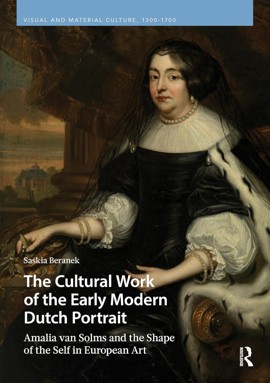
Saskia Beranek has written an important study of the images and image-making of one of the most intriguing figures from seventeenth-century Dutch history, Amalia van Solms, Princess of Orange. Amalia (as she is referred to throughout Beranek’s book) is known today primarily for her relationships to others: as the lady-in-waiting to Elizabeth Stuart, Queen of Bohemia; as the wife of Frederik Hendrik, Prince of Orange and stadholder of the Dutch Republic; and the mother of his successor, Willem II. These relationships extensively inform Beranek’s scholarship, but she centers Amalia’s own strategic decisions, particularly when it came to the making and display of her many portraits. More broadly, these portraits across various media provide Beranek with “a large data set” (38) for thinking about the varying functions, contexts, and modes of agency imputed to the early modern portrait, even as it moved beyond the control of its original patron or sitter.
Beranek’s approach is informed by recent scholarship by Ann Jensen Adams and Laura Bass that treats early modern portraits less as objects for iconographic unpacking or connoisseurial appraisal than as agents shaping cultural discourse in their own right. Yet Beranek’s book is most persuasive as a patronage study that thoughtfully and rigorously reconstructs the achievement of a frequently maligned figure and productively shifts focus from the urban mercantile elite of the Dutch Republic to its small and politically marginalized princely court. At the same time that Beranek seeks to correct a misogynist and anti-courtly historiography, she is frank about the lacunae of the surviving archival record as well as her subject’s own limitations, writing, “Amalia herself may not have been visionary or innovative; mostly, she seems to have been astute at identifying ways to emulate others whose status and wealth she envied” (23). Yet precisely this emulative nature of Amalia’s self-fashioning makes her example instructive; she emerges from Beranek’s argument not as an exceptional patron but rather as an informative case study.
Beranek is an astute reader not only of emulative strategies within portraiture but also the architectural spaces within which portraits were displayed, as reconstructed through a careful interpretation of primary sources such as inventories and travelers’ accounts. For example, she argues convincingly that it was not vanity that led Amalia to replace her famous portrait by Rembrandt with one by Honthorst, as has previously been asserted. Even after Honthorst painted the replacement, Amalia kept Rembrandt’s portrait in her quarters at Noordeinde Palace; Beranek notes that “Amalia would have seen the painting every time she used her rooms…and her most esteemed and privileged visitors would have been invited into the space to see it as well” (45). But Honthorst’s portrait made a better pendant to an earlier painting of Amalia’s husband by the same artist, and it allowed Amalia to fashion herself in the image of her erstwhile patron and subsequent rival Elizabeth of Bohemia. Through such examples, Beranek deftly reframes Amalia not as the vain upstart of previous scholarship but rather a savvy court operator who knew how to deploy different painters and portraits to strategic effect.
As the example of Honthorst indicates, cosmopolitan, heavily allegorical court portraiture of the kind frequently relegated to the margins of Dutch art history lies at the heart of Beranek’s book. She thus adds to the major recent contributions of Nadine Akkerman, Michele Frederick, and Marika Keblusek, who have powerfully argued for the complexity and innovation of Dutch court culture, and particularly the patronage of court women. But Beranek also pushes her investigation well beyond paintings or even physiognomic likenesses. The monument most often associated with Amalia’s patronage is the great cycle of paintings in the Oranjezaal at Huis ten Bosch, her suburban villa that was reconceived as a memorial to Fredrik Hendrik. Beranek, however, argues “for moving beyond [the Oranjezaal] in order to better understand the entire Huis ten Bosch and its gardens, which I argue emerge as a ‘built portrait’ of the living patron-resident, Amalia van Solms, one that embeds her in collective identity as key for ensuring Dutch longevity, fertility, and independence” (93). Beranek’s account of the sightlines and placement of paintings within the house is illuminating, but I was less persuaded by the need to shoehorn Huis ten Bosch into the category of “portrait.” It certainly emerges here as a powerful expression of Amalia’s contested identity as the mother of the Dutch nation, however the building itself may be taxonomized.
In later chapters in the book, Beranek takes her thesis beyond the portraits and palaces that Amalia herself sponsored to think about the wider diffusion of her image in both painting and print. Beranek charts a centrifugal trajectory from Amalia’s residences to those of her courtiers, such as Constantijn Huygens, and then to the homes of ordinary Amsterdam residents who chose to acquire or display the princess’s likeness. In one intriguing section, she surveys Amsterdam inventories for records of Amalia’s portraits, complicating longstanding binaries between The Hague and Amsterdam, or the House of Orange and the urban mercantile classes. Beranek argues that the “examination of micro-level personal choices about domestic décor demands a recalibration at the macro level. Images of one historical individual participated in a form of celebrity culture … situating prominent figures inside the domestic setting of otherwise unconnected individuals” (159). More speculatively, Beranek posits that a “female viewer may very well have responded differently to the printed images of Amalia that circulated in the late 1620s than a male viewer … based on shared experiences of physical labor, the postpartum experience, and infant mortality rates” (161). This section of the book offers a welcome corrective to art historians’ tendency to fetishize the original; as Beranek shows, copies have important “cultural work” to do. Unanswered, and perhaps unanswerable, here is the question of how much ownership of a copy of Amalia’s portrait was a declaration of political loyalty and how much an expression of fascination with her fame, or simply a chance acquisition incorporated into the flotsam of domestic décor.
A further question I pondered as I read Beranek’s illuminating book was that of likeness or resemblance as a contingent cultural value. Modern students of Rembrandt’s or Honthorst’s portraits of Amalia may feel they have a strong sense of her physical appearance and the features that make her recognizable from one image to another. Yet these distinctive traits largely vanish in the printed portraits that Beranek surveys, such as the small oval in the upper righthand corner of the map known as the Comitatus Hollandia, where Amalia figures as an entirely generic princess. These prints suggest that for one class of viewer – those who, unlike the courtiers in The Hague, may never have laid eyes on Amalia in the flesh – the “reality effect” of a distinctive physiognomy may not necessarily have been a selling point.
Beranek’s study will prove invaluable to future scholars not only of Amalia van Solms, but also of Dutch court culture, portraiture, and female patronage more generally. On the theoretical level, she offers a provocative insistence on the agency of portraits themselves, described here as mobile actors who easily become unmoored from their original contexts and the intentions of their makers and patrons. Articulating her method, Beranek writes that “A perpetual triangulation between artist, subject, owner, and viewer and all the plausible agendas and desires at play helps early modern Dutch portraits to regain some of the agency they held in the seventeenth century. Portraits were active participants in social ritual; they were carried in processions, presented at dinner tables, kissed, bowed to, and manipulated” (188). Yet the passive voice in this last sentence is striking. Ultimately, I came away from this book less convinced of the agency of Amalia’s portraits than that of the woman herself.
Adam Eaker
The Metropolitan Museum of Art