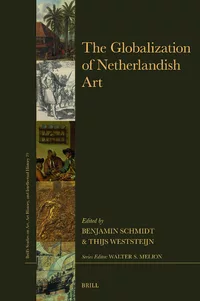
This edited volume, according to its introduction, purports to reevaluate and reframe the study of global Netherlandish art, at a moment when North Americans and Europeans continue to grapple with the echoes of historic inequities culminating in worldwide protests in 2020. I anticipated Thijs Weststeijn’s and Benjamin Schmidt’s introduction would be a state of the field of global Netherlandish art history, a subfield which has been growing steadily since the 1990s. They seek to situate global Netherlandish art history in relation to a trend for global art history in the early 2010s. Countless emerging scholars are generating bold new scholarship in this field, probing encounters in many corners of the globe, expanding methodologies, questioning art history’s Eurocentrism, and publishing in multiple languages – it is nearly impossible to master this whole field. Indeed, with such a rich body of global Netherlandish art history produced in the last quarter century, I was quite surprised that the “Earlier Studies” section only ran to one and a half pages, and, in fact, felt quite limited in scope, elevating several important examples covering the global circulation of goods, and leaving out key players in the development of the global Netherlandish art history subfield. There is a large body of studies of global Netherlandish art, both monographs and thematic edited volumes, which could have been discussed, covering topics like Netherlandish artists working abroad (most notably in Brazil and the Mughal court), the collecting and imitation of foreign objects and their depiction in still life and genre painting and integration into decorative arts, Dutch architecture and city planning in foreign outposts, and book illustration and cartography, among other topics.
Perhaps a state of the field is not even possible, given this wealth of scholarship. Those of us who work in this subfield can hardly claim, individually, to be global in our expertise, when we focus on the subtleties of one interaction between the Low Countries and another place in the world, narrowed to specific media, and limited by our varying levels of access. At best, as Julie Hochstrasser suggests in the conclusion, we can expand beyond one scholar’s singular focus by building teams with multiple specialties, and so present a broader view of the field. And this is what we have here – new scholarship from an international cast of authors (North American, European, Japanese, and Brazilian), including newer and long-established scholars of this subfield, both academics and curators. The essays as a whole demonstrate how global Netherlandish art history cannot be confined to specific methodologies: each place, cultural exchange, and artistic medium generates different questions. They range across geography, taking the reader to Japan, Brazil, Europe, Dutch forts across the world, and the imaginary exotic. Many essays consider print culture, as well as decorative arts and the built environment, and paintings depicting decorative arts and ship architecture.
While “global Netherlandish art history” can clearly be quite broad in scope, in the introduction Weststeijn and Schmidt narrow their focus to specifically the Netherlandish artist: “The volume’s editors have merely envisaged a shift in focus and an exploration of how Netherlandish artworks and artists were historically connected to different regions in a global context. And vice versa: we are interested in exploring how images and objects from all over the world were understood and incorporated by early modern Netherlandish artists.” (8) I found the introduction’s approach to art history’s methods a little narrow, mentioning in several places traditional methods of style, technique, and iconography or meaning; while many scholars in this subfield are interested in social history, material culture, ethnography, the built environment, network theory, reception, history of science, and more. Much of the introduction’s discussion is grounded in print culture methods, though there is some discussion of material culture, and the editors do note that the global approach pushes art historical methods beyond these stated limits. Perhaps it is the focus on the Netherlandish artist that seems limiting, as this could limit study only to those works which have identified makers, setting up the familiar elevation of “high” art over “low,” and also excluding the interventions of non-Netherlandish and non-European artists. However, I did appreciate that they underscore that “Netherlandish” is both Flemish and Dutch, which is a helpful and fruitful reminder in a field which has placed more weight on the impact of the early Dutch Republic through trade and colonial networks, than the role of Flemish prints circulating on Iberian and Jesuit missions. It is wise that Schmidt and Weststeijn attempted to circumscribe the field of Netherlandish global art history, but I was glad to see that several of their authors exceeded their framing.
The first of three essays on Japan describes moments of mutual impact between Japanese and Dutch artists: Akira Kofuko demonstrates how material and cultural exchange can have profound influence on the art histories of the two cultures whose exchange is discussed. He explores how the importation of Japanese paper, which accepts ink from a block differently than European-made paper, allowed Rembrandt, Hercules Segers, Hendrick Goudt and other Dutch artists to better explore chiaroscuro in print. Dutch art, in turn, impacted Japanese artists in the eighteenth and nineteenth centuries, who mostly knew Dutch work through ran-gaku, or Dutch studies, in this case specifically European medical knowledge, which included imagery with the illusion of three dimensions via chiaroscuro. Michiko Fukaya also considers ran-gaku, specifically with a votive image of a Dutch ship produced in between the two major periods of European images bring imported into Japan (the Jesuit missions of 1540s–early 1600s and the second half of the Dutch trading presence at Nagasaki, roughly 1720s–1850s). Japanese artists in both periods experimented with European style, but less is known about the century between, and this essay explores how an image of a Dutch ship with Western stylistic elements might have served the interests of this moment. Benjamin Schmidt’s contribution explores the reverse: how the ban on Catholicism in Japan led to the unique iconoclastic practice of fumi-e, Christian religious images to be performatively stepped upon. Japanese officials produced these metal works, either Japanese-made reliefs derived from the Flemish religious prints imported by Jesuit missionaries, or repurposed European-made reliefs. By stepping on these fumi-e, Europeans in Japan or accused Japanese Christians could prove their adherence to Japanese law. Schmidt notes that Dutch authors seem to have collectively banned discussion of this practice, while other Europeans lampooned the Dutch for their willingness to choose commerce over faith.
Two essays focus specifically on the repetitions and reworkings of prints, which further expand our understanding of Netherlandish authorship. Dutch and Flemish purportedly eyewitness accounts translate to images, which are then copied and reworked and selectively quoted by many other artists until they become either stereotyped Chinoiserie (Cordula Bischoff) or anti-Catholic propaganda (Maria Berbara). These, in turn, are viewed and circulated throughout Europe and on Iberian and Jesuit missions, as well as copied by Asian artists (on this see also Kofuko, Schmidt, and the introduction). The cacophony of hands involved is a good reminder of how diverse these global encounters were – always more complicated than a simple meeting of two cultures. Bischoff begins with an interesting archive, the Chinoiserie print collection of Elector of Saxony Augustus the Strong, now in the Dresden Kupferstich-Kabinett, which brought together both Asian-made images (from China, India, Japan, and Thailand) and European-made, Asian-themed ones, a collection which is directly connected to Augustus’s interests in the Royal Porcelain Manufactory in Meissen. She follows the development of Chinoiserie motifs originating both in European observations of Asian culture and, less frequently but also less-well-known, originating in European copies of Asian prints by artists Pieter Schenk the Elder and Younger and Martin Schnell. Berbara explores the ubiquity of imagery of the Tupinambá of Brazil, most notably the sensationalized violence of revenge and cannibalism, which was incorporated into anti-Catholic imagery whether representing the peoples of America or of Europe.
Junko Aono considers the depiction of porcelain in the background of Willem van Mieris’s commissioned Interior with Monkeys (1719), in relation to the porcelain collecting of his patron Johan Hendrik van Wassenaer Obdam, to suggest a meaning other than the typical monkey satire. Charlotte Hoitsma explores the representation of African figures on a cabinet in the Rijksmuseum, and the conflation of African and American features as a generic “exotic,” with an interesting discussion of the materiality of ebony wood. Thomas DaCosta Kaufmann’s essay asks why the wars of the Dutch global expansion, which were intertwined with the movement of material goods, have not received enough art historical attention, considering a range of examples including diplomatic gifts, the erection of forts, monuments, and images of battles.
Julie Hochstrasser, whose 2007 Still Life and Trade was foundational in this subfield for incorporating the material culture and ethics of the Dutch trading empire into the study of Netherlandish art (yet was not discussed in the volume’s introduction), provides the conclusion. She offers up a consideration of three methodological expansions for art history necessitated by the global turn: a move towards an ethnography of the past, via travelling to the sites we study; working collaboratively to capture a broader range of skills and perspectives; and thinking of time more expansively. These are interesting prompts as the global Netherlandish art historical subfield continues to grow and expand, and as scholars question whether current art historical methods are enough to confront the breadth of artistic and material production of the early modern Netherlands and the cultures, places, and peoples encountered in that age of colonial expansion, global exploitation, and how our understanding of this period continues to impact the inequities of today’s world.
Marsely Kehoe
Independent Scholar