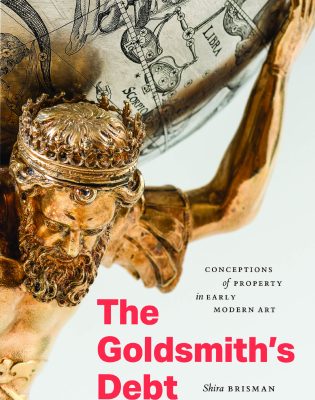
Shira Brisman begins what is likely to become an important text for both the history of art and material culture studies with a declaration of what the book is not: “This is not a book about how crafted wares served as commodities tabulated in records of personal wealth. It does not reduce art to the status of document of, or witness to, the burgeoning regime of racial capitalism” (p. 1). Brisman’s assertion is a welcome arrival to a field in which the status, movement, and exchange of “things” has become increasingly central to studies concerning this period of early capitalism.[1] This “material turn” has over the course of the last forty or so years resulted in increasingly large numbers of scholars who take objects as their subject of study and produce scholarship that considers their meanings, value, and import within the increasingly consumption-oriented early modern world. Works of silver and gold, which could be melted down and converted into currency, have been keystone objects in these analyses.
The Goldsmith’s Debt: Conceptions of Property in Early Modern Art reorients that focus away from what objects of gilded silver meant for their early modern producers and consumers and turns instead toward what they did. These works are read, not as merely reflecting but also justifying the hierarchies that structured their social and political context. Brisman identifies and analyzes a category of silver vessels that, through form and imagery, actively made claims about who had the right to extract their material, to decide on their distribution, to fashion their forms, and to commission that labor and possess those precious objects. For Brisman, while these works participated in the construction and maintenance of ideas about property, ownership, and dominion over land that structured these divisions, they also acknowledge an instability in these systems at the turn of the seventeenth century. Focusing on the oeuvre of Christoph Jamnitzer (1563-1618), a junior member of the well-known Nuremberg goldsmith family, Brisman argues that in certain of his vessels, “the balancing of precious metal in the form of top-heavy bowls steadied on weight-bearing stems materially manifested the ‘judicious calculations’ to which the craftsmen who made them and the rulers, council members, and merchants who owned them wished to lay claim” (p. 314). Thus, they both materialize and (sometimes) question the principles by which “rightful” ownership of land, wealth, labor, and skill were naturalized.
Jamnitzer was, as Brisman calls him, a goldsmith-engraver, and Brisman does not neglect his work in this other medium. Building on her own recent work, Brisman focuses on Jamnitzer’s 1610 New Book of Grotesques, a Kunstbuch filled with what Brisman calls “design proposals” that might be applied to works in various other media.[2] As its title may suggest, the images in the New Book of Grotesques skew toward the fantastic, so Brisman finds in their mixing of categories an “imaginative shifting of classifications” that might inspire reconsideration of “the very categories of abundance and scarcity and thus the conventions by which we hoard, profit, and share” still practiced today (pp. 339, 320). Overall, art’s action, then, affirms existing inequalities and inspires the shaping of alternate futures from the materials of earlier systems – it can both make and inspire re-making.
Each of The Goldsmith’s Debt’s three parts is guided by one of the rhymed couplet poems that serve as preface to the New Book of Grotesques’ images, and Brisman also provides thorough transcriptions and translations. Part One (Chapters One through Four) uses Jamnitzer’s address to apprentices to argue that property from the perspective of the Nuremberg goldsmith included his technical skills, moral education, and his obligation to pass both types of knowledge on to juniors in his field. Part Two argues that patrons commissioned goldsmiths to make vessels that visualized their claims to sovereignty. This is framed by the New Book of Grotesques’ appeal to Carl Ludwig Fernberger zu Egenberg as a potential patron, in which the author compares himself to another Christopher: Columbus. Part Three, the shortest section, concludes with a reflection on the imperial privilege that Jamnitzer was granted to prevent the book from being copied. Brisman considers that assertion as only one of several proprietary claims put forward by the text, and the one least in need of analysis.
Chapter One reads Jamnitzer’s textual offering of his designs to other goldsmiths as consistent with the early modern adoption of the Roman concept of res communes (resources that belong to everyone because by their nature they cannot be depleted). Brisman supports this assertion with close readings of both political texts and the imagery of other artist’s Kunstbücher. Chapter Two defines property for the Nuremberg goldsmith, whose occupation was linked to his citizenship, as his right (and responsibility) to develop and pass on technical skill in apportioning his chosen material according to the established hierarchical structure of the workshop. That shop, in turn, was enmeshed within the overall hierarchical structure of Nuremberg society. This linkage emerges through the forms of vessels that Jamnitzer made for Nuremberg patricians, such as a Milo of Croton bowl for the infant son of councilmember Jacob Stark von Reckenhoff. Brisman argues that when utilized as the bowl’s stem, the emblematic implications of that powerful ancient wrestling figure, an epitome of fortitude, claims that virtue for both Jacob Stark’s family line and Jamnitzer’s own training as a manipulator of the weight of silver.
The disciplines of art history and material culture studies have not always been easy bedfellows, but in constructing her arguments, Brisman has synthesized approaches from both disciplines.[3] Her analysis takes seriously how the weight of her interpretation of a work’s subject lies in her integration of its imagery, three-dimensionality, materiality, and circumstances of production.
Brisman also engages theoretical frameworks that, while well established in comparative literature and philosophy, have been developing more recently in scholarship on the history of early modern art. Chapter Three considers the Jamnitzer family’s Ovidian objects as balancing their deviation from the norms of sexual reproduction – on which intergenerational transmission of property depended – with “allusions to the guarantee of reproductive certainty,” made by their formal references to the highly regulated circumstances of their own facture. This analysis draws on queer theorist Lee Edelman’s notion of reproductive futurism and Sarah Ahmed’s spatial approach to queer phenomenology (p. 106).[4] While explorations of queer gender and sexuality have a robust historiography in early modern studies, to apply queer theory in early modern art history in this vein remains ripe for further development.[5]
Chapter Four reads a work by Christoph Jamnitzer’s grandfather, Wenzel Jamnitzer’s (1507/1508-1585) Perspective of Regular Solids (Perspectiva corporum regularium) (1568), against Albrecht Dürer’s (1471-1528) Treatise on Measurement (Underweysung der Messung) (1525). This first-time comparison describes the political theories embedded in the different ways that these two artists understood the position of the individual within the connections between the heavens and the earth; it also provides further background for Christoph Jamnitzer’s position in his New Book of Grotesques (1610).[6]
Chapter Five expands on Madeleine Viljoen’s foundational essay by analyzing Jamnitzer’s personal analogy to Christopher Columbus within the framework of proprietary claims established in Part One.[7] Jamnitzer’s offering of his designs to Carl Fernberger is read as property in potential, intentionally referencing Columbus’ offering of the Americas as potential property of the Spanish Crown. Both dedications offer the creation of images that function as “anticipatory claims of possession,” naturalizing the logics (alchemical and colonial) behind the European nobility’s possession of land and labor (p. 185).
Brisman features examples of Jamnitzer’s work that put forward through their form and imagery a political theory of property that “licensed colonial and domestic proclamations over land, as well as the subjugation of certain populations by those who ruled over them” (p. 15). Her argument in support of this assertion also demonstrates how looking at these works in terms of these claims about property enhances our readings of the works themselves. The discussion of Christoph’s Heraldic Head (c. 1600) in Chapter Six and of his unfinished Atlas and Hercules globe cups (1612-32, finished by Christoph Ritter (1610-1676) and Johann Hauer (1586-1660) in Chapter Seven provide the most comprehensive analyses of their multiple signifying and multiple audiences addressed in English scholarship to date. Brisman’s study of the Heraldic Head, a sculpted gilded silver vessel in the form of a Black man’s head, demonstrates that the violence underlying its imagery and material is fundamental for understanding how its proprietary claims were made on behalf of its owners.[8] Explicitly analyzing what the Atlas and Hercules goblets might have meant to their makers, commissioners, and various owners, Brisman tests the legibility of their proprietary claims over time and how they proved useful to different political projects: both for Jamnitzer and for the Nuremberg council that commissioned the cups, as well as for Friedrich Schiller (1759-1805), whose History of the Thirty Years War (1793) depicts them at the moment of their eventual presentation by the Nuremberg council to Swedish King Gustavus Adolphus (1594-1632) during the Thirty Years War.
Using Schiller’s understanding of aesthetic experience as a touchstone, the concluding chapters contribute a framework for the material and visual requirements that early modern art objects must meet in order to be seen as able to spark political imagination and to “negate ideological fictions” (p. 315). Increasingly, historians of the early modern period have responded to present political issues through their approaches to our subjects and the questions posed about them.[9] Out of Christoph Jamnitzer’s works, The Goldsmith’s Debt’s draws issues of labor, race and colonization, and the relations between humanity and environment, which places it firmly within this moment of early modern studies. Ulinka Rublack has recently called for a synthesis of the extensive scholarship on artisanal knowledge in the context of Kunstkammer cabinets (the kinds of places where one might find Jamnitzer’s works) with approaches from labor history.[10] This new field situates the studies of artisanal knowledge that have emerged since Pamela Smith’s 2004 The Body of the Artisan within the material realities of the workshop. Brisman attends to Jamnitzer’s understanding of the political situatedness of his labor, and she articulates a “property of skill” belonging to the Nuremburg artisan, providing useful additions to this discourse.
Brisman’s treatment of the Heraldic Head also grapples with an intersection of labor, race, enslavement, and colonialism that has long been part of early modern studies; but, by framing it in terms of its proprietary claims, she offers the field a model for understanding how these categories are at stake in early modern European representations of Black bodies.[11] Similarly, Brisman does not abandon the natural philosophical readings that have done so much for treatments of early modern metalwork.[12] Rather, she builds on them to acknowledge the integral role of natural philosophical thought within the political philosophy of uneven distribution of resources advanced by these works. This book thus complements an emerging scholarship on the relations between artmaking and resource extraction.[13]
The Goldsmith’s Debt is the first analytical treatment of the work of an artist who has previously been neglected in English language art-historical scholarship. Brisman admits that while writing this book, as she came to understand the works of Christoph Jamnitzer more, she also came to like them less. The full-page, high-resolution images of his metalwork (seldom so extensively published before) do facilitate better understanding of these objects. However, the quality of the photographs also highlights the importance of Brisman’s project: one can see how the beauty of these works has made it difficult for scholars to acknowledge the political stakes of their splendor. While The Goldsmith’s Debt approaches these works in gilded silver without apologizing for them, Brisman also avoids suspending her criticism of their aspirations (p. 197). In reading the book, I too have come to like this metalwork less, but I have also come to feel renewed dedication to exploring the power of objects to communicate moral and political, as well as religious and natural philosophies.
Ana Matisse Donefer-Hickie
Tyler School of Art and Architecture, Temple University
[1] See Giorgio Riello, “The ‘Material Turn’ in World and Global History,” Journal of World History 33, no. 2 (2022): 193–232, for the gradual overlap between the fields of early modern global history and material culture studies.
[2] Shira Brisman, “A Matter of Choice: Printed Design Proposals and the Nature of Selection, 1470–1610,” Renaissance Quarterly 71 (2018): 114–64; Shira Brisman, “Against the Quieted Violence of Sixteenth-Century Art,” The Sixteenth Century Journal 50 (2019): 118; Shira Brisman, “Contriving Scarcity: Sixteenth-Century Goldsmith-Engravers and the Resources of the Land,” West 86th: A Journal of Decorative Arts, Design History, and Material Culture 27 (2020): 147–96; Shira Brisman, “Printed Design Proposals as Salvaged Remainders of the Goldsmith’s Workshop,” Art History 47 (2024): 656–77.
[3] See Jules David Prown in: Simon J. Bronner, ed. “Material Culture Studies: A Symposium,” Material Culture 17, no. 2/3 (1985): 77–79; Michael Yonan, “Toward a Fusion of Art History and Material Culture Studies,” West 86th: A Journal of Decorative Arts, Design History, and Material Culture 18 (2011): 232–48.
[4] Lee Edelman, No Future: Queer Theory and the Death Drive, Series Q (Durham NC, 2004); Sara Ahmed, Queer Phenomenology: Orientations, Objects, Others (Durham, NC, 2006).
[5] Jonathan Goldberg, Queering the Renaissance. (Durham NC, 2009). See the following for arguments about representations of queerness in early modern art: Bradley J. Cavallo, “Albrecht Dürer’s The Men’s Bathhouse of 1496–1497: Problems of Sexual Signification,” Journal for Early Modern Cultural Studies 16, no. 4 (2016): 9–37; Leah DeVun, The Shape of Sex: Nonbinary Gender from Genesis to the Renaissance (New York, 2020); J. Vanessa Lyon, Figuring Faith and Female Power in the Art of Rubens, Visual and Material Culture, 1300-1700 (Amsterdam, 2020).
[6] The Perspectiva itself, and printed geometric treatises in general, have been rather sparingly treated by art historians and historians of science. See Christopher S. Wood, “The Perspective Treatise in Ruins: Lorenz Stoer, ‘Geometria et Perspectiva’, 1567,” Studies in the History of Art 59 (2003): 234–57; Andrew Morrall, “Art, Geometry, and the Imagery of Ruins in the Sixteenth-Century German Kunstkabinett,” in: Imagery and Ingenuity in Early Modern Europe. Essays in Honor of Jeffrey Chipps Smith, ed. Catharine Ingersoll et al. (Turnhout, 2019); Noam Andrews, The Polyhedrists: Art and Geometry in the Long Sixteenth Century (Cambridge MA, 2022).
[7] Madeleine C. Viljoen, “Christoph Jamnitzer’s Neuw Grotteßken Buch, Cosmography, and Early Modern Ornament,” The Art Bulletin 98 (2016): 213–36.
[8] Brisman argues that the Head, which is simultaneously a gilded silver vessel, a heraldic device, and a sculpture of the head of a Black man of striking presence that wears a feather headdress, would have “evoked for [German] rulers who were not colonizers overseas not the potential profit to be made in the Americas, but rather the possibility of procuring local natural wealth through the proper management of the landholder’s subjects” (p. 276). That is not to say that there were no Germans engaged in colonial enterprises. See Giovanna Montenegro, German Conquistadors in Venezuela: The Welsers’ Colony, Racialized Capitalism, and Cultural Memory (University of Notre Dame Press, 2022).
[9] See Gary G. Gibbs and Merry Wiesner-Hanks, eds. “Special Issue: Taking the Temperature of Early Modern Studies,” The Sixteenth Century Journal 50, no. 1 (2019).
[10] Ulinka Rublack, “Craft, Labour and Cabinets of Curiosities: Rethinking the Body of the Artisan,” German History 41 (2023), 338-40.
[11] For recent work that explores these issues with objects see Marisa Bass et al., Conchophilia: Shells, Art, and Curiosity in Early Modern Europe, with Anne Goldgar (New Haven, 2021); Alessandra Russo, A New Antiquity: Art and Humanity as Universal, 1400-1600 (Philadelphia, 2024); Adrienne L. Childs, Ornamental Blackness: The Black Figure in European Decorative Arts (New Haven, 2025).
[12] Some examples include Andrew Morrall, “Object, Material, Myth: Ovidian Poetics and Natural Philosophy in the Sixteenth-Century Northern European Kunstkammer,” in The Challenge of the Object = Die Herausforderung Des Objekts: Congress Proceedings, by G. Ulrich Grossmann and Petra Krutisch, Wissenschaftliche Beibände Zum Anzeiger Des Germanischen Nationalmuseums (Nuremberg, 2013); Henrike Haug, “In the Garden of Eden? Mineral Lore and Preaching in the Erzgebirge,” Renaissance Studies 34, no. 1 (2020): 57–77; Noam Andrews, “From Laurel to Coral: The Jamnitzer Daphnes,” in Re-Inventing Ovid’s Metamorphoses (London, 2021).
[13] See Tina Asmussen and Renée Jennifer Raphael, “Resource Landscapes: Introducing a Heuristic Framework,” Renaissance Quarterly 78, no. 4 (2025): 985–1026. The Goldsmith’s Debt is indebted to the thought of Karl Marx (1818-1883), which allies the text to recent calls for early modernists to acknowledge historical materialism in their responses to the eco-crisis. Daniel Vitkus, “‘The Weight of This Sad Time’: Presentism, Eco-Politics, and Early Modern Studies,” Renaissance Quarterly 79, no. 1 (2026): 1–33.