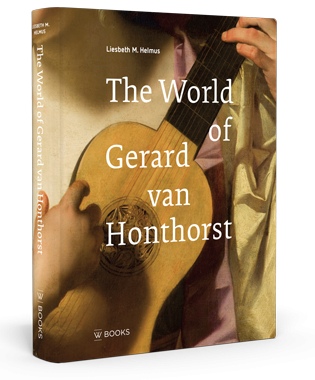
Liesbeth Helmus’s ambitious monograph on the canonical but often underestimated Dutch painter Gerard van Honthorst will surely be the new touchstone for studies of the artist. Published earlier this year to complement her exhibition “Gerard van Honthorst – Different to Rembrandt” [Gerard van Honthorst – In alles anders dan Rembrandt] at the Centraal Museum, Utrecht, Helmus’s book takes an unflinching and detail-oriented look at what we know, or thought we knew, about Honthorst’s life and work.
The first overview of what she calls “the man behind the master,” (11) The World of Gerard van Honthorst is richly illustrated and beautifully designed, providing a new level of insight into Honthorst and his milieu. In several places, Helmus’s contribution is further enhanced by the discovery and publication of new drawings and previously unknown paintings as well as new arguments for the subjects of several works.
Throughout the course of the book, the reader follows in Helmus’s footsteps as she retraces Honthorst’s life from birth to death and all his noteworthy deeds in between.
Chapter 1, “Beginnings,” situates Honthorst within the context of his early life, environment, education, and training, laying the foundation for his future career. It details Honthorst’s birth in 1592 into a Roman Catholic family in Utrecht. Gerard was the eldest of seven children and, Helmus argues, fulfilled the brief of many eldest siblings by being the most ambitious and ultimately most successful (26). Honthorst benefited from the fact that Utrecht was one of the most important artistic centers in the Netherlands, anchored by Joachim Wtewael, Paulus Moreelse, and Abraham Bloemaert, the latter with whom Honthorst studied after possibly learning the basics with his father Herman, a decorative painter (38). Helmus gives Honthorst’s art a thorough grounding within Utrecht painting via the works of Wtewael, Moreelse, Bloemaert, and others (many drawn from the Centraal Museum’s exceptional collection), as well as emphasizing the importance of drawing in Utrecht artistic education.
In the next chapter we follow Honthorst to Rome, where he was one of many eager Northern artists that descended upon the city to finish their education and absorb the innovations of Caravaggio and Annibale Carracci (55).
Chapter 2, “Rome,” presents Honthorst’s arrival – first documented in 1616 – within the broader context of immigration to the city. While the logical assumption is that Honthorst traveled to Italy immediately upon finishing his training with Bloemaert around 1613, Helmus acknowledges that there is no evidence for the date of his departure nor how long his journey took; lengthy stopovers could add years of travel. The chapter goes on to detail Honthorst’s diverse group of friends in Rome, including many members of the well-known Bentvueghels (the subject of another excellent recent exhibition and book by Helmus) as well as other artists like Claude Lorrain and Artemisia Gentileschi (72-74).
This chapter, of course, also traces Honthorst’s relationship to some of the most important Italian patrons of his time, like Cosimo II de Medici, Cardinal Francesco Maria del Monte, and Vincenzo Giustiniani. It also surveys his Caravaggesque innovations, which made him famous in his lifetime and earned him the oft-referenced nickname Gherardo delle Notti (“Gerard of the Nights”). The most important of these is the device of the visible-but-obscured light source. One of the most engaging parts of Helmus’s examination of Honthorst’s Roman period is her detailed study of his altarpieces, examining not just their content and meaning but also the intricacies and documentation of the various commissions.
Perhaps the most intriguing point in this chapter comes from Helmus’s discussion of The Assumption of St. Paul into the Third Heaven (1617, Santa Maria della Vittoria) and The Beheading of St. John the Baptist (1617-18, Santa Maria della Scala). The two paintings, deeply Classicist and Caravaggesque respectively, are, as Helmus notes, “so different from each other that it is almost inconceivable that they were made by the same painter within such a short period of time.” (82) This is a key idea that Helmus emphasizes but that could perhaps have been returned to more consistently throughout the monograph: that Honthorst’s adaptability to the wishes of his patrons, his facility with seemingly antithetical modes of painting, was already fully formed during this earliest period of his career.
Chapter 3, “Utrecht,” chronicles Honthorst’s return to and flourishing in his hometown. It begins with new insights into a trip that he made to Velletri and Albano just before his departure from Italy in the spring of 1620; the stock of paintings he left to be sold in Rome; and his marriage to Sophia Coopmans within a few months of his return. Helmus then surveys the diversity of Honthorst’s works produced in the early 1620s as well as his clever diplomacy in courting English patronage through Sir Dudley Carleton, then Ambassador to the Netherlands (126).
The diversity and humor pervading Honthorst’s output during this period often leaves the reader careening dizzily from one subject to another, for example from the crude gesture of a violinist to suggestive balls of cheese (136). This section can best be characterized not so much as a narrative of Honthorst’s time in Utrecht as an accounting of his works more fully within the contexts in which they were produced and appreciated, including some of his most accomplished pastoral paintings such as Granida and Daifilo (1625, Centraal Museum). Helmus’s consistent emphasis on close looking and attentive visual analysis is impressive, including her notation of one of my personal favorite details in a Honthorst painting: in his St. Sebastian (ca. 1623, National Gallery, London), the arrow wound on the saint’s right leg includes blood running in two directions, indicating that he has collapsed down the tree to which he is bound (158). Helmus’s treatment of Honthorst reveals and emphasizes many of these seemingly inconsequential moments of genius.
Chapter 4, “International Recognition,” continues to trace the development of Honthorst’s career and reputation, which reaches new heights in 1628 with his invitation to the court of King Charles I in London. This event shifts him precipitously toward portrait painting, his style becoming more classical and idealized and his palette brighter, which Helmus attributes entirely to his courtly commissions (173). The bulk of Helmus’s discussion of Honthorst’s London paintings is devoted to the monumental Apollo and Diana (1628, Royal Collection Trust, Hampton Court Palace), one of Honthorst’s most ambitious paintings, especially given the stage in his career during which it was produced, Apollo and Diana was originally commissioned by the controversial and soon-to-be assassinated Duke of Buckingham, George Villiers. Villiers had been the one to facilitate Honthorst’s invitation to London, and his unusual role in Apollo and Diana – he appears as Mercury presenting the seven liberal arts to the king – uniquely preserves the artistic and interpersonal culture of the Stuart court and justifies Helmus’s focus on it.
This chapter is also marked by Helmus’s stunning rediscovery of Honthorst’s monumental – even more so than Apollo and Diana – group portrait of Frederick V and Elizabeth Stuart in a garden surrounded by some of their children (1629, Private Collection). The painting had previously been known only through black-and-white images and its whereabouts had been uncharted for several decades. Helmus’s inclusion of new photographs is the first time the painting has been published in color, and its full character and impact can now be understood (189). Helmus argues, probably rightly in my opinion, that the work should no longer be identified with Honoré d’Urfé’s pastoral novel L’Astrée (1607-27) (191). Honthorst’s painting does exhibit clear pastoral themes in the setting and some of the figures, and L’Astrée was well-known to Elizabeth and Frederick, who referred to himself as the male protagonist Celadon multiple times in his letters to her. However, Helmus’s reading of the painting primarily as “a form of visual propaganda” that emphasizes Frederick’s royal dignity and Elizabeth’s maternal role in securing her family’s dynasty is an appropriate and convincing reframing of one of Honthorst’s major works (192).
Another important inclusion is Honthorst’s altarpiece of The Lamentation of Christ (1633, St. Bavo’s Cathedral, Ghent). The painting recently underwent extensive conservation treatment by IPARC for Helmus’s exhibition. In her hands, the altarpiece and its patron Antoon Triest, Bishop of Ghent, are given full attention and context. She traces Honthorst’s source of inspiration in a work of the same subject by Anthony van Dyck (ca. 1627, Royal Museum of Fine Arts Antwerp, Antwerp), and his deviation from the earlier painting in response to Triest’s preferences (203).
The chapter closes with Honthorst’s commissions from Christian IV of Denmark in 1635 and 1637, with the latter being part of a project overseen by Simon de Passe and described by Helmus as “one of the largest commissions ever given by a foreign monarch to a group of artists from Utrecht.” (206) Helmus’s fascinating discussions reconstruct the complexities of this royal commission, but it is surprising that none of the seventeen extant paintings that Honthorst sent to Denmark are described in detail or illustrated within the text.
We next follow Honthorst’s ascent within the courts of The Hague, where he established a large workshop. Chapter 5, “The Hague,” focuses on Honthorst’s work for Amalia van Solms and Frederik Hendrik as well as Elizabeth Stuart, still in exile there and now widowed. For courtly patrons in The Hague, Honthorst offered idealized and often dynamic portraits which, if ceremonial in nature, could be copied dozens of times in multiple varieties for dissemination across Europe and beyond (214).
This chapter includes an extensive discussion of the visit of exiled French Queen Marie de’ Medici to the Netherlands in 1638. During this visit, Honthorst was commissioned by the mayors of Amsterdam to paint her portrait, which Helmus describes as one of his “most remarkable” ceremonial portraits (218). Helmus details the complex royal protocols surrounding Honthorst’s portraits of Marie de’ Medici, one half-length (1638, Private Collection) for which the queen sat at Amalia’s request, and the better-known full-length (1638, Amsterdam Museum), which Marie gave the artist permission to make based on the half-length (229-31). For the monumental full-length portrait, Honthorst again looked at an earlier painting by Van Dyck but made key divergences in his own finished work.
The chapter then shifts its focus to Elizabeth Stuart, beginning with the pair of large-scale allegorical paintings that Elizabeth commissioned for her palace at Rhenen in 1635 and 1636 (Kurpfälzisches Museum, Heidelberg and Private Collection, on long-term loan to the Museum of Fine Arts, Boston). Helmus then details Honthorst’s role in teaching several of Elizabeth’s children, of which only one, Louise Hollandine, is known to have continued painting and indeed, has surviving works (238).
Helmus’s discussions of Willem van Honthorst’s role in his brother’s workshops, his small independent oeuvre, and his (mostly unrealized) ambitions as a court painter abroad are particularly illuminating in relation to this latter half of Honthorst’s career (242).
The final part of the chapter turns to Honthorst’s series of large-scale portraits of Amalia, Frederik Hendrik, and their children, which focus on the international prestige, continuity of the line of succession, and legitimacy of the House of Orange. Amalia was particularly invested in underlining these themes following the death of Frederik Hendrik in 1647 (252). The chapter then closes with an examination of Honthorst’s final major project, the Oranjezaal at Huis ten Bosch, where he contributed six paintings to the ambitious (and still intact) visual program honoring the late stadtholder (254).
Chapter 6, “The End,” turns naturally to Honthorst’s final years. In it, a handful of his last portraits and one history painting are examined. For example, Helmus argues convincingly that Honthorst’s work traditionally known as The Allegory of Painting (1648, Crocker Art Museum, Sacramento) is a portrait of his daughter Eva executed on the occasion of her marriage that year (267). The final painting discussed is Honthorst’s Susanna and the Elders (1655, Galleria Borghese, Rome), completed just a year before the artist’s death. Helmus designates the work as one of Honthorst’s most beautiful history paintings (271) and emphasizes how relevant the image still feels today, as Honthorst evokes discomfort, embarrassment, and forceful abuse in his approach to the subject; as Helmus summarizes, “This is Honthorst at his best.” (273)
Helmus’s book – appropriately – closes by articulating the appeal of Honthorst’s tomb in the Catharijnekerk in Utrecht, itself only 500 meters away from the Centraal Museum. The inscription praises Honthorst’s artistic skill, important patrons, and virtuous nature, for which “Fame will continue to proclaim his name, to the wonder of posterity.” (274) Helmus concludes by echoing this call from Honthorst’s contemporaries, that he should maintain the place he had earned in the “pantheon of artistic greats in his time” (275). For current and future lovers of Dutch art, I have no doubt that Helmus has achieved this goal and helped to cement Honthorst’s reputation back in its proper place.
Michele L. Frederick
North Carolina Museum of Art