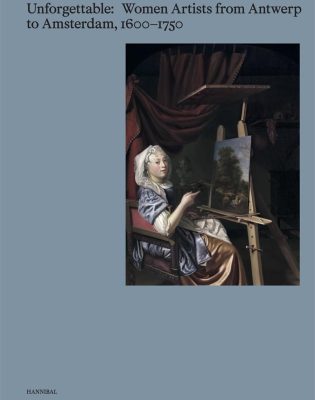
Those who favor exhibitions that dazzle through variety would have appreciated Unforgettable: Women Artists from Antwerp to Amsterdam, 1600–1750. A collaborative project by curators Virginia Treanor and Frederica Van Dam, Unforgettable opened at the Museum of Fine Arts (MSK) in Ghent in March of 2026 after a first stop at the National Museum of Women in the Arts (NMWA) in Washington, DC. The two installations were reportedly somewhat different in their narrative emphases and in the works chosen for display.[1] However, together with the beautifully illustrated scholarly catalogue pertaining to both venues, they shared the common goal of visibility, of making “forgotten” women artists and their works accessible to visitors and readers. The variety evident in the exhibition and volume – represented by the artists and their subjects, styles, media, and more – was intentional, shaped to demonstrate a collective multidimensionality and sustained achievement in artmaking that studies of individual artists or small groups necessarily preclude. This review comments on the NMWA experience and on the catalogue, including some observations on the volume’s broader contributions to the study of early modern women artists in the historical Low Countries, a subject that is captivating specialists and the public alike.
Never has an exhibition united so many objects made by women residing in the Netherlandish regions in the long seventeenth century: no less than two hundred objects representing over fifty artists were included. Among these women were the still-life painter Clara Peeters, the portraitist and genre painters Judith Leyster and Michaelina Wautier, flower-painter Rachel Ruysch, the watercolorist and calligrapher Gesina ter Borch, and the naturalist illustrator Maria Sibylla Merian. These artists remain understudied compared to many of their male counterparts; Rubens and Rembrandt immediately come to mind. Nonetheless, a spate of relatively recent publications has made their names familiar to specialists and the public, and it is a positive sign that much more is known about them now than even a few decades ago.
Certain contributions to the catalog carry this research forward into new territory. This is true for Frima Fox Hofrichter’s essay, one of two in the volume that contextualizes a solitary artist. In this case the subject is Judith Leyster, about whom Hofrichter has published widely.[2] Her focus here is the art market. After a move to Amsterdam from Haarlem, Hofrichter writes, nonnatives Leyster and her artist-husband Jan Miense Molenaer were barred from the artists’ guild. This situation led to all sorts of entrepreneurial activities: the two were art dealers, real estate investors who used their profits to advance their own artistic production, and connoisseurs with a substantial collection of paintings. From there, Hofrichter analyzes the reception of Leyster in the centuries after her death, a time in which her name and works fell from the historical record only to begin to be restored again in the last decade of the nineteenth century.
Most artists in Unforgettable have received less attention than Leyster. Factors both historical and modern explain this problem. Limited biographical information has been discovered about most early modern women artists thus far, and few surviving works represent them. In addition, many works that were probably made by women have no specific information attached to them. Gendered biases about materials and the formation of objects with them made certain media, such as needlework and other textiles, comparatively less valued through history than, say, painting and sculpture, which generally were considered more in the prevue of men. Several contributions to the catalogue, including one by Virginia Treanor and Katie Altizer Takata on value, memory, and legacy, make these points.[3] These challenges can make women artists less attractive for study outside a multi-artists presentation like this one, despite a positive reception for these individuals and their art by contemporaries.
Textiles in fact comprised a notable percentage of the exhibition and catalogue, receiving dedicated attention in an analysis by Elena Kanagy-Loux.[4] The author opens her essay on lacemakers, seamstresses, and laundresses – women who represent three intersecting areas of textile work and for whom little information survives on an individual basis – with an important point about disjuncture between representation and reality. The solitary or small groups of workers who appear in paintings by, for example, Pieter Cornelisz van Slingelandt and Nicolaes Maes, harken to ideal female domesticity rather than to the realities of lived experience. To the contrary, written records from places like the Plantin family’s textile enterprise in Antwerp, and archival materials from the municipalities of Ghent and Amsterdam, provide evidence for practice and use, revealing women’s contributions to both production and economies of textiles: in their teens, two Plantin sisters, Martina and Catharina, not only worked in the shop but liaised on behalf of lacemakers and international clientele, contributions that are known today because of the extant detailed records of this family enterprise. Most of this work, however, represents the labor of girls and young women of lesser means than someone like the watercolorist and calligrapher Gesina ter Borch, who enjoyed a comfortable upbringing and had ample resources at her disposal. The monumental painting of orphaned handcrafters who resided at the Antwerp Maagdenhuis, completed by Johannes de Maré in 1676 (Maagdenhuis, Antwerp) and included in the exhibition in a section on “Choices,” discussed further below, resonated well with this historical reality: artistic agency eluded these disadvantaged girls. Even worse, the Spinhuis in Amsterdam incarcerated women for committing crimes in response to their own poverty, as Kanagy-Loux calls out.
This content provides welcome representation about individuals whose names have slipped from memory. There is, however, a way to deepen this point: by replacing terms such as “unidentified,” “anonymous,” and “unknown” (the latter was a heading in the exhibition’s checklist) with more explicit terms such as “artist once known.” [5] This rubric makes clear that even as some artists’ names were not preserved, their objects were once known to have been made by someone specific, at the time of production and sometimes for a period thereafter (think oral history). Even utilitarian textiles made for the home could be described in this way. Highlighting this situation with a more precise descriptor can lay bare the consequences of historical and modern biases, in structural and individual forms, even as history will ensure that most of the artists it represents will never be recovered. Unforgettable nonetheless does an important service by bringing these points to light in the first place and by contextualizing objects made by underrepresented artists.
This attention is evident from the start of the catalogue, with the Introduction by Virgina Treanor and Frederika Van Dam and two complementary essays by Treanor that follow. Treanor’s first contribution gathers textual evidence to demonstrate the “undeniable presence” of women artists and dealers.[6] Treanor combed the record to gather names of practicing artists, including those for whom little textual information and few if any works survive. A display across a wall in the museum, and again on facing pages of the inside cover of the catalogue, make this point with a list of nearly 200 names of women who advanced production and dissemination in the realm of the visual arts. This era saw a rise in descriptive and biographical compendia, and in laudatory verse, that represented women in increasing numbers over time, such as Lodovico Guicciardini’s Descrittione di tutti i Paesi Bassi, published in 1567, and Arnold Houbraken’s De groote schouburgh der Nederlantsche konstschilders en schilderessen, published in a first edition in 1718. Houbraken integrated women painters from the start, even as their representation of 24 artists could not compare to over 500 entries about male artists. Ten women had their own biographies, and three in this group were also represented through portraits. Some of the women discussed by Houbraken are among the names familiar today, such as Maria Sibylla Merian, while others we would recognize, including Judith Leyster, are absent. For some named painters Houbraken treats at length, no original works survive. This is the case for Margaretha van Godewijck, albeit her painted self-portrait was preserved in a print by Samuel van Hoogstraten.
Treanor’s second essay is on this very subject: self-representation.[7] Self-portraits by Netherlandish women were on the rise in this era, harking back to the first known image of the kind produced in early modern Europe, Catharina van Hemessen’s signed and dated Self-Portrait at an Easel of 1548 (Kunstmuseum, Basel). Treanor tracks variations on this theme in paintings by Leyster, Maria Schalcken, and Michaelina Wautier, as well as a bust-length type without an artist’s tools seen in the more widely accessible prints designed by Anna Maria van Schurman. Alternatively, women such as Clara Peeters and Johanna Helena Herolt inventively included self-representations as reflections in painted glass vessels. Furthermore, portraits of certain women artists made by others attest the esteem in which they were held. These works occasionally included a collaborative element, such as when Rachel Ruysch painted the floral elements of composition that included her portrait, for which Michiel van Musscher painted her visage (Metropolitan Museum of Art).
The breadth, scale, and objectives of Unforgettable led to contributions that had yet to be made in the context of a major exhibition on the Netherlands. Among these are, first, that a greater number of Netherlandish women made art in this time than once believed; second, that despite obstacles, most of these artists embedded themselves deeply into the visual cultures of their moments as contributors and innovators; and third, that their works were admired by viewers, collectors, and patrons, if not consistently across oeuvres and among artists. These points drew out agency-reception situations that complicate the relationship of women and their work to their cultural moments. An example is found in the context of View of the Lakenhal by Susanna van Steenwijck-Gaspoel (Stedelijk Museum De Lakenhal, Leiden). As discussed in two contributions by Frederica Van Dam and Inez De Prekel, in an unusual act for a woman artist at this time, Steenwijck-Gaspoel successfully pitched this work on speculation to the Leiden city council for the astronomical sum of 600 guilders.[8] Additionally, Van Dam and De Prekel challenge enduring assumptions about women’s navigation of tradition and innovation.[9] For example, contemporaries appreciated flower painting, interpreted in later centuries as a “feminine” and therefore lesser subject, and they commented on the skill and invention it took to produce such works, which were made not only by women but also by men. Similarly, portraiture, a lucrative genre for women artists, was considered as mere imitatio, even as painters like Catharina van Hemessen established new approaches that complicated and advanced it. The authors also make clear that women produced historiated portraits and developed history paintings (with religious and mythological subjects), traditionally considered the ambit of male artists, albeit women landscape painters were rare.
The example of Susanna van Steenwijck-Gaspoel selling a painting to the Leiden city council is but a single instance in which Unforgettable foregrounded the strategies deployed by women to disseminate their work, raise their economic status, and enhance their stature, thereby also ostensibly increasing sales and commissions. Collaborating as authors once again, Frederica Van Dam and Inez De Prekel lay out, in an essay on social expectations, how women makers managed the business of painting while navigating expectations for marriage, procreation, and childrearing: they did so variously, operating both inside and outside of societal customs.[10] The authors cite among others the versatile Anna Maria van Schurman, who is represented in the catalogue by calligraphy, paper cutting (attributed), book binding, embroidery, engraving, drypoint, and wood carvings. Van Schurman refused the expectation of marriage since she perceived its obligations as obstacles to a woman’s intellectual and artistic life. This versatility of approach extended beyond making art, into entrepreneurial acts and dissemination. Marleen Puyenbroek’s essay on three women of Amsterdam – Judith Leyster, Catharina van den Dorpe, and Heinrickgen Gerritsdr – makes this very point.[11] Leyster collaborated with her husband in marketing, record keeping, and financial transactions to advance both their careers (as discussed by Hofrichter as well); Van den Dorpe operated an art dealership in the city together with her painter-husband while also traveling independently across the northern Netherlands to sell paintings, as Puyenbroek emphasizes more than other writers on the subject; and Gerritsdr integrated art sales into a broader marketing effort in second-hand goods. A telling contrast with these women were “spiritual daughters,” unmarried women who took vows of chastity and religious devotion but did not enter convents. Frederica Van Dam details the lives and art-related work of three such women from Antwerp: Catarina Ykens II was a painter, Susanna Forchondt was an art dealer, and Johanna Vergouwen was both.[12] These women’s lives were hardly monolithic despite their common vows, however, for each interpreted their relative autonomy differently as contributors to visual culture.
Four subthemes of the exhibition and catalogue scaffold its content: “Presence” (“Identity” in the catalogue), “Choices,” “Networks,” and “Legacy.” The first three sections focus primarily on production and dissemination, including women’s contributions to the art economy, with attention in part to challenges and resolutions relative to gendered situations, while the fourth address the subsequent historical reception of selected artists and their works. “Presence” draws from visual evidence to demonstrate a foundational point of the project: that women artists sought to be identified as practitioners of their craft, as demonstrated by Treanor’s complementary essays discussed above. Self-portraits were not the only mode of self-reference for these women, however, for signatures and inscriptions made similar claims. Klara Alen’s essay on the Mechelen sculptor Maria Faydherbe assigns four carved works representing Christian subjects to this artist through her signature and monogram.[13] Faydherbe operated successfully as an independent artist even though she had declared publicly that she was as much a “master of sculpture” as male members of the local artists’ guild, to their embarrassment according to archival evidence. Alen posits that this exchange responded to a challenge over a contract, now lost, for a Virgin and Child commissioned for the Jesuit chapel in Mechelen. Extrapolating from a contemporary description, Alen attributes a monumental marble sculpture now in Mechelen’s Church of St. Peter and St. Paul to Faydherbe, and she convincingly posits that this is the work under dispute with the guild. The stakes were high, for this was a visible commission with potential to solidify an artist’s reputation. It is no wonder Faydherbe fought for it, and at great risk. More broadly, the visual assertions of self-portraits and signatures fill gender-class gaps that made men of stature the favored subjects of the textual record: even for women of success, documentation can be sparse, even as it is more available for the seventeenth century than for earlier periods.[14]
“Choices” and “Networks” take the project beyond portraits and signatures to demonstrate the wide berth of subjects selected by women artists for representation, as well as the range of media over which they held collective expertise. Among these were historical, classical, religious, and domestic subjects, floral arrangements and garlands, embroidery and lacemaking, watercolor, calligraphy, and sculpture. This visual and material saturation, evident in the exhibition and the catalogue, quickly makes evident the extraordinary versatility of these artists. Some surprises were in store in the galleries. Companions for two of my three visits to the exhibition were astonished that works by Johanna Koerten were neither prints nor drawings, for the delicacy of line and absence of color had suggested this. Rather, they were cut paper, a medium that contemporaries valued very highly for its difficulty of execution and perhaps even more for what continues to amaze: the subtlety with which it alludes and deceives. Three-dimensional paper-cut objects are objects of scrutiny in two paintings of the 1690s by Nicolaas Juwell displayed in “Presence” and “Legacy,” both of which may include portraits of women as makers or collectors. Although both women and men were paper cutters, the reputation Koerten established for herself suggests that women’s work could surpass men’s in quality, even as many women encountered obstacles in training and exposure that male practitioners did not, and even as a lower socioeconomic status and fewer family connections could also be impediments, as advanced by Inez De Prekel and Virgina Treanor in their essay on family connections.[15] It is well known, for example, that gender decorum precluded women from the life-drawing exercises embedded into the formal system of training open to boys and young men. Women circumvented this challenge by sketching ancient sculptures of the human form and elements of the body considered appropriate for observation, as per the red chalk drawings of feet and hands by Catharina Backer on display in “Choices.” In the case of the human form, the evidence demonstrates that women maneuvered around restrictions, although they may have considered societal pressures to have kept them from the fullest realization of their art.
“Networks” explores the economic contributions and global reach of women artists during this period, with attention once again to works by both historically obscured and better-known artists. This section brought forth the artistic and intellectual connections women forged with other women artists, with women who were not in those communities, and with men. These networks helped form thriving careers grounded in the successful navigation of local and international economies, including in the areas of marketing, sales, and commissions. Focusing more on women’s involvement in commissioning and purchasing art on the market in this period, Judith Noorman’s essay on domestic consumption shows that women wielded influence over choices artists made in their push to expand their client base and carve out greater financial success.[16] She concludes, however, that patterns cannot yet be determined in Northern Netherlandish purchases from women artists, leaving the subject open for further exploration.
This section also attended to a rising area of study for women artists: their fascination with aspects of the natural world unusual to them. This interest led Maria Sibylla Merian to set out for Suriname to render from life an array of native botanical and entomological specimens unfamiliar to a European audience. This is yet another example of strategic action, for Merian likely planned from the start to publish the illustrations, which she did to great acclaim by European collectors and scholars. She also was one among several women illustrators who contributed to networks of amateur and professional botanists in Amsterdam and its environs. One such group is the subject of an essay by Catherine Powell-Warren, where we learn that women artist-botanists flourished in this period, producing sophisticated compositions of subjects from nature using innovative approaches to rendition.[17] They did so, however, despite an increased professionalization in the sciences, which excluded them on gender grounds. The success of artists’ networks was sometimes facilitated by women patrons, who, like the artists, remain understudied. Powell-Warren demonstrates the important role that two such women, Agnes Block and Magdalena Poulle, held in advancing this work. Both women invited artists to their garden estates between Utrecht and Amsterdam to observe and produce drawings of botanical specimens, some of which Block gathered into albums along with works by male artists.
Unforgettable confronts the fact that some artists, including Merian, profited from the Dutch Republic’s colonialist ambitions, which took advantage of indigenous populations and benefitted from the slave trade. Treanor’s essay on “Presence” opens by acknowledging the reliance of some women artists on the enslaved and indigenous populations, including Merian, who sought West Africans and the Arawak and Carib for their entomologic and botanical knowledge. Katie Altizer Takata’s essay on global networks makes this point as well, while also positioning Merian and other women at the center of commerce networks that produced and commodified material and visual culture to advance the economic ambitions of the Dutch Republic as well as their own.[18] Takata illuminates ways in which women artists exploited rare botanical specimens, insects, and reptiles from abroad as subjects in the art, knowing that they would appeal to audiences and potential buyers. The same was true for fine imported objects, including Chinese porcelain and fans from Asia. Catharina Backer of Leiden painted a fan with an allegorical scene to reference both a learned subject and a popular import, a globally inspired combination that affluent viewers likely would have understood. Other artists were intrigued by objects from Dutch Brazil, which is reflected in a portrait of Sophia Hollandine, sister of its painter, Princess Louise Hollandine of the Palatinate. The interest in imports was not one-sided, Takata continues, for Flemish women exported lace to the Dutch Republic, Spain, and Spanish Americas. Painters, too, exported their works, including Johanna Vergouwen of Antwerp who specialized in portraits and in copies of images by Rubens and Anthony van Dyck.
Takata’s second essay in the volume, on local networks, addresses women’s participation in the luxury markets of the Low Countries.[19] It draws from the contexts of different artists to uncover the variety of ways and reasons they did so. Artists such as Clara Peeters in Antwerp and Susanna van Steenwijck-Gaspoel in The Hague established successful careers in this way, while others traveled to courts across Europe as practitioners. Women seem to have been particularly invested in print culture, encouraged by the availability of prints in local cities and towns where most of them lived and worked. Women such as Magdalena van de Passe produced reproductive prints in a family workshop, while also engaging in emerging and difficult techniques, such as printing on silk and linen. A relatively new area of study touched on by Takata is the involvement of women in markets for decorative objects, such as Delftware, papercutting, and engraved glass, for which the author provides several examples and cites a need for further investigation.
No exhibition or catalogue can be universally satisfying, and I could not help but think that the range of object types spread across the subthemes disrupted the aesthetic experience and, as well, proved a challenge for the published volume. Indeed, the very variety of artists, media, and subjects that demonstrated the thesis upset the visual coherence one might expect from an exhibition. The dispersal of works across the subthemes created some dissonant relationships for adjacent objects and across longer sightlines. In some cases, furthermore, several works by the same artist were spread across two or three subthemes. This approach resulted in considerable distance between them, up to several galleries. It also made comparisons difficult. A missed opportunity in this regard was the installation of two self-portraits by Judith Leyster. The well-known example of c. 1630 (National Gallery of Art, Washington), where a seated Leyster turns away from a painting underway to greet the viewer with a smile, was hung in “Presence” as one of two key images at the exhibition’s entrance. The other (private collection) was located across the room (still other paintings by her hung in “Choices” and “Legacy”). The latter painting was rediscovered only recently and assigned a date of c. 1640, a decade later than the Washington example. Hanging these two apart precluded an opportunity to compare portraits from different phases of a career (albeit the wall-hung vitrine that encased this painting may have prohibited this arrangement). This situation is somewhat mitigated in the catalogue, where large format illustrations of the paintings appear on facing pages, but of course this is not the same as direct experience.
The organizational challenges of the exhibition extended to the catalogue. There, two or three essays are dedicated to each subtheme; the Introduction describes these contributions as deliberately broad. As described in the volume’s introduction, they are placed in conversation with two “cluster entries” for each category intended to provide deeper focus on the exhibited works.[20] Thus, we have the following. “Identity” includes Treanor’s survey of sources demonstrating presence and Alen’s analysis on Faydherbe, while Treanor’s contribution on portraits and Van Dam and De Prekel’s on tradition and ambition are clustered with them. “Choices” is represented by Van Dam’s essay on spiritual daughters and Kanagy-Loux’s on women and textiles, with clusters on family ties, by De Prekel and Treanor, and social expectations, by Van Dam and De Prekel. Under “Networks,” we find three essays, those by Puyenbroek on the Amsterdam art trade, by Noorman on female clientele, and by Powell-Warren on the arts and sciences. With these are paired Takata’s contributions on local and global networks. Under “Legacy” is an essay by Oana Stan that outlines the history of museum acquisitions and exhibitions about women artists in Belgium, the Netherlands, and the U.S., which contributes to exposing gender biases of the past and unraveling those of the present.[21] Stan’s essay is grouped with Hofrichter’s assessment of Leyster and with Treanor and Takata’s cluster entry on value, memory, and legacy. Structured in this way, the groupings make for an uneven presentation and some repetition among subjects and viewpoints despite good intentions.
Unforgettable joins other recent projects dedicated to the study of early modern women artists of northern Europe. A comprehensive account of exhibitions is maintained by Art Herstory, an online project on women artists by Erika Gaffney that includes blogs by specialists.[22] Other contributions include the book series “Illuminating Women Artists: Renaissance and Baroque” that I coedit with Marilyn Dunn (published by Lund Humphries and Getty Publications).[23] The Journal of Historians of Netherlandish Art, the Historians of Netherlandish Art Reviews, and CODART are doing their parts. Among their recent contributions are a curatorial roundtable on collecting and presenting women artists (JHNA), a review on the Michaelina Wautier exhibition (HNAR), and an interview about the Women of the Rijksmuseum Project (CODART).[24] For its part, Unforgettable accomplishes what it sets out to achieve. Part recovery, part historization, and part fresh analysis, the catalogue moves the field forward by revising lingering misconceptions about early modern women artists and their works.
Andrea Pearson
American University, Washington, DC
[1] See the checklist of “Exhibited Works,” pp. 253–72, for objects included at each venue.
[2] Frima Fox Hofrichter, “Judith Leyster and the Art Market,” pp. 227–35.
[3] Virgina Treanor and Katie Altizer Takata, “Value, Memory, Legacy,” pp. 236–50, here p. 237.
[4] Elena Kanagy-Loux, “Spinning a Life: Lacemakers, Linnennaaisters, and Laundresses in the Low Countries,” pp. 93–101.
[5] My thanks to Maria Maurer for alerting me to this option.
[6] Virginia Treanor, “The Presence of Women: A Survey of Sources,” pp. 17–25.
[7] Virginia Treanor, “Portraits of the Artist,” pp. 36–53.
[8] Frederica Van Dam and Inez De Prekel, “Tradition and Ambition,” pp. 54–71, here p. 66; Frederica Van Dam and Inez De Prekel, “Social Expectations,” pp. 126–48, here p. 140.
[9] Van Dam and De Prekel, “Tradition and Ambition.”
[10] Van Dam and De Prekel, “Social Expectations.”
[11] Marleen Puyenbroek, “Women in the Art Trade: Three Versatile Female Dealers in Seventeenth-Century Amsterdam,” pp. 153–60.
[12] Frederika Van Dam, “Between Pious Devotion and Worldly Independence: The Lives of Catarina Ykens II, Johanna Vergouwen, and Susanna Forchondt, Three Antwerp ‘Spiritual Daughters’,” pp. 77–92.
[13] Klara Alen, “Chiseled with Confidence: The Mechelen Baroque Sculptor Maria Faydherbe (1587–after 1633),” pp. 27–35.
[14] On the problem of gendered archival lacunae, see Andrea Pearson, “Gender, Sexuality, and the Future of Agency Studies in Northern Art, 1400–1600,” Journal of Historians of Netherlandish Art 15:2 (Summer 2023) DOI: 10.5092/jhna.2023.15.2.3.
[15] De Prekel and Treanor, “Family Ties,” 103–25.
[16] Judith Noorman, “A Female Clientele,” pp 161–65.
[17] Catherine Powell-Warren, “Women of Nature: The Intersection of Art and Science in the Dutch Seventeenth Century,” pp. 167–81.
[18] Katie Altizer Takata, “Global Networks,” pp. 202–15.
[19] Katie Altizer Takata, “Local Networks,” pp. 182–201.
[20] Treanor and Van Dam, “Women Artists from Antwerp to Amsterdam, 1600–1750,” pp. 7-9.
[21] Oana Stan, “50 Years of Representation: Dutch and Flemish Women Artists in Exhibitions and Collections,” pp. 221–25, with a list of international exhibitions on Dutch and Flemish women artists from 1993 to 2026 on p. 225.
[22] https://artherstory.net/museum-exhibitions-about-historic-women-artists-2026/#google_vignette [accessed 27 March 2026].
[23] https://www.lundhumphries.com/collections/illuminating-women-artists [accessed 28 March 2026].
[24] Jacquelyn N. Coutré, Katrin Dyballa, Virginia Treanor, Maureen Warren, Laurien Van der Werff, “A Curatorial Roundtable on Collecting and Presenting Women Artists of the Low Countries,” Journal of Historians of Netherlandish Art 17:1 (2025) DOI: 10.5092/jhna.2025.17.1.1; Review of Michaelina Wautier, Malerin by Aaron Hyman, https://hnanews.org/hnar/reviews/michaelina-wautier-malerin/ [accessed 27 March 2026]; and <https://www.codart.nl/codart/new-codartfeature-women-of-the-rijksmuseum-project-jenny-reynaerts-laurien-van-der-werff-and-marion-anker-interviewed/> [accessed 27 March 2026].