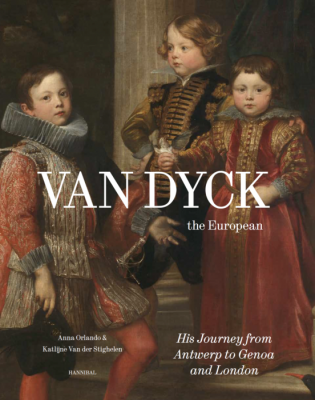
In recent years, Anthony van Dyck (1599–1641) has loomed large in the art historical imagination. A flurry of publications in the 1990s and early 2000s marking 350 years since the Van Dyck’s death sparked renewed interest into his life and works.[1] During the 2010s and 2020s, museum and scholarly enquiries into the Flemish painter have arguably reached new heights.[2] Van Dyck the European, a major exhibition held at Genoa’s Palazzo Ducale this year contributed to this trend, following in the wake of Van Dyck and the Anatomy of Portraiture, held at the Frick Collection in New York in 2026, and Van Dyck at Munich’s Alte Pinakothek in 2019.[3] Comprising sixty works by the artist, including loans from twenty-two public and private collections, Van Dyck the European promised to be the largest monographic exhibition about the artist in over twenty-five years.
The exhibition’s accompanying catalogue follows the aims of the exhibition, namely, to situate Van Dyck within a transnational, European context and trace his career as it unfolded across three vibrant centers in the Low Countries, Italy, and England. Van Dyck’s unusually high level of mobility complicates the traditional geographical boundaries of early modern art history. The painter was born in Antwerp and initially trained in the Flemish tradition yet resided in other cities for significant portions of his career. Furthermore, as the introduction to the catalogue highlights, Van Dyck’s life coincided with a period of dramatic religious, political, economic, climatic, and social upheaval. His trajectory must therefore be understood as one profoundly shaped by the dynamics of an intensely connected and deeply fractured Europe.
Against this backdrop, the catalogue examines the ways in which the artist responded to the sensibilities and demands of his diverse patrons within a climate of immense social change. Specifically, its authors seek to unearth the “exponents of the symbiosis between the painter and the three cities with which he was most familiar. How did the cities, their traditions, their audience and their tastes contribute to Anthony van Dyck’s art.” (17) Highlighting the unique cultural profiles of Antwerp, Genoa, and London draws attention to the artist’s keen ability to adapt his painting to suit the exigencies of his various environments. Furthermore, this geographical approach brings to light the transnational networks that undergirded Van Dyck’s career while also emphasizing how his painterly style developed in tandem with his travels. Buttressed by new archival discoveries, Van Dyck the European provides fresh insights into the artist’s output including and beyond his well-known London period. This catalogue will thus prove useful for specialists while also offering a foundational study for those encountering his oeuvre for the first time.
The catalogue opens with four essays that largely follow the chronology of Van Dyck’s career. Hans Cools convincingly demonstrates how the turbulent history of Europe shaped the painter’s oeuvre, arguing that his “biography is less a sequence of triumphs than a revealing cross-section of a Europe in turmoil, where artistic success was inseparable from the shifting structures of power and belief.” (21) Cools reads the artist’s life and work through this lens, tracing his metamorphosis as he moved from Antwerp, a city paradoxically marked by a “cultural efflorescence and political, economic, and demographic malaise” (23) to Genoa, home to a powerful merchant-banking elite, and on to Sicily, where the painter was quarantined during an outbreak of the plague. Following his Italian sojourn, Van Dyck was increasingly employed by a courtly clientele in Brussels, The Hague, and eventually London. For these aristocratic patrons, he crafted compelling images of noble identity that expressed the sitters’ authority, dignity, and political aspirations. Nonetheless, throughout his career, the painter would grapple with increasing political instability and the vulnerability of courtly societies faced with political, religious, and economic unrest.
The subsequent essays trace the periods of Van Dyck’s life and career spent in several European cities. Katlijne Van der Stighelen and Jean Bastiaensen’s contribution pairs a biographical reading of the painter’s life in Antwerp with a detailed overview of his commissions and interactions with a network of artists and patrons who would influence the “style, iconography and atmosphere” of his painting. (39) This essay is built upon extensive archival evidence and offers crucial glimpses into the social and artistic textures of Van Dyck’s First and Second Antwerp periods, covering his early years and apprenticeship with Antwerp mannerist Hendrick van Balen (1573–1632), his first years as a young master, his output upon his return from Italy, and connections with artists including Peter Paul Rubens (1577–1640) and Jacques Jordaens (1593–1678). The essay also attempts to solve the mystery surrounding Van Dyck’s first studio, believed to be acquired when he was just a teenager. The authors trace the young painter’s relationship with his earliest patrons and supporters, including the Flemish nobleman Christoffel van Etten, who likely granted Van Dyck use of the complex known as Den Dom van Ceulen, and the Genoese merchant Giovanni Agostino Balbi, whose connection with the artist foreshadowed his eventual patronage from Genoese patricians. Surrounded by a vibrant community of artists and collectors, in Antwerp Van Dyck developed a unique stylistic flexibility or “bilingualism” that would capture the imaginations of Europe’s elite.
Following his formative Antwerp years and a brief, exploratory visit to England between 1620 and 1621, Van Dyck traveled to Italy. Anna Orlando’s essay on the painter’s Italian years is a significant addition to scholarship on this lesser-known period of his career. Orlando brings to light new archival documents that update the chronology offered in the 2004 catalogue raisonnée and redates several works to his Antwerp periods, which bookended his time in Italy.
Van Dyck first arrived in Rome in the spring of 1621. During that year, he completed some commissions but mostly dedicated himself to the study of ancient and contemporary art. In 1622, he traveled to Venice and, as Orlando posits, also to Ancona, Florence, Bologna, and Reggio Emilia with the English diplomat George Gage (1582–1638), followed by Padua, Mantua, and Milan. After a month in Turin, the painter made his first trip to the Republic of Genoa. With this new chronology, Orlando argues that Van Dyck did not use the city of Genoa as a “homebase” during his six years in Italy, as has previously been assumed, but rather spent two highly productive stays there between 1623 and 1624, and 1626 and 1627, during which time he was patronized heavily by the Genoese elite. Between these two stints, the painter spent fifteen months in Palermo, where he was quarantined due to an outbreak of the plague. Despite the restrictions on his movements, this proved to be another productive and enriching period during which Van Dyck completed portraits and religious works for Sicilian patrons and even met the great Sofonisba Anguissola (1532–1629). Of particular interest in this essay is Van Dyck’s dense Italian network, carefully mapped by Orlando, which comprised artists, collectors and patrons. Through these connections, the painter found commissions, lodgings, and artistic inspiration.
Finally, Karen Hearn tackles Van Dyck’s mature career at the Stuart Court, where he joined a “lineage of royal painters of northern origins.” (105-106) Despite residing there for less than a decade, he forever changed England’s artistic landscape. Following his Second Antwerp Period, he was called to London by King Charles I to act as “principle Paynter in Ordinarie to their Majesties.” (106) As the official image-crafter of the Stuart monarchy, Van Dyck was tasked with finding and refining an image of powerful and inevitable rule in the face of growing political tension and popular discontent. The painter did not work exclusively for the Crown, however, but established a large workshop capable of performing a meticulous choreography to meet the demands of the fashionable elite. Here, Hearn pays particular attention to the national makeup of the workshop, establishing that Van Dyck favored Flemish apprentices in his workshop over local painters, among them Adriaen Hanneman (1603–1671) and Pieter Thijs (1624–1677).
With a multitude of publications about Van Dyck’s London period, Hearn’s essay provides essential details of this time in the painter’s life, but treats more extensively the rise of pregnancy portraiture in England and considers the painter’s response to this local pictorial trend.[4] Despite the prominence of explicitly pregnant sitters in English portraiture, Van Dyck preferred a more subtle and nuanced approach, using symbolic gestures and meaningful dress elements to convey his sitter’s fecundity. The artist’s last months were spent in Paris, seeking new commissions from the French court as the Stuart monarchy faced its impending collapse, yet another example of inescapable historical forces that the painter encountered throughout his lifetime.
Following these chapters are three brief essays by Nils Büttner, Maria Grazia Bernardini, and Justin L. Davies that explore the dynamics of Van Dyck’s relationship with Rubens; the stylistic evolution catalyzed by his Roman sojourn as seen through his Italian Sketchbook; and the development of his supports over his career, respectively. The remainder of the volume is a richly illustrated catalogue. Divided into four sections, each associated with the cities inhabited by the artist, the catalogue comprises fifty-nine paintings by Van Dyck and three comparative works by Rubens and Geronimo Gerardi. Organized in this manner, the opulence of his Italian portraits, the naturalistic candor of his Antwerp oeuvre, and the shimmering elegance of his London works is immediately apparent. Beginning with his earliest self-portraits painted in Antwerp, the catalogue follows his maturation in Italy and the Low Countries, before concluding with his highly productive London years. Many lesser known but impressive portraits and religious works from private and smaller public collections are given due attention. These include several exquisite portraits and head studies from the Phoebus Foundation; a tenebrous Crucifixion from the church of San Michele Arcangelo in Rapallo, and a captivating allegorical painting of the three ages of man from Vicenza’s Museo Civico di Palazzo Chiericati. The inclusion of these works highlights the quality of Van Dyck’s painting beyond his established masterpieces. Accompanying entries – penned by the volume’s contributors and scholars including Hans Vlieghe, Ben van Beneden, Bert Watteeuw, and Timothy de Paepe – combine discussions of provenance and geographical attribution with discerning insights and iconographical readings, which will be of interest to specialists.
As the scholarship of the past thirty years has made clear, several complex questions arise in relation to Anthony van Dyck’s life and work. Van Dyck the European gestures towards (and partly addresses) some of these issues. Of great significance is his reputation in the historiography of art as a portraitist. Shortly after his death, Van Dyck’s name became synonymous with the genre and the elegant likenesses he executed in his lifetime. Yet with his sitters bedecked in silks and jewels, and his own fondness for fashion, Van Dyck and his paintings came to represent an unattractive and “vulgar commercialism” in the literature.[5] Furthermore, without the moral and cerebral dimensions of history painting, portraiture was dismissed as “mere copying” in early modern art theory. This thinking has tinged subsequent scholarship: Van Dyck is often seen to lack the inventive capacities required for the type of history painting for which his mentor-collaborator Rubens is celebrated. As such, the artist’s association with portraiture has fed persistent narratives of his perceived femininity and flamboyance, excessive love of luxury, and intellectual weakness.[6] Of course, Van Dyck did not receive the deep humanist education enjoyed by painters like Rubens, yet as Van Dyck the European highlights, the young painter had access to classical knowledge, particularly during his time in the Van Balen workshop. Indeed, the catalogue routinely challenges this thinking by giving equal weight to Van Dyck’s role in both the evolution of portraiture and the development and promulgation of new compositional types in history painting. For instance, as Cools’s essay and Orlando’s catalogue entries demonstrate, his creation of an iconography for St. Rosalie in Sicily “gave the new devotion its defining image.” (28) Van Dyck’s imagining of Rosalie was quickly disseminated through Jesuit networks and helped to strengthen the saint’s newly formalized cult. Paying due attention to his allegorical, mythological, and religious scenes, the catalogue conveys the artist’s versatility as a painter and his significant contribution to several genres of painting.
At the heart of the issue, however, is Van Dyck’s seeming inseparability from his illustrious colleague, against whom he is frequently and unfavorably compared. At times Van Dyck the European falls into this trap; the figure of Rubens looms like a specter in its essays and entries and is often the yardstick against which the younger artist’s oeuvre is measured. Furthermore, traditional narratives about Van Dyck’s feminization – in comparison to Rubens’s “masculine” imaginative power – are not entirely avoided. The younger painter’s style is characterized as containing a “nervous sentimentalism” that diverges from the older master’s “rationally balanced” compositions. (49) However, the catalogue also resists these narratives and casts Van Dyck as a painter worthy of celebration in his own right. For instance, in his essay, Nils Büttner argues that the young artist was not Rubens’s pupil but an assistant, an important distinction that allows Van Dyck to step at least partially out of Rubens’s large shadow. Nonetheless, Büttner concedes that the “younger artist’s style emerged from his master’s idiom.” (118) Given the reality of their close association, it is certainly challenging to disentangle the lives and works of the two painters. However, detaching Van Dyck from Rubens’s immense gravitational pull allows for a more nuanced, individualized understanding of the artist to emerge.
Beyond Van Dyck’s positioning in the historiography, the title of the exhibition and catalogue also provoke crucial yet neglected questions around Europeanness, both as it was constructed during the artist’s lifetime and as it is understood today. As is now widely accepted, Europeanness was solidified as an ethnic and racial category during the course of the seventeenth century; indeed, “the European” was actively constructed and assessed in direct opposition to the global societies which with Europeans had increasingly violent and destructive encounters. While tackling this issue was perhaps beyond the intended scope of the exhibition; its inclusion would have been a powerful way to interrogate the role of artists in shaping Europe’s identity. Indeed, one way to begin to address these questions would have been to situate the European cities in which Van Dyck lived within their global contexts: Antwerp, Brussels, The Hague, Genoa, and Palermo, as nodes of the Habsburg Empire, were tightly bound to the conquest of the Americas and the rise of the Atlantic Slave Trade, while London, as the seat of nascent British imperial ambition, was closely connected to key developments in the Atlantic arena.
These complexities could have been explored in several areas of the text, but especially in discussions of Van Dyck’s portrait of the French princess Henrietta of Lorraine (1611–1660).[7] Henrietta, whose portrait Van Dyck painted during his time in Brussels in 1634, is pictured in full length, one hand placed on the shoulder of an Afro-diasporic boy. The child gazes reverently towards Henrietta and offers her a basket of roses. In the portrait’s accompanying entry, this figure is characterized as a status symbol and foil to Henrietta. While not unsound, this analysis could have been enriched by a more nuanced consideration of what the boy’s presence – and the motif of the Afro-diasporic attendant more broadly – conveys about the purposeful orchestration of white Europeanness in Van Dyck’s composition. Indeed, Van Dyck catered primarily to Europe’s courtly and commercial elites, most, if not all, of whom were deeply implicated in the various levels of European imperialism. This global interconnectedness was integral to the kind of image-making for which he was particularly sought after. Painting for rulers of and participants in the British and Habsburg Empires, Van Dyck’s art helped to construct and project an idea of what Europeanness and European hegemony looked like within a climate of increasingly asymmetrical global encounters. This facet of his European identity warrants a closer look.
Despite this omission, Van Dyck the European remains a solid if traditional contribution to the corpus of works by the artist. The depth of the archival research carried out – especially into his largely understudied Italian period – is impressive and provides an enriched picture of the artist, his life and works. The catalogue will thus undoubtedly inspire further conversations about how the structures and cultures of the world Van Dyck inhabited shaped the contours of our own.
Ana Cristina Howie
Cornell University
[1] Key works include Susan J. Barnes and Arthur K. Wheelock, eds., Van Dyck 350 (Washington DC: National Gallery of Art, 1994); Susan J. Barnes et al., eds. Van Dyck a Genova: grande pittura e collezionismo (Milano: Electa, 1997); Christopher Brown, Hans Vlieghe, and Frans Baudouin, Van Dyck: 1599-1641 (London: Royal Academy, 1999); and Susan J. Barnes et al., eds. Van Dyck: A Complete Catalogue of the Paintings (New Haven: Paul Mellon Centre, 2004).
[2] Recent monographs on van Dyck include Christopher White, Anthony van Dyck and the Art of Portraiture (New Haven: Yale University Press, 2021); Adam Eaker, Van Dyck and the Making of English Portraiture (New Haven: Yale University Press, 2022); and John Peacock, Van Dycks’ Genoese Nobles: Two Portraits in Context (Leiden: Brill, 2026).
[3] Stijn Alsteens and Adam Eaker, eds., Van Dyck: The Anatomy of Portraiture (New York: The Frick Collection, 2016); Mirjam Neumeister, ed., Van Dyck (Munich: Hirmer Verlag, 2019).
[4] Key texts include Oliver Millar, Van Dyck in England (London: National Portrait Gallery, 1982) and Karen Hearn, Van Dyck and Britian (London: Tate Britain, 2009).
[5] Eaker, Van Dyck, 6
[6] On the implications of this literature, see Eaker, Van Dyck, 6-8.
[7] The portrait is in the English Heritage Trust and is on display at Kenwood House, London.