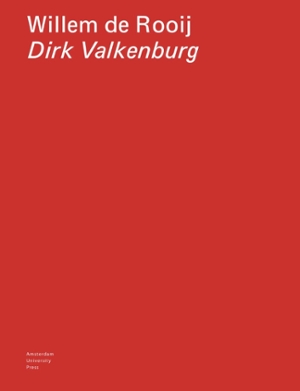
This volume appeared as a pendant to Willem de Rooij’s solo exhibition Valkenburg, on view at the Centraal Museum, Utrecht, September 13, 2025 – January 25, 2026. It sets out to achieve ambitious and complementary goals: to serve as a contextualization for and record of the exhibition, to provide the first catalogue raisonné of Dirk Valkenburg’s known oeuvre, as well as a multidisciplinary reader of fifteen essays that invites intersectional analysis of Valkenburg’s work. This follows De Rooij’s 2010 project Intolerance, presented at the Neue Nationalgalerie, Berlin, which engaged the work of Melchior d’Hondecoeter and similarly consisted of an installation and catalogue raisonné publication. Since this author was not able to view the Valkenburg exhibition in person, this review remains limited to the book. However, it is important to consider the publication’s genesis in this installation project. Edited by De Rooij and Karwan Fatah-Black, it could perhaps be characterized by a similar strategy of “montage” (8) juxtaposing essays that, while functioning autonomously, inform each other’s reading and invite shifting perspectives on their respective topics. Beginning and ending the essay section with reflections on different historic and contemporary uses of flags (De Rooij and Fatah-Black 24-25; Karin Amatmoekrim 263-67), the volume employs a dialectic of subjectivity and elusive meaning that reverberates throughout.
De Rooij and Fatah-Black’s introductory essay identifies the common thread in the publication and across the seemingly divergent artistic genres in which the painter was active: game, hunting, and fruit still lifes, scenes with animals, views of plantations in Suriname, and portraiture. While Valkenburg’s work in Suriname, produced in the service of Jonas Witsen between 1706 and 1708, has more frequently been discussed in relation to the Dutch colonial project, the authors note that the works he produced both before and after this trip were entangled in this history as well. Outlining the volume’s various essays, they call attention to an underlying dynamic: Valkenburg’s participation in a visual archive that constructs the elite white male subject through a classification of difference – between human and animal, between racialized categories, and between the sexes. It is, however, predominantly the scenes representing Witsen’s plantations Waterland, Palmeneribo and Surimombo that prompt the extended contextualization presented in this volume, which makes it a compelling contribution to contemporary scholarship on art of the Dutch Atlantic in particular.
The first two sections “Life and Work” and “Appraisal” provide thematic essays one would readily expect in an artist monograph, such as a biographic overview based on documentary evidence (Mark Ponte), aspects of the oeuvre in relation to studio practices (Julie Hartkamp on hunting trophy still lifes) and network (Sabine Craft-Giepmans on portraits), and a reception history (Matthies Klink). Yet, as will become clear, these essays lay a thoughtful foundation for deeper analysis. Ponte, for instance, includes the bone chilling testimonies about the 1707 uprising of enslaved workers at the Palmeneribo plantation, during which the artist assaulted one of the men, Wally, who was later sentenced to death by burning (39). Valkenburg is also described in his role as plantation employee, who was not averse to ownership of a futuboi, or enslaved child used for errands (34). It is important that these truths are acknowledged early on. Ponte is also attuned to what can no longer be reconstructed, including the precise identities of people Valkenburg has depicted, or the exact motivations Valkenburg had in traveling to Suriname and leaving prematurely. The documentary evidence presented, however, helps us start to question narratives supplied by earlier biographers like Johan van Gool (1685-1763), and foresees questions that will be raised again by other authors. Ponte’s essay is helpfully followed by an essay by Frank Dragtenstein that gives further details of the uprising and the central figures in this history.
Hartkamp’s thorough analysis of Valkenburg’s hunting still life compositions reveals a reliance on models to reuse motifs systematically in the production of variants. This not only informs our understanding of this section of his oeuvre but also becomes crucial context for interpretation in other genres, including his fruit still lifes and Suriname work – employing a standardized approach to the presentation of other kinds of “trophies” (67). Maurice Saß places hunting still lifes in a broader social and political context of human and white male supremacy, including issues of invisible labor, and extractive human-animal relations. Rebecca Parker Brienen writes a comprehensive history of the interpretations of Valkenburg’s best known work, Gathering of Enslaved People on One of Jonas Witsen’s Plantations in Suriname (Statens Museum for Kunst, Copenhagen; cat. 70), as tracked through cataloguing (particularly assigned titles), curation, and scholarship, to which she herself has been an important past contributor. She describes a history of conflicting interpretations, ranging from ethnographic to art historical. Perceptions of the work have been both positive – e.g. capturing a rare glimpse of marginalized lives in a moment of defiance – and extremely negative, as predominantly promoting racist stereotypes. While she concludes that the work most likely is a product of artifice, created in the artist studio based on intermediary drawings of non-consenting people, she identifies the crux of its unresolve as she writes “and yet, there is violence done to these same individuals if we ignore their lives, culture and historical circumstances in an effort to limit our analyses to established traditions and practices.” (124)
Gathering of Enslaved People figures heavily in several contributions in the sections “Tropics” and “Visual Culture” that follow, and the complexity of this painting in particular compounds within the volume. Renzo S. Duin and Agir Axwijk share the valuable insights of Hedi-Kabiten Mutu Poeketi, chairman of the council of Sa’amaka village leaders and representative of the Surinamese Maroon communities in Europe, who underscores the artifice of the scene by calling attention to the improbability of a figure leaning on the drum (which would be considered extremely disrespectful) and the likewise implausible public displays of affection (168). Poeketi also identifies the drum as a zangklimbu doong, which was used only for apuku ceremonies. These included drumming, song, and dance to invite the intervention of powerful deities, the precise contents and meaning of which remain with the appropriate knowledge keepers. The presence of this specific drum in the painting indicates the occurrence of such ceremonies around the time of Valkenburg’s visit – possibly in relation to the uprising that would soon follow. If the ceremony can be interpreted as the “condition and genesis” of the painting, as the authors propose (175), it was however significantly complicated by the level of artistic artifice and lack of understanding on Valkenburg’s part.
The value of the multidisciplinary approach of this volume is that different contributions offer perspectives on this painting that may diverge yet hold simultaneous truths. Sarah Thomas, considering the audience of one for which the painting was originally intended, notes the work’s emphasis on fertility and reproduction – a trope that appeased enslavers like Witsen in the context of growing abolitionist sentiments and offered reassurance about their economic investment (254). She notes that Witsen hung the work in his cabinet of curiosities rather than his paintings gallery, reinforcing the idea that the work was explicitly meant to document “possessions” (246). This mode of viewing, combined with the conspicuous nudity and displays of affection in the painting, also deliberately evoked erotics and racialized transgressive desire for its intended audience, as Will Furtado Fredo observes (196). Furtado Fredo considers what subjectivities the artist and his colonial patron suppressed in their engagements with the work and opens a door to contemporary subversive readings via the concept of “race play” – employing a parody of transgression to reveal the fallacy of racism (202).
In its sensitivity to the various audiences for which this body of work holds past, present, and future meaning(s), this publication poses a fundamental question: what is the value and justification of engaging scholarly (or otherwise) with artistic production that is explicitly based in violence? Some essays focus their analysis on how Valkenburg’s oeuvre is complicit in a larger visual context that supported the colonial project, such as Benjamin Schmidt’s insightful contribution on the coconut as material and motif in the service of the colonial imaginary, and Lilia Moritz Schwarz’s contextualization of Valkenburg in colonial European visual traditions more broadly. Acknowledging the rarity of representations of plantations in this place and historic moment, the book also offers contributions that consider how alternative histories can be accessed through them. Alex van Stipriaan takes the ubiquitous waterways represented in these views as a departure to think through their intersections with Afro-Surinamese oral traditions and spirituality. In addition to the aforementioned Sa’amaka Maroon perspective, Renzo S. Duin, Philip Dikland, and Agir Axwijk offer a very welcome and insightful contribution that center Indigenous voices in a review of archival sources and Caribs/Karina, Arowak/Lokono and Warrau oral tradition relative to the places Valkenburg depicted. Their reading calls upon histories of Indigenous place-naming, resistance, and presence, both before and long after Valkenburg’s visit.
The essays are followed by the catalogue raisonné, produced in collaboration with the RKD, which makes helpful distinctions between still life variants (detection of which has been aided by a systematic implementation of the visual search option of RKD Research) and gives clarity about Valkenburg’s previously lesser studied portraits. Identification of Surinamese flora and fauna, credited in the footnotes to botanists Eliza Zschuschen and Dorothy Traag, among others, has established more accurate information and titles for the fruit still lifes in particular. The entries are accompanied by full page color illustrations that make it a very attractive and useful book, which reshapes the catalogue raisonné format into a multi-authored volume that provides more contextualization than typically is the case. This is overshadowed in some way by the single-authored appearance of the project, with most prominence given to Willem de Rooij as originator in a way that perhaps was more suitable for the exhibition project than for this publication. While this could have been a marketing decision, given the topic and intention of the volume, it feels somewhat uneasy. If we see the approach of the book as an extension of the artistic project (which I have done here), perhaps this prompts a more introspective question for the field of Dutch art: does openness to multidisciplinary or polyvocal perspectives in 2026 need artist intervention?
Also published as an open access e-book, this publication offers a significant contribution to early eighteenth-century Dutch art and its entanglements with colonialism, conveniently made available to a wide audience. While it occasionally could have been embedded more thoroughly in existing and recent scholarship, the critical essays provide valuable new insight into a body of work that undoubtedly will continue to pose questions – and problems – for many audiences to come.
Suzanne van de Meerendonck
Agnes Etherington Art Centre, Queen’s University