In 2007, Koenraad Jonckheere published a monograph on the relatively little-known, under-studied Antwerp painter, Adriaen Thomasz. Key: Adriaen Thomasz. Key (c. 1545 – c. 1589): Portrait of a Calvinist Painter; Brepols (Pictura Nova, XIV). This was followed in 2011 by the same author’s monograph on Key’s better-known Antwerp teacher, Willem Key (no familial relation): Willem Key (1516-1568): Portrait of a Humanist Painter, with an Appendix to the Oeuvre of Adriaen Thomasz. Key; Brepols (Pictura Nova, XVII). Notwithstanding a notable career that included distinguished patrons and important commissions, Willem Key was still generally relegated to second-tier status relative to his more famous contemporaries, Anthonis Mor, Pieter Pourbus, and Frans Floris. As the 2011 book title indicates, Jonckheere concluded his monograph on Willem with an Appendix on Adriaen, cataloguing nearly twenty newly surfaced or reattributed paintings to him. The present volume, now the third in this “series” about these two linked painters, takes over the latter procedure. Other than its 11-page Introduction, this entire book consists of Addenda devoted to updating the two earlier catalogues raisonnés. It catalogues 68 new additions or clarifications to the oeuvres of both these artists since 2007 and 2011, and it profiles another 22 works as dismissed attributions.
Jonckheere is the editor of this volume, an occasional collaborator, and the author of its brief but incisive Introduction. The book’s attributions and its catalogue entries are the domain of Lien Vandenberghe, with assistance from Gijs Key, who had previously helped Jonckheere in his 2011 monograph. Vandenberghe, a Ph.D. student at the University of Ghent, has Jonckheere as her graduate supervisor.
The breakdown of works catalogued here is established by counting the Addenda entries according to both artist and category (Add. A1, Add. B1, Add. C1, etc.). For Willem Key, 26 catalogued pictures are signed or securely attributed (category A). Many of them reveal recent discoveries or works newly resurfaced, reattributed, or altered in location, often formerly unknown. Five others are likely, but uncertain, attributions (category B). And 14 works make up dismissed attributions (category C). For Adriaen Thomasz. Key, 35 works appear in category A, 2 in category B, and 8 in category C. These combined 68 works from categories A and B constitute a very significant enlargement – and clarification – of the two artists’ oeuvres.
In his Introduction, Jonckheere starts by addressing portraiture by each artist, his principal field of activity. He emphasizes their austerely serious portraits, typical of the time. This is particularly true for Adriaen Thomasz., who “adhered strictly to an extremely austere format throughout his career… Rarely is the oeuvre of a [portrait] painter so uniform.” (p. 7). In this connection, Jonckheere returns to a theme developed in his 2007 book: the influence of Calvinism in shaping Adriaen’s strict, dispassionate mimesis. But here he also introduces another influence, the study of physiognomy, also prominent at the time.
The paintings presented here show that history and religious pictures were more significant than previously recognized, especially in the work of Willem Key. On the other hand, devotional work is likely underrepresented in the extant oeuvre of Adriaen Key, owing to the depredations of iconoclasm, which would have negatively impacted his already completed religious work and affected his future production choices and possibilities after 1566. Adriaen lived and worked under the dark shadow of iconoclasm far longer than Willem, who died in 1568. Among Adriaen’s surviving religious works, one is especially notable. The righthand thief in his Valencia Christ on the Cross was later adopted by Rubens for the counterpart figure in his famous Coup de Lance (Koninklijk Museum, Antwerp; see p. 12 and Add. A32, pp. 194-95).
Among the especially significant Addenda here are Add. A30 (p.190), a beautiful drawing by Adriaen Thomasz. of the Virgin and Child that surfaced in 2007. After its discovery, it is now the artist’s second known drawing. Add. A8 (p.140) is a small, handsome, three-quarter view of a standing gentleman with right arm akimbo (his hand gorgeously foreshortened). Its date, 1568, was the year when Adriaen joined the Antwerp guild as a free master and the year of Willem’s death, when Adriaen took over his studio. This makes it one of Adriaen’s first paintings as an independent master. For Willem, two portrait miniatures have come to light: Add. A7 and Add. A8. Finally, it is intriguing to learn that Horace Walpole owned and displayed two Willem Key portraits at Strawberry Hill, Add. A1 and A3, the latter descended from the royal collections of Charles I and Charles II.
In a separate, bizarre afterlife stands Willem’s large, often-copied Lamentation of Christ (Add. A19, Belgian private collection). A simplified version of it has been in the collections of the Dukes of Bavaria since the early seventeenth century. There, Vandenberghe stresses, it “sparked a specific devotional culture” (p. 68), which included copies made in wax with real human hair.
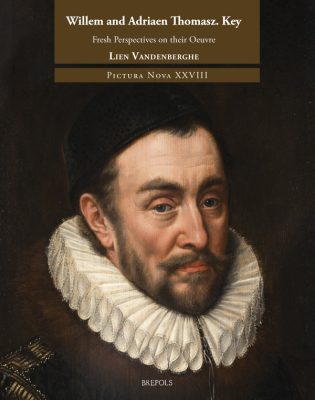
Both Willem and Adriaen Thomasz. executed portrait commissions for noble sitters, as the two previous monographs had emphasized. Several notable portraits are added here. The book’s jacket photo reproduces Adriaen Thomasz.’s exquisite, perceptive portrait of William of Orange (1583; Add. A5, p. 132), one of four autograph versions painted by the artist. There is also a fine copy of a portrait bust of the Count of Horne in full-dress armor (Add. A23, p. 172), confident in life, years before his 1568 public execution by the Spanish in Brussels’ Grand Place. The catalogue also includes an exquisite, full-length formal portrait of Margaret of Parma, Governess of the Netherlands (Add. A13), whose chief councillor, Cardinal Grenvelle, was Horne’s nemesis. Previously attributed to Anthonis Mor – thus confirming its high quality – Vandenberghe reassigns it to Willem and argues that it was likely painted from life. Finally, there are the curious pendant portraits of the Duke of Alba and his wife, copies by Willem (Add. B2, B3). I say “curious” because, in contravention to the generally invariable rule, the Duchess is positioned on stage left, the side of honor, while her husband is relegated to stage right, the lesser position. By contrast, the canonical arrangement is seen in all other pendant portraits illustrated here: Add. A4 & A5; Add. A12 & A13, pp. 148-49; and Add. A15 & A16, pp. 154-55.
This catalogue is an invaluable addition to the older Jonckheere monographs and to the growth of scholarship on Willem and Adriaen Thomasz. Key since then. In relation to portraiture of the time, these three books occupy an important place in the salutary growth of scholarship on sixteenth-century portraiture. This growth includes, for example, a study of less familiar portrait artists in contemporary Bruges – Frans II Pourbus, and Pieter I, Pieter II and Gillis Claeissens, among others (Forgotten Masters: Pieter Pourbus and Bruges Painting, 1525-1625, exh. cat., Bruges, Groeningemuseum, 2017). More recently, Peter van den Brink has also significantly added to this scholarship with a series of exemplary publications on the Master of the 1540s (Cornelis van Cleve?).
Note: Both the 2007 and 2011 Jonckheere monographs were reviewed at HNA. They are archived in the HNAR website: https://hnanews.org/hnar/reviews/book-reviews. The previous reviews can be found here (2007) and here (2011).
Dan Ewing
Barry University, Emeritus