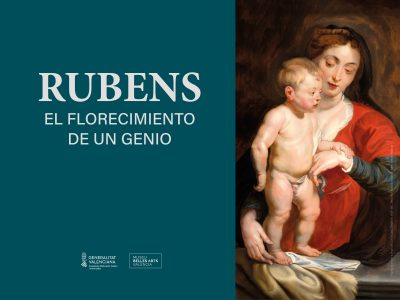
Exhibition: Rubens. The Blossoming of a Genius
Venue: Museum of Fine Arts of Valencia (Spain)
Dates: 3 July- 4 October, 2026
Guest Curator: Ana Diéguez-Rodríguez
On 2 July, the Museum of Fine Arts of Valencia will open Rubens. The Blossoming of a Genius, an exhibition curated by Dr Ana Diéguez-Rodríguez. The exhibition explores the formative years of Peter Paul Rubens, tracing his artistic development from his apprenticeship in the workshops of Tobias Verhaecht, Adam van Noort and Otto van Veen to his admission as a master in the Antwerp Guild of St Luke in 1598 and his subsequent work for the court.
Rubens’s return to the Southern Netherlands following his Italian sojourn (1600–1608) marked the emergence of an artist whose close relationship with the Archdukes Albert and Isabella would become one of the defining features of his career. The exhibition examines how Rubens came to embody an artistic vision placed at the service of political, religious and cultural ideals. Within the context of the Twelve Years’ Truce (1609–1621), his artistic genius reached full maturity, establishing a model that would profoundly influence the course of European painting for decades.
For the first time, visitors will be able to experience the cultural and artistic environment of Antwerp during the final decades of the sixteenth century. The exhibition brings together works associated with some of the city’s leading artistic personalities, including Maerten de Vos, Willem Key, Adriaen Thomasz. Key, Crispijn van den Broeck and Pieter Pourbus II. It also offers a rare opportunity to view works by Adam van Noort in a Spanish public institution for the first time and presents the largest group of paintings by Otto van Veen ever assembled in an exhibition context, moving beyond the emblem books for which he is principally known.
The exhibition includes several remarkable discoveries and exceptional loans. Among the highlights is one of the paintings from the Facchetti series that Rubens famously “restored” after it was damaged while being transported from Mantua to the court of Philip III in Valladolid. Also on display is an oil sketch for the high altar of the Chiesa Nuova in Rome, a work virtually unknown to the Spanish public. Another major contribution is the identification, within a surviving fragment, of part of the long-lost composition of The Continence of Scipio, a painting recorded in the collection of the 2nd Duke of Richelieu in 1681 and described by Roger de Piles.
The accompanying catalogue features essays by leading international scholars, including Dr Ralph Dekoninck (KU Leuven), Dr Alexandra Libby (National Gallery of Art, Washington), Dr Raffaella Morselli (Sapienza University of Rome), Dr Sirga de la Pisa (CEU San Pablo University, Madrid), and the exhibition’s curator, Dr Ana Diéguez-Rodríguez (Instituto Moll, Madrid).
Works have been generously lent by major international institutions, including the Ashmolean Museum, Oxford; the Real Academia de Bellas Artes de San Fernando, Madrid; Gemäldegalerie der Akademie der bildenden Künste Wien; The Albertina Museum, Vienna; Biblioteca histórica “Marqués de Valdecilla” de la Universidad Complutense of Madrid; Biblioteca Nacional de España; Biblioteca de la Universidad of Valencia; Cathedral of Our Lady, Antwerp; Casa de Alba Collection, Madrid; Epiarte Collection (Spain); Private collection Luxemburg in a long term loan to the Snijders/Rockox Museum Antwerp (Belgium) and to the MNAHA (Musée National d’archéologie, d’histoire et d’Art) (Luxemburg); Monastery of Saint Clare in Medina de Pomar (Burgos); Hermanas Clarisas del Monasterio de la Inmaculada (San Antonio) Church of Saint Anthony, Vitoria-Gasteiz (Álava); Kupferstichkabinett, Staatliche Museen zu Berlin; MAH Musée d’art et d’histoire, City of Geneva (Swiss); Museum of Fine Arts of Valencia; Royal Museum of Fine Arts Antwerp – Flemish Community (KMSKA); Museo Lázaro Galdiano, Madrid; M-Leuven Museum, Leuven; Museu Nacional d’Art de Catalunya, Barcelona; Museo di Palazzo Ducale di Mantova (Italy); Museo Nacional del Prado, Madrid; Museo Nacional Thyssen-Bornemisza, Madrid; Patrimonio Nacional. Colecciones Reales (Spain); The Phoebus Foundation, (Belgium) and San Telmo Museoa, Donostia-San Sebastián.