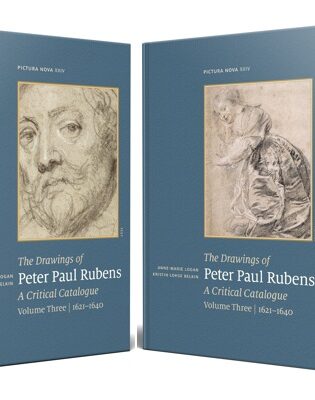
At the end of last year, the long-awaited third and final volume of the The Drawings of Peter Paul Rubens by Anne-Marie Logan and Kristin Lohse Belkin was published. After all the publications that have dealt with Rubens’s drawings as selective overviews, this is the first time a catalogue raisonné of all surviving drawings by the greatest Flemish artist of the seventeenth century has been completed and made available in print. Not only are the in-depth analyses of the individual drawings invaluable, it is equally worthwhile to explore all the given cross connections, which make it possible to link drawings from his entire career and compare them within a rich variety of contexts and issues. It was Sir Christopher White who reviewed the previous volumes in this journal: https://hnanews.org/hnar/reviews/the-drawings-of-peter-paul-rubens-a-critical-catalogue-volume-one-1590-1608 and https://hnanews.org/hnar/reviews/the-drawings-of-peter-paul-rubens-a-critical-catalogue-volume-two-1609-1620-pictura-nova-xxiii. The eminent scholar and expert on seventeenth-century Flemish and Dutch art recently passed away.[1] This review is dedicated to his memory.
The texts of Volume III are written exclusively by Kristin Lohse Belkin. With only few exceptions (e.g. Addenda, cat. A6, A8), the attributions and de-attributions of the drawings continue, as in the preceding two volumes, to be based on Anne Marie Logan’s expertise. Volume III comprises 161 catalogue entries (cat. 427–588), covering almost twenty years of Rubens´s drawn oeuvre (1621-1640), plus eight in the Addenda.
A general observation that the authors emphasize throughout the catalogue – and one that readers should bear in mind before exploring its individual entries – is the remarkable development Rubens underwent as a draftsman during these years. The volume documents the full spectrum of his graphic practice, ranging from the earliest, cursory compositional sketches, known as primi pensieri in Italian and crabbelinghen in Flemish (Studies for the Virgin and Child, cat. 486; Dancing Peasants, cat. 509) to highly finished studies, such as expressive head studies for saints (Young Woman with Crossed Hands, cat. 508).
The authors also discuss Rubens’s modelli for engravings and woodcuts. While many served as preparatory designs for reproductive prints, a small number were conceived independently by the artist. Among these are designs based on ancient engraved gems, including the celebrated Gemma Tiberiana, which Rubens intended to have engraved for his projected publication on antique gems – a scholarly undertaking that ultimately remained unfinished. Prepared by engravers or woodcutters, the drawings for reproductive prints were reworked by Rubens, often to such an extent that Logan and Belkin convincingly regard these designs as works in his own hand (Christ on the Cross, cat. 502; The Garden of Love, cat. 543 and 544).
A distinct group within the catalogue consists of the sometimes highly finished portrait drawings that Rubens made of members of his family and of prominent political figures associated with the English and Spanish courts. In a brief Addenda section, Logan and Belkin discuss a small number of drawings that came to their attention too late to be incorporated into the chronologically appropriate parts of the catalogue. The Addenda are followed by an equally concise Corrigenda section, in which the authors reconsider drawings for which they now agree on revised dates. The excellent design of Volume III, including the high-quality illustrations in the plate volume, maintains the standard established by the two earlier volumes.[2] Throughout, the catalogue preserves a clear and highly accessible organizational structure.
Perhaps it is useful, before considering the catalogue from a few selected perspectives, to briefly recall the principal events that shaped Rubens’s career during these years. They included a series of major artistic commissions as well as important biographical milestones: the execution of the Medici cycle; his long-standing collaboration with engravers and woodcutters, which produced groundbreaking innovations in the development of printmaking; the commission for the ceiling paintings of the Banqueting House at Whitehall Palace; and his diplomatic service to the Spanish Crown, which took him to Madrid and London. These years also saw the knighthood conferred upon him by King Charles I and, in 1630, his second marriage to Helena Fourment, who was then barely sixteen years old. Finally, in 1635, he purchased the country estate Het Steen and left Antwerp to settle in the countryside.
To reflect this trajectory of Rubens’s career, the authors chose for the two covers drawings of exceptional evocative power that offer rare glimpses into the artist’s private world: his late self-portrait, a forcefully sketched close-up in black chalk (cat. 588), and the magnificent chalk study of a young woman in a shimmering gown, made for The Garden of Love, whose features seem to evoke those of Helena Fourment (cat. 527). The self-portrait, whose remarkable intimacy has long intrigued scholars, presents a man who has unexpectedly abandoned all ceremonial distance and theatrical self-fashioning, revealing himself with a striking degree of immediacy.
The very selection of these two drawings touches on a particularly sensitive issue in the study of Rubens. In fact, it has often been pointed out how complex it is to form an idea of Rubens’s private life, whether through his artistic work or his correspondence – even though the latter was so extensive that it fills entire volumes. As Julius Held observed, Rubens was: “By nature discreet, and especially reticent when it came to speaking of himself,”[3] while Evers had previously expressed similar sentiments when he wrote: “The greatest gap in research lies into Rubens’s psychology, into the background to his character. Perhaps it might be considered presumptuous to set this as a research objective at all.”[4] This makes the few moments in his drawn oeuvre all the more precious, in which, like in the two cover images, slight insights into his private life shine through.
As in the other two volumes, in Volume III the authors face the problem that Rubens rarely signed his drawings or designs. However, the artist added explanatory or commenting inscriptions to some of his designs (cat. 541), so that an analysis of his handwriting might offer clues for more precise dating. Contracts related to the title page designs Rubens created for the Plantin publishing house also facilitate chronological classification (cat. 536). For example, on December 10, 1633, 2 guilders and 8 stuivers were paid to the engraver Karel van Mallery (1575–1631?) for engraving the text on the title page covering a collection entitled Epigrammata et Poemata by various contemporary authors (cat. 541). In other cases, Rubens had the engraver sign the title page with his own name. In this context, one could refer to the title page of Balthasar Cordier’s Opera Dionysii Areopagita (cat. 536). It would, however, be mistaken to infer from the inscription Pet. Paul Rubenus pinxit on the engraving that Rubens necessarily executed the original design for the title page as a painting. In this context, the verb pinxit should instead be understood in the broader sense of “created” or “designed.”
As for Rubens’s preferred drawing media, starting from around 1621, a shift from his earlier years as a draftsman can be observed: now, most of the surviving drawings were executed in pen and brown ink as well as black chalk. Only a handful of drawings are done in red chalk. In his portraits and studies of saints’ heads the artist preferred to combine several media (A Girl in Profile, cat. 557; Portrait of Helena Fourment, cat. 521; Study of a Seated Nude Woman – Helena Fourment, cat. 549). The same applies to his highly finished designs for title pages and engravings (cat. 502, 536, 582).
Moreover, this final volume makes particularly clear just how many of Rubens’s drawings have been lost. This is especially true of the preparatory studies he must have executed for his major commissions, most notably the Medici cycle, which occupied him from 1621 to 1625. Rubens had first encountered Marie de’ Medici in October 1600, when, as a recent member of the Gonzaga court, he attended her proxy marriage to Henry IV in Florence Cathedral and drew the small pen-and-ink profile portrait now in the British Museum (Vol. I, cat. 31). It is almost certain that, some twenty years later, while working on the Medici cycle, he produced numerous portrait studies of the queen. Yet only four are known to survive today (cat. 434, 438, 439, 475), one of which appears to have been drawn after a bronze bust by Guillaume Dupré.
As proposed by Logan and Belkin – a view with which this reviewer concurs – it is likely that, with the exception of the study after the bust by Dupré, the surviving portrait sketches were drawn from life during Rubens’s visits to Paris in 1622 and 1625. This hypothesis is supported by the French art critic Roger de Piles, who reported in 1677 that Marie de’ Medici visited the artist several times in his Paris studio, thereby affording him opportunities to sketch her from life. Nevertheless, when preparing the principal portraits for the Medici cycle, Rubens requested that a cast be taken from a bust of Marie by Barthélemy Prieur and sent to him in Antwerp, so that he could use it as a reliable point of reference alongside the sketches executed in Paris, in addition to the earlier drawing he had made after the bust by Guillaume Dupré.
Reading the three volumes of the catalogue side by side makes strikingly clear the extraordinary extent to which Rubens, at any given moment, could draw upon both his visual memory and his accumulated visual archive. His remarkable ability to keep these resources constantly at his disposal over the course of decades is demonstrated time and again. This is especially evident in the copies he made as a young artist during his years in Italy after masterpieces of the Italian Renaissance. Two such copies deserve particular attention. The first is Rubens’s celebrated red chalk copy after one of Michelangelo’s ignudi on the Sistine Ceiling (British Museum; Vol. I, cat. 158; c. 1606). More than twenty years later, he took a counterproof from the drawing, transforming the figure into Apollo, Bestowing Royal Liberality in the magnificent grisaille modello for the Banqueting House ceiling (cat. 538). Less frequently discussed is Rubens’s copy after Francesco da Sangallo’s sculpture of the reclining Pan. Roughly two decades later, he likewise made a counterproof from this drawing and extensively reworked it (cat. 539).
As Held already observed, the number of Rubens’s portrait drawings increased during the 1620s. Among the finest is the sketch of the young Spanish king Philip IV (cat. 491), executed in black chalk with pen. During his second stay in Madrid in 1628 – this time as a diplomatic envoy for Clara Isabella Eugenia – Rubens met the twenty-three-year-old monarch daily, as he reported in a letter to his close friend Gaspar Gervartius.[5] He was thus able to study the king’s appearance and character at leisure, unlike a few years earlier in Paris, where he probably had only limited opportunities to sketch Marie de’ Medici. In the same letter Rubens remarked that he was suffering from severe attacks of gout, which confined him to bed for extended periods. The portrait sketch is therefore all the more remarkable. Executed with extraordinary speed and assurance, it transcends the conventions of official portraiture – which Rubens would inevitably have had to observe in a painted likeness – and instead conveys a vivid impression of the young monarch’s personality.[6]
Another portrait drawing from this period is that of the young George Gerbier, executed in London in 1629–30 (cat. 495). Beyond its striking individuality, the sheet is a profound study in elegiac expression. Logan and Belkin have described it as “an intimate and sensitive portrait of a young boy,” but it may be taken a step further by observing that, in this and several other portrait drawings, Rubens began subtly to idealize his sitters. This interpretation is supported by his incorporation of portraits of the Gerbier children into the allegorical painting Minerva Protects Pax from Mars (National Gallery, London), in which George appears in the guise of Hymen.
A recurring leitmotif that emerges as a defining artistic characteristic throughout Volume III is the economy with which Rubens executed his drawings. In both his designs for engravers and certain figure studies for paintings, only selected parts of the composition are fully developed, while others are either omitted altogether or indicated with only the briefest of sketches. Rubens adopted this practice whenever the unresolved passage had already been established in another drawing (Young Man Embracing a Young Woman, 1631/32, cat. 525) or when elements of the composition – such as an architectural framework – were intended to be repeated in reverse on the opposite side of the sheet (Plantin’s Printer’s Mark, cat. 490).
As for the subjects Rubens explored in his drawings, Volume III demonstrates the remarkable consistency with which he returned to, revised, and reinterpreted themes that continued to engage him throughout his career. Among these were the Twelve Labors of Hercules, and in particular the episode of Hercules Strangling the Nemean Lion. The earliest surviving drawing of this mythological struggle dates to 1602–05 (Vol. I, cat. 152). A second version, originally dated by the authors to 1605–07 in Volume I but now reassigned to around 1620 (Vol. III, Corrigenda, I:167), was revisited and reworked by Rubens in 1639. In that same year he also produced another variation on the subject (cat. 586), indicating that he was simultaneously engaged with two distinct interpretations of Hercules Strangling the Nemean Lion.
A small section of Volume III is devoted to a category of drawings that Rubens only began to pursue more extensively in the final years of his career and which, consequently, received little attention in the previous volumes: his landscape drawings and studies from nature (cat. 565–569). These works occupy a distinctive place within his oeuvre, as many are connected with paintings executed for his own pleasure rather than for patrons. They belong to the period following the completion of his diplomatic missions, when Rubens had largely withdrawn to his country estate, Het Steen, where he spent much of his time.
Since the exhibition Van Dyck’s Landscape Drawings and Watercolours, curated by Martin Royalton-Kisch at the British Museum in 1999, a number of studies from nature that had long been accepted as works by Rubens have been reattributed to his most gifted pupil, Anthony van Dyck. Among them is the celebrated Dead Tree Overgrown with Brambles (Chatsworth). These reattributions have underscored the remarkable affinity between master and pupil, revealing how closely their drawing techniques – and even their artistic conception of nature – could at times converge.
In a catalogue raisonné of this scale and importance, it is inevitable that observations of broader significance – extending beyond the individual drawings under discussion – are dispersed throughout the catalogue entries and may therefore escape the reader’s attention. Only a selection can be highlighted here, including several that illuminate aspects of Rubens’s working methods and artistic practice more generally.
- Rubens was right-handed and habitually worked from left to right. This seemingly simple observation is crucial for understanding his working process and may even help reconstruct the chronological sequence in which he placed multiple sketches on a single sheet, sometimes juxtaposing mythological and Christian subjects (cat. 554).
- In his later years, when drawing on both sides of a sheet, Rubens increasingly established thematic relationships between recto and verso, a practice that is not evident in his earlier work. One example is the drapery study for Helena Fourment on the verso (cat. 583), paired with a portrait of his young wife on the recto (cat. 522). The same principle applies to his late self-portrait, on the reverse of which he rapidly sketched the much-discussed nude couple embracing (cat. 588). Most poignant is the famous portrait of his first wife, Isabella Brant (British Museum; cat. 431), on whose verso Rubens later drew himself with his second wife, Helena Fourment, and one of their children (cat. 572).
- Although Rubens regularly reused figure studies in different contexts (cat. 524), he also employed them in compositions of markedly contrasting meaning. The female figure originally devised for The Garden of Love (cat. 530), for example, reappears as the companion of marauding mercenaries in a later composition (cat. 579), demonstrating the remarkable adaptability of his figure inventions.
- Recurrent disruptions in the supply of paper – particularly the fine paper imported from Lorraine – caused by warfare and severe winters affected artistic and publishing practice alike. The shortage had a discernible impact both on the Plantin-Moretus publishing house (cat. 529) and on Rubens’s increasingly economical use of paper in his drawings (cats. 492, 578).
- During these years, Rubens generally preferred black chalk for studies of male models and red chalk for female ones, although only a single drawing of a female nude survives (cat. 549). He also habitually rendered the exposed flesh of clothed women – especially hands and faces – in red chalk.
- Whereas Rubens had traditionally regarded only his paintings as fully autonomous works of art, in these later years he increasingly took pleasure in drawing for its own sake, independent of any immediate functional purpose. This represents a significant development that is not yet apparent in his earlier drawings.
- Rubens died eight years before the Peace of Westphalia and therefore did not live to witness the end of the Thirty Years’ War, a conflict that profoundly shaped his life and found powerful expression in a number of his paintings, most notably Hercules and Minerva Restraining Mars (cat. 553).
This brief overview of just a few of the many observations made by Logan and Belkin in the catalogue entries is intended to emphasize how substantial an introductory volume would be – one that provides a summarizing and narrative framework – no matter how well-known some of these facts may be.[7]
Let us return once more to the late self-portrait mentioned above (cat. 588).
Rubens is no longer portrayed as the “grandseigneur,“ the man of the world, of position and of means, as Held commented on this drawing. Perhaps one could add: This scrutinizing gaze of the elderly artist may reflect the words Rubens wrote to Nicolas-Claude Fabri de Peiresc in his later years: Fate and I have come to know one another.[8]
Hans Jakob Meier
Stuttgart
[1] Brian Allen, Obituary: Christopher John White (1930-2026), in: The Burlington Magazine, vol. 168, no. 147, April 2026, p. 418-20; Robert Fucci on the HNA website: https://hnanews.org/in-memoriam-sir-christopher-white-cvo-fba-1930-2026; Elizabeth McGrath, The Rubenianum Qarterly, 2026, I, p. 1.
[2] For comments on the layout, see Meier, review of Vol. I, in: Oud Holland, March 2021.
[3] Julius S. Held, Rubens. Selected drawings, revised edition, Mt. Kisco, NY, 1986, p. 59.
[4] “Die größte Lücke besteht in der Forschung über die Psychologie von Rubens, über die Hintergründe seines Wesens. Vielleicht wird man es als vermessen bezeichnen, überhaupt dieses Forschungsziel aufzustellen:“ Hans G. Evers, Rubens und sein Werk, Brussels, 1954, p. 333.
[5] Ruth S. Magurn, The Letters of Peter Paul Rubens, Cambridge, 1971 (1955), letter no. 181 (Madrid, December 29, 1628), p. 295.
[6] In the same letter, Rubens described the king as intellectually gifted, physically well-built and suited to ruling. However, he added, Philipp IV mistrusted his own judgement and relied too much on that of others.
[7] A survey on Rubens as a draftsman by Kristin Lohse Belkin, to be published in the Pictura Nova series as companion volme to the catalogue of Rubens Drawings, is forthcoming.
[8]Experti sumus invicem fortuna et ego (letter to Peiresc, Antwerp, December 18, 1634); see Ruth S. Magurn, The Letters of Peter Paul Rubens, Cambridge 1955, p. 391, letter nr. 235.