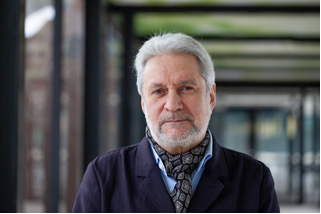
 Our colleague and friend Volker Manuth passed away in the morning of Sunday, 23 August 2026, after a brief battle with pancreatic cancer. He had just celebrated his 70th birthday two weeks earlier. His scholarly journey in Netherlandish art began in the early 1980s in Northwest Germany, at the University of Kiel, not far from where he grew up. He had already left a career in field hockey behind, that ended with the boycott of the 1980 Moscow Olympics, and also a subsequent stint in the military. It was the renowned art historian Reiner Hausherr, still famous for interpreting the inscription in Rembrandt’s Belshazzar’s Feast, who inspired him to take this path. He followed Hausherr to Berlin, where he completed his dissertation in 1987. It was divided into two components, the main body consisting of essays on the interpretation of Old Testament themes in the art of Rembrandt and his circle, often with an eye to variation among the different denominations in The United Provinces. Drawing on new sources such as theological treatises and printed sermons, in the spirit of Panofskian iconology, this research represented a substantial development forward from Christian Tümpel’s analyses of visual sources for such depictions. Connoisseurship was not left behind, however, as this section was complemented by a checklist of the paintings of Jan Victors, the Rembrandt pupil best known for restricting his choice of Biblical themes to the Old Testament. Published only on microfilm, Manuth’s first considerable impact in the field was when various chapters were published as articles, the most prominent being on Denomination and Iconography, appearing in English translation in Simiolus, and on The Blinding of Samson, in German in Artibus et Historiae.
In the process of completing the Victors catalogue, Manuth took the unusual measure of flying around the United States on an unlimited standby ticket, visiting as many museums and private collections as possible, to study paintings. He was also looking ahead to his next project, a full monograph on another Rembrandt pupil, Gerbrand van den Eeckhout. One of his stops was in Milwaukee to visit the Bader Collection, with its concentration of works by Rembrandt, his pupils, and depictions of Old Testament themes. He would later return to New York as visiting scholar at the Institute of Fine Arts, as guest of Egbert Haverkamp Begemann, in 1989. In 1991 he joined the Baders on a visit to Queen’s University and could study the paintings already donated to Alfred Bader’s alma mater.
Manuth stayed on in Berlin as a university lecturer (Wissenschaftlicher Assistent), but had drawn the attention of the scholars of the Rembrandt Research Project. It had been reformed into a project led by Ernst van de Wetering and joined by younger scholars with more specialized interests, forming a team with wider expertise. Manuth joined as a scholar of iconography, but went onto to participate extensively in deliberations of authorship. Much of this material was unfortunately shelved after the team was dispersed around 2000. A new prospect emerged at Queen’s University, with Bader support for a Chair of Northern European Art as part of a new Ph.D. program in Art History. Manuth started in 1995, continuing until late 2002. One of his major projects working with students at Queen’s was the loan exhibition Wisdom, Knowledge & Magic (1996-1997). The Image of the Scholar in 17th-Century Dutch Art which demonstrated the iconographic research and exhibition potential of the Bader Collection, while providing students with critical museum exhibition experience. In Berlin, Manuth continued to supervise students with dissertation topics in 17th-century Dutch art. In The Netherlands he built a profile in exhibition contributions, to the Arent de Gelder exhibition opening in Dordrecht in 1998, and the Rembrandt Self-Portrait exhibition in the Mauritshuis, together with the Royal Academy, in the following year. One highlight of his final years in Kingston was the re-identification, in collaboration with Marieke de Winkel, of Anthony van Dyck’s portrait pair of boys in Vienna, as Princes of Savoy (2000).
After his fellow specialist in Biblical iconography Christian Tümpel retired from the Catholic University of Nijmegen St. Radboud (now Radboud University Nijmegen), Manuth succeeded him as chair in the department there (2003). He immediately embarked on research on the portrait historié, gathering a team of scholars, including Ph.D. candidate Rudie van Leeuwen who dedicated his dissertation to the topic, to produce a comprehensive volume of papers (Example or Alter Ego?, 2016). The years leading up to the next Rembrandt anniversary year 2019 were consumed by another major project, a complete volume on Rembrandt’s paintings, written together with his life partner, Marieke de Winkel, and Rudie van Leeuwen. In this way they could present their vision of the artist, developed during the R.R.P. years, as well as their critical viewpoint of ensuing scholarly developments, with their expansive tendency.
Manuth maintained a strong link to the museum world, with many students choosing object-oriented topics, often in the form of artists’ monographs, and going on to museum careers. Manuth even served for a time as honorary curator at the Rijksmuseum, where he spearheaded the Rembrandt anniversary year blockbuster Rembrandt-Caravaggio, presented at the Van Gogh Museum (2006), and more recently served on the Supervisory Board of the Frans Hals Museum. He subsequently contributed to the major Caravaggio exhibition curated by Liesbeth Helmus at the Centraal Museum, Utrecht (2018-2019). The striking highlight of his later career came with an exhibition on the enigmatic painter known only as the Monogrammist I.S. (2025), to which Manuth made a major research contribution, working with Marieke de Winkel. Although they did not crack the code of the artist’s identity, they did assemble vital indications, helping to bring this major talent to life. The two were planning to develop their research material into a full catalogue raisonné of the artist. Manuth is remembered by his students and colleagues for his enormous generosity with time, knowledge and advice, and for his positive élan. But also for his strong conviction of the long term importance and continuing relevance of studying works of art with a wide range of approaches, especially established ones such as connoisseurship, archival research, and iconography. And for his caution and thoroughness, which slowed progress on the envisioned monograph on Gerbrand van den Eeckhout, now a task for future scholars.
David de Witt
Museum Rembrandthuis